The smell of coffee at dry fragrance and wet aroma stages
B
Flavour & Cupping
Balance
Scored SCA attribute describing harmony between acidity, sweetness, body, and flavour
B
Flavour & Cupping
Bitter
A basic taste detected at the back of the tongue - natural in coffee at low levels
B
Flavour & Cupping
Body
The weight and texture of coffee on the palate - from light and delicate to full and
B
Flavour & Cupping
Bouquet
The complete aromatic impression of a coffee - fragrance, aroma
B
Flavour & Cupping
Brightness
The lively, vibrant quality of acidity in high-quality coffees
C
Flavour & Cupping
Chlorogenic Acid
Phenolic compounds in green coffee - break down during roasting
C
Flavour & Cupping
Citric Acid
Key organic acid in Arabica - produces bright, citrus-like cup character
C
Flavour & Cupping
Clean Cup
Coffee free from off-flavours and defects - a scored SCA attribute and prerequisite for
C
Flavour & Cupping
Complexity
Depth and range of flavours that shift and reveal themselves as a coffee cools
C
Flavour & Cupping
Cup of Excellence
The world's most prestigious green coffee competition
C
Flavour & Cupping
Cupping Protocol
The standardised SCA procedure for evaluating coffee
F
Flavour & Cupping
Flavour Notes
Descriptive words communicating what a coffee tastes and smells like
F
Flavour & Cupping
Fragrance
The smell of dry ground coffee before water is added
L
Flavour & Cupping
Lactic Acid
Organic acid produced by lactic acid bacteria during fermentation
M
Flavour & Cupping
Malic Acid
Organic acid in coffee producing apple and stone fruit character
M
Flavour & Cupping
Mouthfeel
The tactile sensation of coffee in the mouth - texture, smoothness, coating
P
Flavour & Cupping
Phenolic
A defect descriptor for medicinal, antiseptic off-flavours
P
Flavour & Cupping
Phosphoric Acid
An acid in coffee producing clean, effervescent brightness
Q
Flavour & Cupping
Q Grader
A licensed professional coffee taster certified by the Coffee Quality Institute to
Q
Flavour & Cupping
Q Score
A numerical quality rating out of 100 assigned by a licensed Q Grader using the SCA
S
Flavour & Cupping
SCA Flavour Wheel
The SCA's visual reference tool mapping hundreds of coffee flavour descriptors from broad
S
Flavour & Cupping
Sweetness
A scored SCA cupping attribute - the natural sugar-derived quality in the cup
T
Flavour & Cupping
Trigonelline
Key coffee alkaloid that breaks down during roasting to produce roasted
U
Flavour & Cupping
Uniformity
Scored SCA attribute measuring consistency across the five cups in a cupping session
W
Flavour & Cupping
Winy
Cupping descriptor for coffees with wine-like fruit complexity, bright acidity
A
General Terms
Aceh District
Coffee-producing province at the northern tip of Sumatra - home of Gayo Highlands coffee.
A
General Terms
Aeropress
Manual brewer combining immersion and air pressure - quick, clean, and highly versatile.
A
General Terms
After-dinner Roast
Informal term for a dark, low-acidity coffee served at the end of a meal.
A
General Terms
Agronomy
Science of crop production - covers varietal selection through disease management.
A
General Terms
Altitude
Elevation at which coffee grows - higher means slower maturation and more complexity.
B
General Terms
Blender
Coffee for blending - valued for consistency and body, not single-origin character.
B
General Terms
Bloom
Initial pour in brewing that releases CO2 from freshly roasted coffee
B
General Terms
Broker
An intermediary who connects buyers and sellers of green coffee without taking ownership
C
General Terms
C-Market
Global Arabica futures market setting the benchmark price in US cents per pound.
C
General Terms
Caffeine
Natural alkaloid responsible for coffee's stimulating effect
C
General Terms
Coffee Cooperative
Member-owned group giving smallholders access to markets, infrastructure, better prices.
C
General Terms
Coffee Year
The ICO's standard 12-month reporting period: 1 October to 30 September
C
General Terms
Commodity Coffee
Coffee traded as a standardised product priced against the C-Market
C
General Terms
Cupping
Standardised protocol for evaluating aroma, flavour, acidity, body, and aftertaste.
D
General Terms
Differential
Premium or discount in US cents per pound applied above or below the C-Market price.
E
General Terms
Elevation
Height above sea level at which coffee grows - higher elevation means cooler
E
General Terms
Estate
Coffee from a single named farm or plantation - implies unified management and full
F
General Terms
Farm Gate
The price paid to a producer at the farm itself - the most upstream price point and key
F
General Terms
Fazenda
Portuguese for farm - appears on Brazilian green coffee specifications to identify the
F
General Terms
Finca
Spanish for farm - identifies the specific producing property on Latin American green
G
General Terms
Grain Pro
Hermetically sealed bag liner protecting green coffee from moisture, odour, and insects.
G
General Terms
Green Bean
Raw unroasted coffee seeds ready for export - what GCC sources and supplies to roasters.
I
General Terms
Importer
A company that purchases green coffee at origin and sells it to roasters in consuming
M
General Terms
Microclimate
Localised climate conditions at farm or hillside level
N
General Terms
Nano-lot
An exceptionally small green coffee parcel - typically below 60kg
O
General Terms
Origin
Geographic source of a coffee - from country level down to specific farm or cooperative.
P
General Terms
Price Volatility
The large, unpredictable swings in green coffee market prices
S
General Terms
Seasoning Beans
Low-value green coffee used to condition a drum before quality roasting begins.
S
General Terms
Specialty Coffee
Coffee scoring 80+ on the SCA scale - the quality tier defined by traceability
S
General Terms
Stale Coffee
Coffee that has lost freshness through oxidation and volatile compound loss
S
General Terms
Supply Chain
The full sequence from farm to cup - each link determines both price distribution and how
T
General Terms
Third Wave Coffee
The specialty coffee movement treating coffee as a traceable artisan product
T
General Terms
Trader
A company that buys and sells green coffee commercially without roasting it
A
Roasting
Agtron Spectrophotometers
Numerical scale measuring roast level by bean colour - higher score means lighter roast.
A
Roasting
Ambient Temperature
Roasting room temperature - affects machine behaviour and must be logged for consistency.
B
Roasting
Baked
Roast defect from a stalling rate of rise - flat, hollow, lacking sweetness.
B
Roasting
Batch Roaster
A roasting machine that roasts a fixed quantity at one time
B
Roasting
Batch Size
The weight of green coffee loaded for a single roast
B
Roasting
BT (Bean Temperature)
Bean temperature - the primary roasting measurement tracking heat absorbed by the coffee
C
Roasting
Caramelization
Thermal breakdown of sugars during roasting - produces caramel, toffee, and sweet notes.
C
Roasting
Chaff
The papery silverskin that detaches from beans during roasting
C
Roasting
Charge temperature
Drum temperature at green coffee load - sets the heat transfer profile for the roast.
C
Roasting
Cooling Stage
Final roasting phase - beans discharged and rapidly cooled to stop development.
C
Roasting
Crash and Flick
A RoR pattern where the rate drops sharply then rises at first crack
D
Roasting
Degassing
CO2 release from roasted beans - affects packaging, resting, and extraction quality.
D
Roasting
Development Time
Phase from first crack to roast end - where most flavour decisions are made.
D
Roasting
Development Time Ratio (DTR)
Development time as a percentage of total roast time
D
Roasting
Dialling In
Adjusting grind, dose, and brew variables to find optimal extraction for a specific
D
Roasting
Drop
The moment beans are discharged from the roaster into the cooling tray
D
Roasting
Drum Roaster
The most common roasting machine type - a rotating drum heats beans through conduction
D
Roasting
Drum Speed
The rotation speed of the roasting drum - affects bean agitation, even heat transfer
D
Roasting
Drum Temperature
The surface temperature of the roasting drum itself
D
Roasting
Drying Phase
First roasting stage - residual moisture evaporates before browning reactions begin.
E
Roasting
End Temperature
The bean temperature at the moment the roast ends - a key reference point for profile
E
Roasting
ET (Environmental Temperature)
Environmental Temperature - the air temperature inside the drum
E
Roasting
Exothermic and Endothermic
Endothermic reactions absorb heat (most of the roast); exothermic reactions release it
F
Roasting
Facing
A roasting defect where beans develop a burnt patch on one side from contact with the
F
Roasting
Fan Speed
Controls airflow through the roasting drum - affects heat transfer, smoke removal
F
Roasting
First Crack
Audible cracking marking the shift to exothermic reactions - start of development phase.
F
Roasting
Fluid Bed Roaster
A roaster using hot air rather than a drum - beans are suspended in an upward airflow;
G
Roasting
Green Weight
The weight of green coffee before roasting - used to calculate roast loss and track
H
Roasting
Heat Transfer
The three ways heat reaches the coffee bean: conduction (drum contact)
L
Roasting
Lipids
Fats and oils comprising 15-17% of Arabica dry weight
M
Roasting
Maillard Phase
The second roasting stage between yellowing and first crack
M
Roasting
Maillard Reaction
Chemical process between sugars and amino acids driving browning and roasted flavour.
M
Roasting
Melanoidins
Brown polymers produced in the final stages of the Maillard reaction
O
Roasting
Omni Roast
Single roast profile designed to work across espresso and filter brewing methods.
O
Roasting
Over-extraction
Brewing too much from the grounds - causes harsh, bitter
P
Roasting
Preheat
Bringing the roaster to a stable target temperature before loading beans
P
Roasting
Pyrazines
Nitrogen-containing aromatic compounds produced by the Maillard reaction during roasting
P
Roasting
Pyrolysis
Thermal decomposition of organic compounds during roasting
R
Roasting
Rate of Rise (RoR)
Rate of bean temperature increase during roasting - key metric for profile control.
R
Roasting
Roast Curve
A graph of temperature against time during roasting
R
Roasting
Roast Date
The date a coffee was roasted - the most useful freshness indicator
R
Roasting
Roast Level
The degree to which coffee has been roasted - from light (origin-forward
R
Roasting
Roast Log
A record of key data from each roast session - the foundational tool for replicating
R
Roasting
Roast Loss
The percentage weight difference between green and roasted coffee
R
Roasting
Roast Profile
The complete set of parameters defining how a coffee is roasted
R
Roasting
Roast Recipe
Programmed roasting instructions that automatically adjust power, fan
R
Roasting
Roasted Weight
The weight of coffee after roasting - always less than green weight due to moisture and
R
Roasting
Roasting
The process of applying heat to green coffee to develop flavour
R
Roasting
Roasting Milestones
The key reference points during a roast - yellowing, first crack, and second crack
R
Roasting
Roasty
A sensory descriptor for coffee where roasted, smoky
S
Roasting
Sample Roaster
A small-batch roaster (50-200g) used for evaluating green coffee samples
S
Roasting
Scorched
Roast defect - bean exterior burnt while interior stays underdeveloped.
S
Roasting
Second Crack
Rapid cracking marking the start of medium-dark roast territory.
S
Roasting
Strecker Degradation
A reaction between amino acids and Maillard products that produces potent aromatic
S
Roasting
Sucrose
The primary sugar in green coffee - 6-9% of Arabica dry weight
T
Roasting
Tipping
A roasting defect where the bean tip burns - caused by excessive early heat or too-fast
T
Roasting
Turning point
Lowest point on the roast curve - when bean temperature stops falling and starts rising.
U
Roasting
Underdeveloped
Roast defect from insufficient heat or time - grassy, sharp, lacking sweetness.
Y
Roasting
Yellow Point
The moment beans turn from green to pale yellow during roasting
Y
Roasting
Yellowing
Visual transition from green to yellow during roasting
A
Sustainability & Ethics
Agroforestry
Growing coffee under shade trees - better for environment, often better for the cup.
B
Sustainability & Ethics
Biodiversity
The variety of living organisms in and around a coffee farm
B
Sustainability & Ethics
Biodynamic
Holistic farming philosophy beyond organic - treats the farm as a self-sustaining
B
Sustainability & Ethics
Bird Friendly
The most rigorous shade certification - Smithsonian-administered
C
Sustainability & Ethics
Carbon Sequestration
The storage of atmospheric CO2 in plants and soil - shade-grown coffee agroforestry
C
Sustainability & Ethics
Certification
Third-party verification of environmental or social standards - e.g. Organic, Fairtrade.
C
Sustainability & Ethics
Climate Change
Rising temperatures and shifting rainfall are shrinking suitable Arabica growing land and
D
Sustainability & Ethics
Direct Trade
Buying directly from a producer rather than through an importer
F
Sustainability & Ethics
Fair Trade Organic (FTO)
Combined Fairtrade and organic certification - carries premiums above either alone.
F
Sustainability & Ethics
Fairtrade
Ethical trade certification guaranteeing a minimum price floor and community premium for
I
Sustainability & Ethics
Intercropping
Growing other crops alongside coffee - improves soil health, farm income
L
Sustainability & Ethics
Living Income
The income needed for a decent standard of living in a specific place
L
Sustainability & Ethics
Living Wage
The hourly or daily wage needed for a decent standard of living
L
Sustainability & Ethics
Lot Traceability
The ability to track a specific lot back through the supply chain to farm, harvest
O
Sustainability & Ethics
Organic Coffee
Coffee grown without synthetic pesticides or fertilisers
P
Sustainability & Ethics
Price Floor
A minimum price below which coffee cannot be sold regardless of market conditions
R
Sustainability & Ethics
Rainforest Alliance Certification (RFA)
Sustainability certification for environmental and social farming standards.
R
Sustainability & Ethics
Regenerative Agriculture
A farming philosophy aiming to actively restore ecological systems
R
Sustainability & Ethics
Relationship Coffee
Sourcing built on ongoing, mutually beneficial connections with producers
S
Sustainability & Ethics
Shade Grown
Coffee grown under trees - traditional method, benefits biodiversity and cup quality.
S
Sustainability & Ethics
Shade Tree
Trees grown alongside coffee plants to provide canopy cover
S
Sustainability & Ethics
Smallholder
A small-scale farmer typically working under 5 hectares
T
Sustainability & Ethics
Transparency
Open disclosure of prices and supply chain information
Varietals & Genetics
Abyssinia
Rare Indonesian cultivar introduced to Java in 1928 - notable for longberry beans.
A
Varietals & Genetics
Acaiá
Brazilian Mundo Novo descendant - large bean size and reliable yield at lower altitude.
Varietals & Genetics
Anacafe 14
Guatemalan cultivar combining Catimor rust resistance with Pacamara cup quality traits.
A
Varietals & Genetics
Andung Sari
Sumatran Catimor cultivar from Jambi - productive at altitude with notable sweetness.
A
Varietals & Genetics
Arabica
Primary specialty coffee species - ~65% of global production, valued for complexity.
A
Varietals & Genetics
Arabigo
Latin American name for the Typica cultivar - tall, low-yielding, high cup quality.
A
Varietals & Genetics
Arabusta
Arabica-Robusta interspecific hybrid bred for hardiness - used in commercial blends.
A
Varietals & Genetics
Ateng
Indonesian name for Catimor cultivars in Sumatra - disease-resistant, lower cup quality.
B
Varietals & Genetics
Backcrossing
Breeding technique crossing a hybrid back with a parent to reinforce desired traits.
B
Varietals & Genetics
Batian
Kenyan CRI hybrid combining SL28/SL34 cup quality with disease resistance
B
Varietals & Genetics
Bergendal
Rare Typica-derived heritage cultivar from Aceh and North Sumatra - low yield.
B
Varietals & Genetics
Blue Mountain Cultivar
Typica variety known for Jamaica Blue Mountain coffee and East African CBD resistance.
B
Varietals & Genetics
Bourbon
Foundational Arabica cultivar - parent of many specialty varieties, valued for sweetness.
B
Varietals & Genetics
Bourbon Mayaguez
Bourbon cultivar from Rwanda and Burundi - bright, fruit-forward washed coffees.
C
Varietals & Genetics
Castillo
Compact, rust-resistant Colombian cultivar developed by Cenicafe - dominates production.
C
Varietals & Genetics
Catimor
HdT and Caturra cross - disease-resistant and productive but lower cup quality.
C
Varietals & Genetics
Catuai
Compact, high-yielding Arabica from Brazil - Mundo Novo and Caturra cross.
C
Varietals & Genetics
Caturra
Natural dwarf Bourbon mutation - widely planted in Colombia and Central America.
C
Varietals & Genetics
Charrieriana
Naturally caffeine-free Coffea species from Cameroon - of interest for breeding research.
C
Varietals & Genetics
Chiroso
Colombian Arabica from Antioquia - floral, fruit-forward
C
Varietals & Genetics
Coffea
The plant genus containing all coffee species - over 120 species
C
Varietals & Genetics
Colombia F8
Cenicafe backcrossing line combining leaf rust resistance with Arabica cup quality.
C
Varietals & Genetics
Costa Rica 95
Leaf rust-resistant Costa Rican cultivar from a Timor Hybrid and Caturra cross.
D
Varietals & Genetics
Dega
Ethiopian heirloom from Gedeo and Guji - floral, complex cup; name means highland.
E
Varietals & Genetics
Excelsa
Distinct African Coffea species - mild, Robusta-adjacent cup character.
F
Varietals & Genetics
F1 Hybrids
First-generation inbred-line crosses - hybrid vigour gives superior yield and uniformity.
F
Varietals & Genetics
French Mission Bourbon
Bourbon introduced to East Africa by missionaries - genetic foundation of SL28 and SL34.
G
Varietals & Genetics
Garungan
Typica-Bourbon hybrid from Lintong, Sumatra - disease-tolerant, full-bodied cup profile.
G
Varietals & Genetics
Geisha
Ethiopian variety celebrated for intensely floral, tea-like, fruit-forward cup character.
G
Varietals & Genetics
Gesha 1931
Historically documented Gesha accession from Ethiopia - grown by Gesha Village Estate.
G
Varietals & Genetics
Golden Beans
Underdeveloped pale seeds in dry-processed lots - secondary defect, common in Yemen.
G
Varietals & Genetics
Gori Gesha
Local Ethiopian forest Gesha type from Bench Maji Zone - grown by Gesha Village Estate.
H
Varietals & Genetics
Heirloom / Local Landraces
Ethiopian native varieties - the world's greatest reservoir of Arabica diversity.
H
Varietals & Genetics
Hibrido
Spanish for hybrid - loosely applied in Central America to mixed-parentage coffee plants.
H
Varietals & Genetics
Hibrido De Timor
Natural Arabica-Robusta hybrid - genetic source of rust resistance in modern cultivars.
I
Varietals & Genetics
Icatu
Brazilian Robusta-Arabica hybrid from IAC - high yield, disease resistance, commercial.
I
Varietals & Genetics
Illubabor Forest
Rare Ethiopian variety from Bench Maji Zone - same region as original Gesha collection.
J
Varietals & Genetics
Jackson
Typica-derived cultivar from Mysore, India - foundational genetics for Rwanda and Burundi.
J
Varietals & Genetics
JARC Varietals
Ethiopian research selections - bred for yield, disease resistance, and adaptability.
J
Varietals & Genetics
Java Cultivar
Typica-related variety widely grown in Cameroon, introduced from East Java.
K
Varietals & Genetics
Kent
Indian Typica selection - first useful rust-resistant Arabica cultivar (1937).
K
Varietals & Genetics
Kona Typica
Kona Typica - Hawaii's most tightly regulated and expensive coffee designation.
K
Varietals & Genetics
Kudhum
Ethiopian heirloom from Guji zone - related to Kurume, floral and sweet at altitude.
K
Varietals & Genetics
Kurume
JARC-selected Ethiopian heirloom from Guji and Gedeo - floral, Yirgacheffe character.
L
Varietals & Genetics
Laurina
Rare dwarf Bourbon mutation from Reunion - naturally low caffeine and delicate cup.
L
Varietals & Genetics
Lempira
Catimor-derived Honduran cultivar from IHCAFE - rust-resistant and high-yielding.
L
Varietals & Genetics
Liberica
African Coffea species - large beans, grown in Southeast Asia, heavy smoky cup character.
M
Varietals & Genetics
Maracatu
Brazilian Maragogype-Catuai hybrid - large beans, more manageable than pure Maragogype.
M
Varietals & Genetics
Maracaturra
Nicaraguan Maragogype-Caturra hybrid - oversized beans, complex cup at altitude.
M
Varietals & Genetics
Maragogype
Giant Typica mutation from Brazil - known as the Elephant Bean for its oversized seeds.
M
Varietals & Genetics
Marsellesa
Central American disease-resistant hybrid from CIRAD
M
Varietals & Genetics
Mibirizi
Bourbon cultivar from Rwanda and Burundi - associated with bright, citric cup character.
M
Varietals & Genetics
Mixed heirloom
Ethiopian coffee from multiple unidentified native varieties - most common designation.
M
Varietals & Genetics
Mundo Novo
Natural Typica-Bourbon hybrid from Brazil - high yield, consistent, parent of Catuai.
O
Varietals & Genetics
Obata
Brazilian Sarchimor cultivar from IAC - compact, rust-resistant, large bean size.
O
Varietals & Genetics
Orange Bourbon
Bourbon colour mutation with orange cherries - grown in El Salvador, sweet and complex.
P
Varietals & Genetics
Pacamara
Salvadoran Pacas-Maragogype hybrid - large beans, complex fruit-forward cup at altitude.
P
Varietals & Genetics
Pacas
Dwarf Bourbon mutation from El Salvador - compact, productive, parent of Pacamara.
P
Varietals & Genetics
Pache
Dwarf Typica mutation from Guatemala - compact and productive with clean cup character.
P
Varietals & Genetics
Parainema
Honduran disease-resistant cultivar from IHCAFE - capable of specialty cup quality at
P
Varietals & Genetics
Peaberry
Single round seed developing alone in the cherry - ~5-10% of any crop.
P
Varietals & Genetics
Pink Bourbon
Rare Bourbon colour variant from Colombia - intense fruit, floral complexity, high scores.
P
Varietals & Genetics
Purpurascens
Rare Arabica mutation with purple leaves - maintained for genetic interest only.
R
Varietals & Genetics
Rambung
Typica-derived cultivar introduced to Java in 1928 - largely displaced by Catimor types.
R
Varietals & Genetics
Robusta
Second major coffee species - lower altitude, higher yield, heavier body, more caffeine.
R
Varietals & Genetics
Ruiru 11
Kenyan hybrid resistant to CBD and rust - compact, productive, less complex than SL types.
S
Varietals & Genetics
S.288
Early Indian rust-resistant Arabica selection - historically significant, parent of S795.
S
Varietals & Genetics
S795
India's most widely planted cultivar - S.288 and Kent cross, large beans, rust-resistant.
S
Varietals & Genetics
San Roque
Costa Rican SL-28 mutation - shares its fruit complexity and bright acidity.
S
Varietals & Genetics
Sarchimor
Villa Sarchi and Hibrido de Timor hybrid - genetic base of Obata, Tupi, and many others.
S
Varietals & Genetics
Semperflorens
Bourbon-derived Brazilian cultivar with year-round flowering - mainly research interest.
S
Varietals & Genetics
Sidikalang
Typica-derived variety from North Sumatra - both a cultivar and regional origin name.
S
Varietals & Genetics
Sidra
Rare Ecuadorian Arabica - likely Bourbon-Typica cross, high sweetness and vibrant acidity.
S
Varietals & Genetics
Sigarar Utang
Indonesian Catimor - name means 'payback the debt', reflecting its high productivity.
S
Varietals & Genetics
SL-28
Kenyan selection celebrated for intense blackcurrant complexity - a specialty benchmark.
S
Varietals & Genetics
SL-34
Scott Labouratories selection from French Mission Bourbon - bright and fruit-forward.
S
Varietals & Genetics
St.Helena Green Tipped Bourbon
Rare pure Yemeni Arabica introduced to St. Helena in 1733.
S
Varietals & Genetics
Stenophylla
West African wild Coffea - tolerates heat better than Arabica, comparable cup quality.
S
Varietals & Genetics
Sulawesi
Indonesian wet-hulled origin - earthy, full-bodied, low-acid Toraja highlands coffee.
T
Varietals & Genetics
Tabi
Tall Colombian cultivar - Typica, Bourbon, and Timor Hybrid cross with good cup quality.
T
Varietals & Genetics
Tekisic
High-yield Bourbon selection from El Salvador - clean, well-balanced cup character.
T
Varietals & Genetics
Tupi
Brazilian Sarchimor cultivar from IAC - compact, rust-resistant, commercially productive.
T
Varietals & Genetics
Typica
Foundational Arabica cultivar - excellent cup, low yield, parent of most named varieties.
V
Varietals & Genetics
Varietal
The botanical variety of the coffee tree - Geisha, Bourbon, SL28, Caturra, and so on.
V
Varietals & Genetics
Villa Sarchi
Dwarf Bourbon mutation from Costa Rica - quality cup, parent of the Sarchimor hybrid.
V
Varietals & Genetics
Villalobos
Dwarf Typica mutation from Costa Rica - compact with typical Typica cup character.
W
Varietals & Genetics
Wolisho
Ethiopian heirloom from Guji and Gedeo highlands - large cherries, aromatic complexity.
W
Varietals & Genetics
Wush Wush
Ethiopian heirloom from Keffa zone - intensely floral and fruit-forward
Y
Varietals & Genetics
Yellow Bourbon
Yellow-ripening Bourbon variant from Brazil - sweet, rounded cup in well-processed lots.
Y
Varietals & Genetics
Yellow Catuai
Yellow-cherry Catuai variant - one of Brazil's most planted varieties, clean and reliable.
Abyssinia
Varietals & Genetics
Rare Indonesian cultivar introduced to Java in 1928 - notable for longberry beans.
What is the Abyssinia coffee varietal?
Abyssinia is a coffee cultivar introduced to Java by Dutch researchers in 1928. The name reflects its origins - Abyssinia was the historical name for Ethiopia, and that's where the plant material came from. From Java it spread to other parts of Indonesia, most notably Aceh in northern Sumatra, where it remains part of the local coffee landscape.
The variety is recognisable by its longberry beans and bronze-coloured new leaf growth. It exists in two documented forms - AB-3 and AB-7 - with AB-7 thought to have been crossed with the Timor Hybrid to produce further descendants.
You won't encounter Abyssinia named as a single varietal on most export specifications - it's more part of the underlying genetic fabric of traditional Indonesian production than a commercial variety in its own right. Worth knowing when exploring the deeper history of Sumatran coffee origins.
Brazilian Mundo Novo descendant - large bean size and reliable yield at lower altitude.
What is the Acaiá coffee varietal?
Acaiá is a Brazilian coffee cultivar developed from the Mundo Novo germplasm - itself a natural cross between Typica (called Sumatra in Brazil) and Bourbon - and selected by the Instituto Agronômico de Campinas (IAC) in São Paulo state from the mid-20th century onwards.
The cultivar is known for large bean size, consistent yield, and reliable cup quality - typically a balanced body and moderate acidity. It's suited to lower-altitude growing conditions and performs well across Brazil's key coffee-producing regions.
Acaiá is primarily a commercial variety. It won't usually appear as the star of a specialty single-origin lot, but it's part of the productive infrastructure that supports Brazil's position as the world's largest coffee producer.
Extra freight charges beyond standard drop-off - liftgate, inside delivery, surcharges.
What are accessorials in green coffee freight?
When your green coffee is shipped from a warehouse to your roastery, the base freight rate covers one thing: getting the truck from A to B. Anything beyond that - a liftgate to lower the pallet to the ground, inside delivery if you don't have a loading dock, a fuel surcharge, a residential delivery fee - gets billed separately. Those extras are accessorials.
They're easy to overlook when you're negotiating the headline price of a lot. A roastery in a converted unit without a loading dock, for example, will almost always trigger a liftgate charge. That might be £30–£60 per delivery - not ruinous on its own, but if it's happening on every order and you've never accounted for it, it quietly eats into your margins.
When you're comparing freight quotes, ask specifically what's included in the base rate and what gets billed as an extra. The cheapest headline number isn't always the cheapest all-in cost.
Coffee-producing province at the northern tip of Sumatra - home of Gayo Highlands coffee.
What is the Aceh District in coffee?
Aceh is a province at the northern tip of Sumatra, Indonesia, and one of the country's most significant coffee-producing regions. The main growing area centres on Takengon - a highland town at around 1,200 metres above sea level, beside Lake Tawar in the Gayo Highlands. That name, Gayo, is how most of this coffee reaches international buyers.
The coffees here are processed using Giling Basah - the wet-hulling method unique to Indonesia - which produces the characteristic full body, low acidity, and earthy complexity that defines Sumatran coffee. Ateng (Catimor) is the dominant variety, though older Typica-derived plants survive on some farms and produce notably different results.
One small thing worth knowing if you're ever discussing the region with producers or exporters: Aceh is pronounced "Ah-Chay," not how it reads phonetically in English. Getting it right is a small detail that tends to be noticed.
Harsh, unpleasant sourness from processing faults, defective beans, or over-extraction.
What does acerbic mean in coffee?
Acerbic describes an unpleasant, harsh sourness - the kind that makes you wince rather than brighten. It's distinct from the clean, fruit-like brightness that makes a well-processed washed Ethiopian interesting. That acidity is a positive quality attribute. Acerbic is a fault.
It's a useful diagnostic signal at the cupping table. You taste something sharp and uncomfortable, and the question is where it came from. Common causes include fermentation faults during processing, sour beans in the green lot, or brewing issues like water that's too hot or a contact time that's dragged on too long.
If you're consistently getting acerbic notes from a specific lot across multiple brew methods, the problem usually sits upstream - in the green coffee itself, not your roasting. It's worth pulling a small sample to check the green appearance before writing off the whole lot.
Organic acid produced by bacteria during fermentation
What is acetic acid in coffee?
Acetic acid is the organic acid responsible for the sharp, vinegary taste and smell of vinegar. In coffee processing, it is produced by acetic acid bacteria (AAB) - obligate aerobic organisms that convert ethanol (produced by yeast fermentation) into acetic acid in the presence of oxygen.
In most processing contexts, the presence of acetic acid at significant levels is considered a defect - a symptom of fermentation that has progressed too long, at too warm a temperature, or in conditions where AAB have proliferated uncontrollably. Coffees with ferment defect taste sharply sour, vinegary, or like rotting fruit - what cuppers sometimes describe as compost bin or salad dressing notes.
However, in low concentrations, acetic acid contributes to the perception of fruity and floral brightness in the cup - research has shown it can actually enhance the sensory character of coffee at controlled levels. This is the basis of intentional acetic processing, where producers deliberately encourage AAB growth under controlled aerobic conditions to produce complex fruitiness rather than defect. The line between controlled acetic complexity and unpleasant ferment defect is narrow and determined primarily by concentration. Understanding acetic acid helps explain both why fermentation faults taste the way they do and why some experimental processes deliberately court the same bacteria that cause them.
Processing method deliberately encouraging acetic acid bacteria in oxygen-rich
What is acetic process coffee?
Acetic process is a named processing method that deliberately encourages the growth of acetic acid bacteria (AAB) during fermentation - organisms that produce acetic acid as their primary metabolic by-product. Unlike most fermentation methods that aim to minimise acetic acid (which in excess produces undesirable vinegary, sour defect notes), acetic processing uses it intentionally as a flavour variable.
AAB are obligate aerobes - they require oxygen for their metabolism. Acetic process therefore involves fermentation in an oxygen-rich environment, typically with the coffee being stirred or mixed regularly to maintain aerobic conditions. La Palma y El Tucán in Colombia popularised the naming convention, using a vessel where pulped coffee is continuously mixed during fermentation to encourage AAB alongside aerobic yeasts.
The goal is to harness acetic acid in controlled, low concentrations where it contributes fruity or floral character rather than the vinegary defect associated with out-of-control fermentation. The line between intentional acetic complexity and fermentation fault is genuinely narrow - temperature control, timing, and cherry quality all determine which side of that line a lot lands on. For buyers, acetic process coffees are typically intensely flavoured and fruit-forward, and knowing the process helps set expectations for what you're likely to find in the cup.
Bright organic acids - citric, malic, phosphoric - that give coffee its vibrancy.
What does acidity mean in coffee?
When coffee people talk about acidity, they don't mean the kind that upsets your stomach. They mean the bright, lively quality you get in a well-grown, carefully processed coffee - the sensation that makes it feel crisp and alive on the palate rather than flat and dull.
Chemically, this comes from organic acids - primarily citric, malic, phosphoric, and tartaric - that develop within the cherry as it matures. Higher altitude slows that maturation down, giving more time for these acids to form. It's why coffees from 1,800 masl in Ethiopia or Colombia's Huila tend to taste more vibrant than lower-grown equivalents from the same region.
Roasting progressively suppresses acidity as heat breaks down acidic compounds - a lighter roast preserves it, a darker roast softens or eliminates it. On the SCA cupping form, acidity is scored separately for intensity and quality, because bright acidity well-expressed is one of the clearest markers of exceptional green coffee. It can't be added later. If it's not in the green, no amount of careful roasting will put it there.
Formal notice from seller to buyer confirming dispatch, with vessel and arrival details.
What is an advice of shipment?
Once your green coffee has been loaded onto a vessel at origin, the seller sends you an advice of shipment - a formal notification confirming the coffee is on its way. It includes the vessel name, bill of lading reference, port of loading, number of bags and total weight, and the estimated arrival date.
In most green coffee contracts, sending this notification within a set number of days of loading is a contractual obligation, not just a courtesy. It gives you everything you need to arrange insurance, line up customs documentation, and plan your warehouse intake.
If you're buying from an importer who handles logistics end-to-end, you may never see a formal advice of shipment - they absorb it into their own tracking. But when you're buying closer to origin or working directly with exporters, you'll encounter it regularly, and knowing what to do with it when it arrives matters.
Manual brewer combining immersion and air pressure - quick, clean, and highly versatile.
What is an AeroPress?
The AeroPress is a manual brewing device invented by Alan Adler and released in 2005. It combines immersion brewing - steeping ground coffee in hot water - with gentle air pressure to push the brew through a paper or metal filter into the cup. The whole process takes under two minutes.
What makes it genuinely useful as a roaster or cupper is its flexibility. Grind size, water temperature, steep time, and brew ratio can all be pushed in different directions without the device struggling, which means you can use it to explore a coffee across a wide range of variables quickly. Many professional cuppers keep an AeroPress to hand for fast evaluations when they don't want to set up a full cupping table.
It's also practically indestructible and fits in a bag - which is why it's become the default travel brewing device for roasters working across origin, warehouse, and roastery.
Green coffee loaded onto a vessel and currently in transit by sea.
What does afloat mean in green coffee trading?
Afloat means the coffee is on a ship right now - it's left the origin port and is somewhere mid-journey to its destination. Not in a warehouse at origin, not yet available in the UK. It's at sea.
Buying afloat is common in green coffee. Importers and traders will often offer lots while they're still in transit - you commit and pay before the coffee arrives, sometimes without a physical sample in hand. The upside is quicker turnaround than a forward contract; the trade-off is you're making a decision based on pre-shipment samples rather than the landed lot.
If you're offered a washed Ethiopian afloat and you're confident in the importer's sourcing, it can be a good way to get ahead of stock running out. Just factor in the ETA - "afloat" doesn't mean it'll be with you next week.
Informal term for a dark, low-acidity coffee served at the end of a meal.
What is an after-dinner roast?
After-dinner roast is an informal term for a dark-roasted coffee designed to be served at the end of a meal - low acidity, full body, bold enough to hold its own alongside dessert without the brightness of a lighter roast getting in the way.
The term is more common in traditional European coffee culture than in modern specialty circles, and it doesn't correspond to a specific roast level or technical standard. Different roasters interpret it differently, which means it's a category defined more by occasion than by chemistry.
In specialty coffee, the concept is occasionally approached more thoughtfully - using naturally processed or chocolate-forward coffees taken to a medium-dark development rather than simply pushing beans until they're dark and oily. The underlying idea of a coffee that complements food rather than competes with it is worth taking seriously, even if the name itself feels dated.
Residual aromas lingering in the nasal passage after swallowing - the aromatic finish.
What does afternose mean in coffee cupping?
Afternose is the aroma that lingers in your nasal passage after you've swallowed or spat - the olfactory equivalent of aftertaste. Where aftertaste is what you keep tasting on the palate, afternose is what you keep smelling through the retronasal passage.
The term doesn't appear on the standard SCA cupping form, which groups finish under aftertaste. But experienced cuppers pay close attention to it, because some of the most interesting aromatic qualities in a coffee - delicate florals, spice, dried fruit - reveal themselves most clearly in the afternose rather than the initial hit. A Yirgacheffe that seems quiet on first sip can open up dramatically in the finish.
If you're cupping and something catches your attention a moment after the liquid has gone - that's afternose. Worth noting down.
Flavour lingering on the palate after swallowing - scored on the SCA cupping form.
What does aftertaste mean in coffee cupping?
Aftertaste is the flavour that remains on your palate after you've swallowed or spat the coffee. It's one of the ten attributes scored on the SCA cupping form, and for good reason - a long, clean, pleasant aftertaste is one of the hardest things to fake and one of the clearest signs of quality green coffee.
At its best, aftertaste extends the experience well beyond the sip. You might notice dark chocolate or dried cherry that wasn't obvious in the first slurp, or a caramel sweetness that outlasts the cup by a minute or more. At its worst - short, harsh, astringent, or bitter - it points towards processing faults, poor green quality, or a roast that pushed too far.
It's worth distinguishing aftertaste from afternose, which is about lingering aroma rather than taste. Both deserve attention when you're evaluating a new lot. A coffee that scores well on both is one worth remembering.
Green coffee stored 2+ years to develop a low-acidity, full-bodied cup profile.
What is aged coffee?
Aged coffee is green coffee deliberately stored for two to three years or more under controlled conditions - the goal being a cup that's fundamentally different to fresh-crop coffee. Lower acidity, fuller body, and a heavy, earthy, sometimes musty character that simply doesn't exist in a newly processed lot.
The mechanism is slow chemical change. As moisture content shifts and cellular structure alters over years, the brightness of new-crop coffee fades and something heavier takes its place. Well-managed aged stocks are rotated regularly to ensure even ageing and prevent mould.
Monsooned Malabar from India is the most famous example - beans exposed to monsoon winds for months that swell, lose acidity dramatically, and develop an intensely pungent character. In espresso blending it's valued for body and depth. It's a divisive style, but a deliberate and historically significant one - not simply poorly stored old coffee with its flaws politely reframed.
Growing coffee under shade trees - better for environment, often better for the cup.
What is agroforestry in coffee production?
Agroforestry means growing coffee under a canopy of trees rather than in open sun. In many of the world's most celebrated origins - Ethiopia, Yemen, parts of Central America - this is simply how coffee has always been grown. The canopy moderates temperature, builds soil through leaf litter, reduces erosion, and supports the kind of biodiversity that monoculture displaces.
In the mid-20th century many farms deliberately cleared shade trees to increase yield, using synthetic fertiliser to compensate for the soil degradation that followed. The trade-off, in retrospect, wasn't always worth it. Agroforestry is increasingly recognised as the more sustainable long-term model - and evidence suggests that slower cherry maturation under shade can contribute to more complex flavour development.
Systems range from simple - coffee under a single shade species - to complex multi-storey arrangements that function more like managed forest than a farm. When you see shade-grown on a specification or certification, agroforestry is the underlying practice.
Science of crop production - covers varietal selection through disease management.
What is agronomy in coffee?
Agronomy is the science of crop production and soil management. In a coffee context it covers everything involved in growing the plant well - choosing the right variety for a given altitude and climate, managing soil nutrition and irrigation, diagnosing disease, and getting the most consistent cherry from the trees available.
The work of coffee agronomists - employed by exporters, NGOs, certification bodies, or national research institutes - directly shapes the quality and quantity of green coffee in the market. A well-supported farm doesn't just yield more cherry; it tends to produce more uniform ripening, which makes processing more predictable and the resulting green coffee cleaner and more consistent.
For anyone sourcing directly from producers, it's worth asking what agronomy support a farm receives. A producer with access to regular agronomic advice, quality inputs, and disease management guidance is a more reliable long-term partner than one working in isolation. The cup quality tends to reflect the difference.
Numerical scale measuring roast level by bean colour - higher score means lighter roast.
What is Agtron and how is it used in roasting?
Agtron is a numerical scale used to measure roast level by analysing the colour of roasted coffee - either ground or whole bean - using a spectrophotometer that measures near-infrared light reflectance. The scale runs from 0 (very dark) to 100 (very light). A higher number means a lighter roast.
Specialty roasters typically work in the range of roughly 45–75 on whole beans, depending on their target profile. Agtron is particularly useful for production consistency - roasting the same coffee to the same Agtron score batch after batch gives you a repeatable, objective reference point that taste alone can't always provide. If your Colombia profile reads 63 today and 58 next week with no change to the recipe, something in your process has drifted.
"Agtron" refers both to the company that developed the system and the scale itself. Third-party devices - including many modern roast colour meters from companies like Tonino and Colourette - produce Agtron-equivalent readings and are widely used across specialty roasteries. The SCA has incorporated the Agtron scale into its roast classification system.
Volatile roasting compounds producing nutty, caramel, or fruity aroma notes.
What are aldehydes in coffee?
Aldehydes are a family of volatile organic compounds formed during roasting - products of the Maillard reaction and caramelisation as heat transforms the structure of the green bean. They're one of the main reasons freshly roasted coffee smells so immediately distinctive when you open the bag.
Different aldehydes contribute different notes. Some read as nutty or malty; others as caramel or toffee; some, at lower concentrations, as fruity or even floral. The balance between them shifts depending on the roast curve, the green coffee's composition, and how development time is managed - which is part of why the same green coffee can smell quite different roasted by two different people.
Coffee scientists map aldehydes using gas chromatography, linking specific volatile compounds to specific aromas. As a roaster or cupper you won't be working at that level of detail - but understanding that what you smell has a precise chemical origin makes sensory evaluation feel less like guesswork and more like reading something that was always there.
Alkaloids are naturally occurring nitrogen-containing compounds in coffee that affect both how it tastes and how it makes you feel. The most significant is caffeine - the stimulant that blocks adenosine receptors and keeps you alert. Others present in meaningful quantities include trigonelline, theobromine, and theophylline.
Caffeine contributes to bitterness in the cup, though it's only part of the picture - degraded chlorogenic acids also play a role. Trigonelline breaks down during roasting to produce pyridines and niacin, contributing to roasted aroma and some of the characteristic bitterness of darker roasts. Theobromine, found in cocoa too, has a milder stimulant effect than caffeine and a softer, less harsh bitterness.
Alkaloid content varies by species. Robusta contains roughly double the caffeine of Arabica - one of several reasons the two species taste so different, and why a Robusta component in an espresso blend tends to increase both perceived strength and crema. It's also why naturally low-caffeine species like Stenophylla and Laurina are attracting serious research interest as climate pressures reshape what's viable to grow.
The quantity of a limited coffee lot designated to a specific buyer
What is allocation in green coffee buying?
Allocation refers to the quantity of a specific green coffee lot that a seller has designated for a particular buyer. When a highly sought-after coffee - a top-scoring micro-lot, a celebrated washing station's limited release, or a new-crop arrival from a popular origin - is in limited supply, the importer or exporter allocates a fixed quantity to each buyer rather than selling on a first-come basis.
Allocation matters because demand for premium specialty green coffee often exceeds supply. A washing station producing 30 bags of an exceptional lot may have relationships with 15 importers, each of whom has buyers wanting more than their fair share. Allocations are typically based on relationship history, forward commitment, and volume - buyers who have consistently taken coffee from a particular importer, committed early, and purchased reliably tend to receive better allocations than occasional buyers.
For new roasters, understanding allocation explains a common frustration: finding a coffee you want and being told there isn't enough for you. Building relationships with importers before you need specific coffees - cupping regularly, giving feedback on samples, committing to purchases even in smaller volumes - is how you move up the allocation priority list over time. The best allocations go to the buyers importers know and trust.
Elevation at which coffee grows - higher means slower maturation and more complexity.
What is altitude in coffee growing and why does it matter?
Altitude is one of the most significant variables in determining how a coffee tastes. It affects temperature, which affects how quickly the coffee cherry matures - and that development rate has a direct bearing on the flavour you end up with in the cup.
Coffee grown at higher altitudes - typically between 1,500 and 2,200 metres above sea level for the best specialty lots - matures more slowly in cooler conditions with a greater diurnal temperature swing between day and night. That slower maturation gives the cherry more time to build complex organic acids and sugars. The result is typically brighter acidity, more defined fruit character, and greater overall complexity.
Lower-grown coffees develop faster, producing heavier body, softer acidity, and simpler flavour - often more suited to commercial blending than specialty. Altitude is almost always listed on green coffee offer sheets for this reason. It's a strong indicator, but it interacts with variety, processing, and farm management - no single variable tells the whole story on its own.
Roasting room temperature - affects machine behaviour and must be logged for consistency.
What is ambient temperature and why does it matter in roasting?
Ambient temperature is the temperature of the air in your roasting environment. It matters because your roaster doesn't operate in isolation - the machine absorbs heat from and loses heat to its surroundings, and those conditions change with the weather.
On a cold January morning your drum will behave differently to a warm August afternoon, even if you set the same charge temperature. Cold ambient air drawn through the drum and cooling tray removes heat faster; a warmer environment means less thermal loss. The result, if you don't account for it, is roast-to-roast inconsistency even when the profile looks identical on screen.
Experienced roasters log ambient temperature alongside every roast and adjust charge temperature or heat application seasonally. If you've ever had a profile that worked reliably in summer start producing different results in winter without any obvious changes, ambient temperature is almost always where to look first.
Guatemalan cultivar combining Catimor rust resistance with Pacamara cup quality traits.
What is the Anacafe 14 coffee varietal?
Anacafe 14 is a cultivar developed by Anacafe - Guatemala's national coffee association - and released in 2014. It's a selection from Catimor-Pacamara crosses, bred specifically to resist coffee leaf rust while retaining some of the cup quality associated with the Pacamara parent.
Its development was a direct response to the devastating CLR outbreaks that swept Central America from 2012 onwards - wiping out significant portions of harvest in some countries. Traditional quality varietals like Bourbon and Caturra have no meaningful rust resistance. Producers needed an alternative that wouldn't simply trade cup quality for survival.
At higher altitudes in Guatemala, Anacafe 14 can produce complex, well-structured coffees - a notable achievement given that many rust-resistant hybrids have historically been associated with flat or woody cups. It's not a replacement for Bourbon at its best, but it's a serious attempt at solving a serious problem.
What is anaerobic fermentation in coffee processing?
Anaerobic fermentation means the coffee ferments in a sealed, oxygen-free environment - typically stainless steel tanks, food-grade barrels, or vacuum-sealed bags. Removing oxygen changes the microbial population: lactic acid bacteria and anaerobic organisms dominate over the mixed communities of open-tank fermentation.
The by-products are different too. In the right conditions, anaerobic fermentation produces lactic acid, ethanol, and various esters that interact with the bean and create flavour profiles impossible through conventional processing - tropical fruit, fermented berry, sometimes boozy or candy-like notes that can be striking or overwhelming depending on execution.
It requires careful management: temperature, CO₂ buildup, and timing all need close monitoring. Poor execution - too long, too warm, poorly sealed - produces vinegary or unstable results. When it works, it produces some of the most distinctive cups in specialty coffee.
Sumatran Catimor cultivar from Jambi - productive at altitude with notable sweetness.
What is the Andung Sari coffee varietal?
Andung Sari is a coffee cultivar grown primarily in the Kayo Aro area of Jambi province, Sumatra. It's a hybrid of Caturra and HdT 1343 (a specific Híbrido de Timor selection), placing it within the broader Catimor family of disease-resistant Arabica crosses.
The variety is dwarf in stature and best suited to altitudes above 1,250 masl. It's valued locally for consistent yield and notable sweetness - a desirable trait in Sumatran coffees where earthiness can otherwise dominate the cup profile.
Andung Sari won't typically appear as a named varietal on export specifications - it contributes to the broader Sumatran green coffee supply rather than being traded on its own identity. It's one of several regional Indonesian selections that balance practical agronomics with decent cup character.
Primary specialty coffee species - ~65% of global production, valued for complexity.
What is Coffea arabica?
Coffea arabica is one of the two primary commercially cultivated coffee species - the other being Coffea canephora (Robusta). It accounts for approximately 60–70% of global coffee production and is the dominant species in specialty coffee.
Arabica originated in the highland forests of Ethiopia and South Sudan, where it still grows wild. It's a tetraploid species - carrying four sets of chromosomes - which gives it a broader genetic base for flavour development than the diploid Robusta. It thrives at altitude, typically between 1,000 and 2,500 metres above sea level, in temperatures of 15–24°C.
In the cup, Arabica generally produces higher acidity, greater aromatic complexity, and more nuanced flavour than Robusta. Caffeine content is typically 1.2–1.5% by dry weight, compared to 2–2.7% in Robusta. The species encompasses hundreds of cultivars - Typica, Bourbon, Geisha, SL28, and many more - each shaped by centuries of selection, migration, and breeding. Understanding Arabica at the species level is the foundation for understanding the diversity of everything in a specialty green coffee catalogue.
Latin American name for the Typica cultivar - tall, low-yielding, high cup quality.
What is the Arabigo coffee varietal?
Arabigo is the name used in Latin America - particularly Mexico and parts of Central America - for the Typica cultivar of Coffea arabica. The name is Spanish for "Arab" or "Arabian," reflecting the perceived origins of the plant material via the Arabian Peninsula.
Arabigo/Typica plants are tall, relatively low-yielding, with large elongated beans and a conical tree structure. They're susceptible to leaf rust and other diseases, but associated with excellent cup quality - clean, sweet, and well-structured - which explains why they continue to be cultivated in some specialty-focused regions despite their agronomic limitations.
In Mexico, Arabigo may refer to specific local selections within the broader Typica family. In most other contexts, Typica is the internationally recognised name for the same genetic material. If you see Arabigo on a Mexican specification, think Typica.
Arabica-Robusta interspecific hybrid bred for hardiness - used in commercial blends.
What is the Arabusta coffee variety?
Arabusta is an interspecific hybrid created by crossing Coffea arabica with Coffea canephora (Robusta) - a cross between two different species rather than two cultivars within the same species. That distinction requires specialised breeding techniques to produce fertile offspring.
The hybrid was developed primarily in West Africa with the aim of producing a plant that could grow at lower altitudes and in warmer climates where Arabica struggles, while producing a better cup than Robusta. Arabusta plants are disease and pest resistant, tolerant of difficult conditions, and reasonably productive.
In the cup, Arabusta doesn't compete with quality Arabica and isn't found in specialty coffee. It's primarily used in commercial blends and instant coffee where hardiness and yield matter more than flavour complexity. That said, interspecific hybrids like Arabusta represent a direction of ongoing research as climate pressures push the boundaries of where Arabica can viably grow.
The smell of coffee at dry fragrance and wet aroma stages
What is aroma in coffee cupping?
Aroma refers to the smell of brewed coffee - the volatile compounds released when hot water meets ground coffee. It's one of the ten attributes scored on the SCA cupping form and is evaluated at two distinct stages: dry fragrance (the smell of the dry grounds before water is added) and wet aroma (the smell immediately after water is poured, and again when the crust is broken during cupping).
Aroma and flavour are closely linked because most of what we perceive as taste is actually smell processed retronasally. A coffee with exceptional aroma typically has a lot to say in the cup too - the volatile compounds responsible for both are largely the same.
Specific aroma notes - jasmine, citrus peel, stone fruit, dark chocolate, cedar - are among the most useful early indicators of a coffee's character. A lot that smells extraordinary in the dry fragrance stage has set expectations high before a single sip is taken.
Indonesian term for hulled, dried green coffee ready for sale to an exporter.
What does asalan mean in Indonesian coffee?
Asalan is a Bahasa Indonesia term for green coffee that's been wet-hulled, sun-dried, and prepared for sale to a local exporter. It marks the end of the farm-level processing chain, most commonly used in North Sumatra and Aceh.
In practice: a smallholder in the Gayo Highlands picks cherry, pulps it using the Giling Basah wet-hulling method, dries it to a tradeable moisture level, and sells it locally as asalan - essentially in its ungraded, unsorted state. A collector or exporter then buys it, carries out additional sorting and grading, and prepares it for export.
Because asalan is sold before export grading, quality is variable. Understanding the term helps when reviewing supply chain documentation from Indonesian origins - it tells you where in the chain the lot was aggregated, and therefore how much traceability you can reasonably expect.
Indonesian name for Catimor cultivars in Sumatra - disease-resistant, lower cup quality.
What is the Ateng coffee varietal?
Ateng is the Indonesian name for a group of Catimor cultivars widely planted in Sumatra and other Indonesian islands. The name derives from "Aceh Tengah" (Central Aceh) - the region where it became most prevalent - and covers multiple sub-types including Ateng Super and Ateng Jaluk.
Catimors are crosses between Caturra and Híbrido de Timor, developed for disease resistance and high productivity. Ateng was adopted widely in Indonesia following leaf rust outbreaks that threatened the country's Arabica production. It does the agronomic job it was designed to do.
The cup quality question is more complicated. Catimors as a group have a reputation for flat, woody, or astringent results - but this varies significantly with altitude and processing. Some Ateng lots from higher elevations in Aceh, properly wet-hulled and well-sorted, produce acceptable specialty cups. What's certain is that Ateng is a significant part of the Sumatran supply chain and often present in lots even when not labelled on the specification.
Breeding technique crossing a hybrid back with a parent to reinforce desired traits.
What is backcrossing in coffee breeding?
Backcrossing is a breeding technique where a hybrid is crossed back with one of its parent varieties. In coffee it's used to progressively recover the flavour quality of a traditional Arabica parent while keeping the disease resistance introduced by a resistant parent such as Híbrido de Timor.
The typical sequence: cross a high-quality Arabica with a disease-resistant parent to get a rust-resistant hybrid. That hybrid may cup poorly - too much Robusta influence. Cross it back with the high-quality Arabica parent. The offspring recover more Arabica character while retaining some resistance. Repeat across multiple generations, selecting for desired traits at each step.
Castillo - Colombia's most widely planted cultivar - is the product of five backcross generations starting from a Caturra × HdT cross. Each generation took time (coffee trees need three to four years to fruit), which is why developing a commercially viable cultivar takes decades. Backcrossing is the patient, methodical work that most of the world's rust-resistant specialty coffees are built on.
The standard jute sack used to ship green coffee - 60kg is most common
What is a bag in green coffee trading?
In green coffee trade, a bag refers to the standard unit of packaging and measurement - a woven sack (most commonly jute) used to hold and ship green coffee from producing countries to importing markets. Bag weight varies by origin and is not universally standardised, which matters when reading trade documentation and comparing prices across origins.
The most common bag weight in international green coffee trade is 60kg, used widely across Africa, Central America, and most specialty origins. Colombia uses 70kg bags. Brazil uses 60kg bags for most export but historically used 132-pound (approximately 60kg) bags domestically. Some origins use 69kg bags. When green coffee is priced per bag or when you're calculating how many bags fit in a container, knowing the bag weight for that origin is essential to avoid errors.
At GCC we list all coffees by kilogram price and weight to avoid the confusion of varying bag sizes, but understanding the bag unit is important for anyone working with trade documentation, import paperwork, or buying direct from exporters whose pricing may be expressed per bag.
Roast defect from a stalling rate of rise - flat, hollow, lacking sweetness.
What is baked coffee?
Baked is a roast defect that produces coffee that's dull, flat, and somehow both roasted and uninteresting at the same time. It happens when the roast loses momentum - the rate of rise crashes or plateaus for too long - leaving the beans stuck at a temperature that's too low for meaningful development reactions but high enough to slowly drive off aromatic volatiles without replacing them.
The result in the cup is hollow: some colour, some roasted character, but no sweetness, muted acidity, and a flatness that can be hard to put your finger on. It's subtle enough to seem like a mediocre coffee rather than an obvious fault, which makes baked harder to diagnose than something like scorched or underdeveloped.
The cause is almost always a roasting decision - too little heat at a critical stage, gas dropped too aggressively after first crack, or a temperature crash that wasn't caught and corrected. Monitoring RoR continuously through the roast is the most reliable way to catch it before it ruins the batch.
Scored SCA attribute describing harmony between acidity, sweetness, body, and flavour
What is balance in coffee cupping?
Balance is one of the ten scored attributes on the SCA cupping form and describes the overall harmony between a coffee's acidity, sweetness, body, and flavour - the sense that no single characteristic dominates to the detriment of the others. A balanced coffee has a complete, integrated profile; an unbalanced one feels lopsided - perhaps too acidic and thin, or heavy and flat without brightness.
Balance doesn't mean neutral or uneventful. A coffee can be intensely acidic, full-bodied, and intensely flavoured and still score highly for balance if those characteristics complement and support each other. What balance assesses is whether the cup feels like a coherent whole. An Ethiopian washed coffee might be bright and floral; a Brazilian natural might be heavy and chocolatey - both can be balanced expressions of their respective styles.
In green coffee evaluation, balance is one of the more subjective scores but also one of the most revealing. It captures the cupper's holistic response to how a coffee fits together - which individual high scores on other attributes can't fully replace. Two coffees with identical acidity and body scores might taste very different in terms of overall integration, and balance is where that difference shows up.
A roasting machine that roasts a fixed quantity at one time
What is a batch roaster?
A batch roaster is any roasting machine that roasts a fixed quantity of coffee at one time - with a defined start point (loading the green coffee) and end point (dropping the roasted beans). The vast majority of coffee roasters used in specialty coffee, from home machines like the Aillio Bullet to large commercial drum roasters, are batch roasters.
This distinguishes them from continuous roasters - large industrial machines used in commodity coffee production that feed green coffee in at one end and roast it continuously as it moves through the machine. Continuous roasters prioritise throughput over precision; batch roasters prioritise control over flavour development.
Within the batch roaster category, the drum roaster is the most common type in specialty use. The green beans are loaded into a rotating drum heated by gas or electric elements, tumbled for a defined time, and discharged at the roaster's judgement. Each batch is a self-contained roasting event with its own profile, milestones, and result - which is why batch roasting lends itself to data logging, profile comparison, and iterative improvement in a way that continuous roasting doesn't.
The weight of green coffee loaded for a single roast
What is batch size in coffee roasting?
Batch size is the weight of green coffee loaded into the roaster for a single roast, typically measured in grams or kilograms. It's one of the most fundamental variables in roasting because it directly affects how the machine behaves: how quickly the bean mass absorbs heat, how milestones like yellowing and first crack arrive, and how much thermal capacity the roaster needs to maintain momentum through the roast.
Every drum roaster has an optimal batch size range - typically expressed as a percentage of the drum's stated capacity. Roasting at 50-70% of stated capacity is a common guideline for home drum roasters, providing enough bean mass for even agitation without overloading the machine's heating ability. Batches significantly below the minimum may not agitate properly in the drum, leading to uneven development or facing. Batches above the maximum may stall mid-roast as the machine can't deliver enough heat to keep pace.
Keeping batch size consistent between roasts is critical for profile repeatability. A batch 100g lighter than usual will absorb heat faster and hit milestones earlier - so the same profile settings will produce a different result. When logging roast data, recording green weight for every batch is a basic but essential practice that makes it possible to diagnose what changed between a roast that worked and one that didn't.
Kenyan CRI hybrid combining SL28/SL34 cup quality with disease resistance
What is the Batian coffee varietal?
Batian is a Kenyan coffee cultivar developed by the Coffee Research Institute (CRI) and released in 2010. It is a complex hybrid involving SL28, SL34, Ruiru 11, and K7 parentage, bred to combine the exceptional cup quality associated with the SL selections with meaningful disease resistance to both coffee leaf rust and Coffee Berry Disease.
Named after Batian Peak - the highest point on Mount Kenya - it was developed specifically to address the limitations of both SL28/SL34 (outstanding cup quality, poor disease resistance) and Ruiru 11 (good disease resistance, less distinguished cup). Batian aims to sit between the two: better cup quality than Ruiru 11, better disease tolerance than the SL types.
Early results have been promising. At altitude in Kenya's premium growing regions, Batian can produce coffees with complexity and acidity approaching the SL benchmark. It is compact, productive, and more disease-tolerant than SL28 or SL34. Whether it ultimately closes the gap on the cup quality of the best SL selections remains an ongoing debate in Kenyan specialty circles.
Rare Typica-derived heritage cultivar from Aceh and North Sumatra - low yield.
What is the Bergendal coffee varietal?
Bergendal is a rare Typica-derived cultivar found in Aceh and North Sumatra, named after the Bergendal estate in Sumatra where it was historically grown. Like Rambung, Pasumah, and BLP, it was part of the Dutch colonial coffee introduction programme that brought Arabica varieties from Africa and Ethiopia to Java and Sumatra in the 18th and 19th centuries.
It's low-yielding, not widely planted commercially, and has been largely displaced by higher-yielding disease-resistant types like Ateng. Cup quality isn't well documented in modern specialty literature.
Its value today is primarily genetic and historical - it's one of the heritage Typica-family varieties that Indonesian coffee researchers and conservationists track as part of the region's coffee biodiversity. When you're reading about traditional Sumatran variety genetics, Bergendal is one of the names that comes up.
Primary shipping document - receipt, contract of carriage, and document of title.
What is a Bill of Lading?
The Bill of Lading - usually written as B/L or BOL - is the single most important document in a green coffee shipment. It does three things at once: it's a receipt confirming the goods were loaded onto the vessel, a contract of carriage between the shipper and the carrier, and a document of title. That last part is what gives it real commercial weight - whoever holds the original B/L legally controls the goods.
In practice: your importer ships a lot from Mombasa to Felixstowe. The carrier issues a Bill of Lading naming you as the consignee. Until the importer releases or transfers that document to you, they still control the coffee. Once you hold the original, you can collect it from the port.
For most roasters buying from UK importers, the B/L stays in the background - the importer handles it and you just collect from the warehouse. But if you're buying direct from an exporter or working with a freight forwarder, you'll need to understand how it moves through the chain. A missing or delayed B/L can hold up your entire shipment.
The variety of living organisms in and around a coffee farm
What is biodiversity in coffee farming?
Biodiversity refers to the variety of living organisms - plant species, insects, birds, fungi, soil microorganisms - present in and around a coffee farming system. High biodiversity is associated with resilient, ecologically healthy farms; monoculture coffee production with few other species present tends to be more vulnerable to pest and disease outbreaks, soil degradation, and climate stress.
In specialty coffee sourcing, biodiversity has become an increasingly important quality and sustainability indicator. Farms with diverse shade canopies, mixed crop systems, and intact forest buffers tend to produce better environmental outcomes - more carbon sequestration, better water retention, richer soil biology - and are often associated with greater resilience to climate variability. The Bird Friendly certification from the Smithsonian Migratory Bird Centre explicitly measures biodiversity through canopy diversity and structural complexity requirements.
Genetic biodiversity within coffee itself is another dimension - the wild diversity of Coffea species in Ethiopia's forest ecosystems represents an irreplaceable genetic resource for future breeding programmes. As climate change threatens current Arabica growing conditions, wild coffee species with traits like heat tolerance, drought resistance, or natural caffeine reduction become increasingly valuable. The erosion of this genetic diversity through deforestation and habitat loss is one of the less-discussed long-term threats to the global coffee supply.
Holistic farming philosophy beyond organic - treats the farm as a self-sustaining
What is biodynamic coffee farming?
Biodynamic farming is a holistic agricultural philosophy developed by Rudolf Steiner in the 1920s that treats a farm as a self-sustaining ecosystem. It goes beyond organic farming by incorporating principles around soil health, biodiversity, and cyclical farming practices aligned with natural rhythms including lunar cycles.
In coffee, biodynamic farming involves avoiding synthetic pesticides and fertilisers (as with organic), but also composting on-farm to create closed nutrient loops, maintaining biodiversity through intercropping and shade canopy, and timing planting, pruning, and harvesting according to a biodynamic calendar that designates different days as optimal for root, leaf, flower, or fruit work.
Biodynamic certification - primarily administered by Demeter International - is more demanding and less common than organic certification. For specialty coffee buyers, a biodynamic designation signals a particularly committed approach to sustainable and ecologically integrated farming. Whether biodynamic practices produce measurably different cup quality to well-managed organic farming is debated, but the emphasis on soil health and biodiversity aligns closely with the long-term thinking that regenerative specialty coffee sourcing increasingly demands.
The most rigorous shade certification - Smithsonian-administered
What is Bird Friendly certification in coffee?
Bird Friendly is the most rigorous shade-grown certification in the coffee industry, administered by the Smithsonian Migratory Bird Centre (SMBC). It sets specific, science-based standards for canopy cover, canopy height, tree species diversity, and foliage density - requirements that go significantly beyond what most shade-grown or organic certifications demand.
To achieve Bird Friendly status, a farm must first hold organic certification and meet the SMBC's specific criteria: a minimum 40% canopy cover, a canopy height of at least 12 metres, a minimum of 10 woody species per hectare, and specific requirements for structural complexity of the shade canopy. These standards are designed to create habitat that genuinely supports migratory bird populations and biodiversity - not simply a token shade layer over a monoculture.
Bird Friendly certification is relatively rare in commercial green coffee. The combination of organic certification, rigorous shade standards, and the associated audit costs creates a high barrier that only a small number of producers worldwide meet. For specialty buyers, a Bird Friendly lot signals a farm that has made a serious, verified commitment to ecological integrity. It's one of the few certifications where the environmental claim has been scientifically validated rather than simply asserted.
A basic taste detected at the back of the tongue - natural in coffee at low levels
What does bitter mean in coffee?
Bitter is one of the five basic tastes - detected primarily at the back of the tongue - and is a natural component of roasted coffee. A degree of bitterness is normal and expected in coffee; it becomes problematic when it dominates the cup or creates an unpleasant harshness.
In coffee, bitterness comes from several sources: caffeine (which is inherently bitter), degraded chlorogenic acids produced during roasting, and certain compounds produced through over-extraction or overly dark roasting. Darker roasts are intentionally more bitter than lighter roasts, as the extended roasting time produces more bitter compounds while breaking down the acids that provide brightness and sweetness.
As a defect descriptor, bitter implies an unpleasant, sharp harshness that overwhelms other cup attributes - typically the result of over-extraction (grinding too fine, water too hot, or brew time too long), over-roasting, or poor-quality green coffee. The distinction between acceptable bitterness (which provides balance and structure) and defect bitterness (which dominates and detracts) is one of the key calibrations in developing sensory skills at the cupping table.
Primary defect - fully blackened beans from mould damage, causing off-flavours in cup.
What are black beans in green coffee?
Black beans are a primary defect in green coffee - beans whose interior has turned entirely black from fungal, mould, or pest damage. They develop when overripe cherries fall to the ground and decompose before harvest, or when damaged cherry sits too long on the drying bed.
On the SCA grading scale, one fully black bean counts as one full primary defect - the most serious category. Even a small number in a batch can significantly reduce a cupping score, because they contribute harsh, fermented, or putrid off-flavours that are very hard to miss once you're tasting.
They're removed through float separation, optical sorting, and hand sorting. If you're receiving green coffee with unusually high defect counts, black beans are often the primary culprit - and it almost always points to cherry sorting and drying management issues at origin, not anything addressable downstream.
Most or all mucilage left on bean, dried slowly under shade
What is black honey processing?
Black honey processing is the most intensive category of honey processing, in which most or all of the mucilage is left on the bean after pulping. The name refers to the near-black colour the mucilage develops as it oxidises slowly under shade, over the longest drying period of any honey variant - sometimes 4-6 weeks or more.
Producing black honey requires constant monitoring. The high mucilage content and long, slow, shaded drying creates conditions where mould and over-fermentation can develop rapidly if the coffee isn't turned frequently and weather conditions aren't managed carefully. The drying environment is deliberately humid and slow - the opposite of the sunny, fast drying of yellow honey.
The resulting cup is the closest honey-processed coffee gets to natural processing in character: heavy body, pronounced sweetness, intense fruit, and sometimes a complex fermented quality. For espresso in particular, black honey can produce an almost syrupy, honey-like richness that's hard to achieve with any other method. The trade-off is shelf life - black honey green coffee is at its best roasted promptly on arrival, as the high residual mucilage content means it fades faster than washed or lighter honey lots.
Coffee for blending - valued for consistency and body, not single-origin character.
What does blender mean in coffee sourcing?
A blender is a coffee bought specifically as a component in a blend rather than as a standalone single-origin. Blender coffees typically provide a consistent, reliable base - moderate body, low to neutral acidity, good roastability, nothing distracting but nothing that gets in the way either.
Common blenders include lower-grown Brazilian naturals, Indonesian wet-hulled coffees, and commercial-grade Central American washed coffees. They're available in larger volumes at predictable price points with consistent quality across harvests - which is exactly what a blend anchor needs.
The term is descriptive, not a slight. A well-sourced blender does its job precisely by not standing out. The distinction is simply between coffees bought for their character as standalones and those bought for what they contribute to something assembled. Both have a clear role, and understanding which you're buying for matters when you're speccing green.
Initial pour in brewing that releases CO2 from freshly roasted coffee
What is bloom in coffee brewing?
Bloom - sometimes called pre-infusion - is the initial stage of brewing where a small amount of hot water is poured over ground coffee and left to rest for 20-45 seconds before the main pour begins. During this time, the coffee releases a visible surge of CO₂ gas, causing the grounds to bubble and swell.
The bloom matters because freshly roasted coffee contains significant amounts of CO₂ trapped inside the bean structure during roasting. If you pour all your water at once without blooming, that CO₂ can interfere with extraction - the gas escaping from the grounds creates channels and prevents water from saturating the coffee evenly, leading to an uneven and often underwhelming cup.
For home roasters, the bloom is one of the clearest indicators of freshness. Very fresh coffee produces an energetic, domed bloom that rises dramatically from the grounds. Older coffee blooms less vigorously, or barely at all. If you've just roasted a batch and the bloom is dramatic, the coffee is probably still too fresh - most roasters recommend waiting at least 5-7 days after roasting before brewing, and longer for espresso, to allow CO₂ levels to stabilise.
Typica variety known for Jamaica Blue Mountain coffee and East African CBD resistance.
What is the Blue Mountain coffee cultivar?
The Blue Mountain cultivar is a Typica-derived variety originally associated with Jamaica's Blue Mountains, where it produces the famously expensive Jamaica Blue Mountain coffee. Beyond Jamaica, it's been planted in Papua New Guinea, Kona in Hawaii, and parts of East Africa.
In Kenya and Tanzania, the Blue Mountain cultivar attracted attention for its noted resistance to Coffee Berry Disease (CBD) - a fungal infection causing significant crop losses in East Africa. That CBD tolerance made it a useful parent in East African breeding programmes, though its direct cultivation outside Jamaica is limited.
In Jamaica, strict regulations govern what can be labelled Jamaica Blue Mountain, making it one of the world's most tightly controlled coffee designations. The cup profile is characterised by large bean size, clean mild character, and well-balanced acidity - qualities that command a premium reflecting scarcity and regulation as much as exceptional complexity.
The weight and texture of coffee on the palate - from light and delicate to full and
What is body in coffee cupping?
Body refers to the physical sensation of coffee in the mouth - its weight, texture, and how it coats the palate. It's one of the ten attributes scored on the SCA cupping form and is evaluated separately from flavour and acidity. A coffee can be described as light-bodied (thin, watery, delicate), medium-bodied, or full-bodied (heavy, syrupy, coating).
Body is primarily determined by the concentration of dissolved solids, oils, and colloidal particles suspended in the brewed coffee. Higher concentrations of these compounds produce a heavier, more viscous mouthfeel. Processing method significantly influences body: natural-processed coffees tend to have fuller body than washed coffees from the same origin, because the extended contact with drying fruit allows more lipids and sugars to migrate into the bean. Indonesian wet-hulled coffees are typically the fullest-bodied of all, a direct result of the Giling Basah process.
Roast level also affects body - darker roasts generally feel heavier and more coating than lighter roasts from the same green coffee, as roasting breaks down cellular structure and releases more oils. For buyers evaluating green coffee, body is a useful signal for how a coffee will perform across different brew methods and market positioning - a full-bodied coffee that coats the palate tends to perform well as espresso; a lighter-bodied coffee with high clarity suits filter brewing.
Customs-approved storage where imported goods are held without paying duty until released
What is a bonded warehouse in green coffee?
A bonded warehouse is a secure storage facility approved by customs authorities where imported goods can be held without import duty or VAT being paid until the goods are released into the domestic market. The goods are technically still "in bond" - under customs control - and duty is only triggered when they are cleared for domestic use.
In green coffee, bonded warehouses are where most bulk imported coffee is stored between arrival at port and sale to roasters. A UK importer bringing a container of Ethiopian coffee through Felixstowe will typically have it moved to a bonded warehouse rather than paying duty immediately. The coffee can be bought, sold, and physically held in the bonded warehouse without triggering the duty payment. When a roaster purchases a lot and it's released to them - via a Delivery Order - that's when it clears customs and duty becomes payable.
For roasters, the practical implication is that green coffee listed on an importer's offer sheet is often held in bonded storage. The price quoted may or may not include duty - it's worth confirming whether a price is ex-bond (duty unpaid) or duty-paid (cleared), as this affects your true landed cost calculation.
The complete aromatic impression of a coffee - fragrance, aroma
What is bouquet in coffee cupping?
Bouquet is a term used to describe the complete aromatic experience of a coffee - encompassing fragrance (the smell of dry grounds), aroma (the smell of brewed coffee), and aftertaste (the lingering scent after swallowing). It treats the full aromatic impression as a single, integrated attribute rather than separate components.
The term is borrowed from wine vocabulary, where bouquet refers to the complex aromatic character developed through fermentation and ageing - distinct from simpler varietal aromas. In coffee, bouquet is used less commonly than in wine but still appears in traditional cupping vocabulary, particularly in older industry literature.
In modern SCA cupping protocol, the aromatic attributes are evaluated and scored separately: dry fragrance and wet aroma each have their own assessment. Bouquet as an integrated term has become less common in professional cupping, where precision of individual attributes is preferred. However, it remains a useful shorthand when describing a coffee's overall aromatic impression in consumer-facing contexts - a coffee with a great bouquet smells complex and inviting from grounds to cup to finish.
Foundational Arabica cultivar - parent of many specialty varieties, valued for sweetness.
What is the Bourbon coffee varietal?
Bourbon is one of the two foundational cultivars of Coffea arabica - the other being Typica. It takes its name from the island of Bourbon (now Réunion) in the Indian Ocean, where French colonists cultivated a distinct population of Arabica trees introduced from Yemen in the early 18th century.
Bourbon is a tall, productive plant relative to Typica and spread widely across Latin America from the 19th century onwards. In the cup it's associated with well-balanced acidity, pronounced sweetness, and a clean, rounded profile - qualities that have made it the genetic foundation for many of specialty coffee's most celebrated cultivars. Caturra, Catuai, SL28, SL34, Pink Bourbon, Villa Sarchi, and Tekisic all carry Bourbon genetics.
The variety exists in red, yellow, and orange colour variants - red being the most widespread. Bourbon is susceptible to leaf rust and produces modest yields compared to modern commercial cultivars. Despite this, it's still planted widely in specialty-focused regions where its cup quality justifies the investment, and it remains one of the most important names to know in the varietal landscape.
Bourbon cultivar from Rwanda and Burundi - bright, fruit-forward washed coffees.
What is the Bourbon Mayaguez coffee varietal?
Bourbon Mayaguez is a Bourbon-derived cultivar associated with Rwanda and Burundi, where it forms much of the genetic foundation of both countries' coffee production. It's believed to have been introduced by Belgian missionaries in the early 20th century, with the Mayaguez designation referring to a specific selection or introduction rather than a distinct genetic group.
In Rwanda, Bourbon Mayaguez is closely tied to the country's high-altitude, fully washed coffees - known for bright citric acidity, fruit-forward character, and elegant clarity. These are among the most vibrant expressions of the Bourbon family you'll find anywhere in the world, shaped by Rwanda's volcanic soils and dramatic altitude.
The cultivar is susceptible to leaf rust, which has pushed some producers towards hybrid alternatives. But Bourbon Mayaguez remains the variety most associated with Rwanda's specialty identity and the lots that perform best at auction.
Pre-container era shipping method - bags loaded loose in a ship's hold
What is break bulk in coffee shipping?
Break bulk refers to cargo that is loaded individually onto a vessel rather than packed inside a shipping container - in coffee's case, individual jute bags stacked loose in the ship's hold. It was the dominant method of shipping coffee for most of the 20th century before containerisation became standard.
Today, break bulk is largely obsolete in green coffee trade. The container revolution from the 1970s onwards dramatically reduced shipping costs, improved handling efficiency, and made cargo far less vulnerable to damage, theft, and moisture exposure during transit. Almost all green coffee now ships in sealed containers.
You'll encounter the term primarily in historical context - discussing how traditional large-estate coffees from India or East Africa used to reach European ports - or occasionally in very specific trade routes where containerisation infrastructure is limited. It's also a useful baseline reference point for understanding why containerised shipping was such a significant development for coffee quality and traceability.
The lively, vibrant quality of acidity in high-quality coffees
What is brightness in coffee?
Brightness is a sensory descriptor used to describe the lively, vibrant quality of acidity in coffee - the perceived freshness and clarity that well-developed acids bring to the cup. It's related to acidity but describes the overall impression rather than just the acid content: a bright coffee feels alive and vibrant on the palate, like a squeeze of lemon or a crisp green apple, rather than simply tasting acidic.
Brightness is primarily associated with high-quality washed coffees from high-altitude origins - Ethiopian, Kenyan, and Colombian washed lots are frequently described as bright. The organic acids responsible - particularly citric, malic, and phosphoric - create a fresh, clean sensation that is distinct from the sourness of under-extraction or defect-related acidity. The key distinction: brightness is desirable and pleasurable; sourness and sharpness are not.
For buyers evaluating green coffee, brightness is one of the clearest indicators of altitude, cherry quality, and processing care. A coffee with genuine brightness has been grown slowly at elevation, harvested ripe, and processed cleanly - each of those conditions is necessary. Brightness tends to diminish in older crop coffees and is among the first qualities to fade as green coffee ages past its freshness window, which makes it a useful real-time indicator of how well a lot has been stored and transported.
Sugar content measurement used to assess cherry ripeness at harvest
What is Brix in coffee?
Brix is a measurement of the sugar content of a liquid, expressed as grams of sucrose per 100 grams of solution. In coffee, it's used primarily at the farm level to measure the sugar concentration of ripe coffee cherry - providing an objective indicator of cherry ripeness and quality potential at harvest.
A refractometer - a small handheld optical device - is used to measure Brix in the field. A drop of juice squeezed from a coffee cherry is placed on the lens; the device reads the sugar concentration by measuring how the liquid bends light. Ripe specialty-grade cherry typically reads between 18-24 degrees Brix, though this varies by variety and growing conditions. Lower Brix suggests underripe cherry; higher readings indicate peak or slightly past-peak ripeness.
For specialty producers and buyers who pay attention to harvest precision, Brix measurements are a useful tool for deciding when to pick and for setting intake standards at the wet mill. Cherry accepted at the washing station can be tested on arrival, with lots below a minimum Brix threshold rejected or separated. It brings objectivity to a decision - cherry ripeness - that is otherwise left to the pickers' judgement.
An intermediary who connects buyers and sellers of green coffee without taking ownership
What is a coffee broker?
A coffee broker is an intermediary who facilitates transactions between buyers and sellers of green coffee without necessarily taking ownership of the coffee itself. Unlike a trader who buys and then resells, a broker acts as an agent - connecting a roaster looking for a specific coffee with an importer or exporter who has it, and earning a commission on the transaction rather than a margin on the goods.
In practice, the distinction between broker, trader, and importer is often blurred. Some companies described as brokers do take title to coffee; others described as importers act in a broker capacity for certain transactions. The key characteristic is the agency relationship: a broker's value is their network and market knowledge, not their inventory.
For roasters, working with a broker can provide access to coffees or origins that their usual importer doesn't carry - a broker with strong relationships at specific origins can source specific lots on request. The trade-off is that broker-facilitated transactions often involve less direct relationship with the supply chain and less of the educational support a good specialty importer provides. Brokers are more common in higher-volume commercial trade than in the micro-lot specialty market, where importer-roaster relationships tend to be more direct.
Bean temperature - the primary roasting measurement tracking heat absorbed by the coffee
What is BT (bean temperature) in coffee roasting?
BT stands for bean temperature - the temperature reading from a probe positioned in contact with, or in the middle of, the coffee bean mass inside the roasting drum. It is the primary measurement used to track and control a roast and is the line most roasters focus on when reading a roast curve.
Bean temperature tells you the actual heat absorbed by the coffee itself, as opposed to the environmental or air temperature (ET) surrounding it. In the early stages of a roast, BT drops sharply as cold green beans absorb heat from the drum - this is the turning point. From there, BT rises steadily through the drying phase, yellowing, Maillard phase, first crack, development phase, and finally to the drop point.
The shape of the BT curve - how steeply it rises, whether the rate of rise is declining steadily or crashing - is the primary diagnostic tool for understanding what's happening in the roaster. A smoothly declining rate of rise through the Maillard phase and into development is associated with well-developed, consistent results. A sudden RoR crash produces baked coffee; a spike can push the roast too fast. Most roasting software plots BT in real time alongside ET, giving roasters an immediate picture of how the batch is progressing.
Global Arabica futures market setting the benchmark price in US cents per pound.
What is the C-Market in coffee?
The C-Market is the global Arabica coffee futures exchange, operated by ICE Futures U.S. in New York. It sets the benchmark price for green coffee worldwide - quoted in US cents per pound, moving continuously based on supply forecasts, weather events, currency movements, and speculative trading activity.
Almost everything in green coffee trade references it. When a coffee is priced at "+45 cents over C," that means the C-Market spot price plus 45 US cents per pound. When the market moves sharply - as it did in 2021 and again through 2024, hitting historic highs - every coffee in the supply chain gets more expensive, regardless of whether it has any direct relationship to commodity-grade material.
For roasters, the C-Market matters even when you're buying outside commodity channels. It sets the floor that influences how producers, exporters, and importers price their lots. Keeping a rough eye on it gives useful context when a price quote comes in higher than last season, or when an importer flags availability issues - often those conversations start with what's happening at the exchange.
Natural alkaloid responsible for coffee's stimulating effect
What is caffeine in coffee?
Caffeine is a naturally occurring alkaloid found in coffee beans, responsible for the stimulating effect that makes coffee the world's most widely consumed psychoactive substance. It works by blocking adenosine receptors in the brain - adenosine is the compound that builds up over the course of a day and promotes sleepiness. By blocking those receptors, caffeine keeps you alert.
Caffeine content varies significantly by species and preparation. Arabica beans typically contain 1.2-1.5% caffeine by dry weight; Robusta contains roughly double at 2-2.7%. This is one of the reasons Robusta produces a more intense, harsher cup - the higher caffeine content contributes directly to bitterness. Contrary to common belief, roast level has a relatively minor effect on caffeine content - a dark roast and a light roast from the same green coffee contain broadly similar caffeine levels by weight, though the density change from roasting means the comparison by volume or scoop is more complicated.
For green coffee buyers sourcing decaf, caffeine removal method matters - the various decaffeination processes (Swiss Water, CO₂, Methylene Chloride, Ethyl Acetate, Sugarcane) each remove caffeine to different levels of efficiency, with regulatory standards typically requiring 97% or more removal for a coffee to be labelled decaffeinated.
Costa Rican harvest measure of ~20 litres of cherry - used to calculate picker wages.
What is a cajuela in coffee harvesting?
A cajuela is the standardised volume measurement used in Costa Rica to quantify harvested coffee cherry - a basket of approximately 20 litres, equivalent to around 11–12 kilograms of ripe fruit. It's the unit by which pickers are paid: daily earnings are calculated by counting cajuelas filled.
It matters as a buyer because Costa Rican farm records, yield data, and producer payment documents reference cajuelas rather than kilograms. One cajuela of cherry yields roughly one kilogram of exportable green - a practical conversion when reviewing harvest data or production figures.
The system is Costa Rica-specific. Other origins use different units - a fanega in other Latin American countries, a debi in Ethiopia - but the underlying function is the same: a standard measure that enables verifiable payment at the farm gate.
Thermal breakdown of sugars during roasting - produces caramel, toffee, and sweet notes.
What is caramelization in coffee roasting?
Caramelization is the thermal decomposition of sugars when exposed to heat - the process by which sucrose and other sugars in the coffee bean break down and reform into hundreds of new aromatic compounds. It begins at around 170-180°C during roasting and is one of the two primary browning reactions, alongside the Maillard reaction, that shape the flavour and colour of roasted coffee.
Caramelization produces the sweet, toffee, caramel, and syrupy notes associated with medium roasts, as well as contributing to the brown colour of the beans. As roasting progresses further, caramelization increasingly gives way to pyrolysis - the destructive breakdown of organic compounds that produces the bitter, charred character of dark roasts.
The distinction between Maillard reaction and caramelization matters in practical roasting because they operate at different temperatures and respond differently to roast curve decisions. Most of the complex aromatic compounds in specialty coffee are Maillard products; caramelization contributes the sweetness and body that round them out.
Decaf method using supercritical CO2 to remove caffeine - highly flavour-preserving.
What is the CO₂ decaffeination process?
The CO₂ process uses carbon dioxide in its supercritical state - where it behaves simultaneously like a liquid and a gas - as a highly selective solvent to extract caffeine from green coffee beans. At around 250–300 bar of pressure and 45°C, CO₂ molecules penetrate the bean's cellular structure and bind specifically to caffeine, leaving larger flavour compounds largely intact.
The caffeine-saturated CO₂ is then depressurised, the caffeine separates out, and the CO₂ is recycled. No chemical solvents, no residues - just pressure, temperature, and physics.
It's widely considered the most flavour-preserving decaffeination method available. The selectivity for caffeine over flavour compounds is genuine, not marketing. The capital investment required means it's used by relatively few producers, which is why CO₂ decaf sits at a price premium. For roasters building a premium decaf, the quality difference is worth it.
The storage of atmospheric CO2 in plants and soil - shade-grown coffee agroforestry
What is carbon sequestration in coffee farming?
Carbon sequestration refers to the process by which carbon dioxide (CO₂) is removed from the atmosphere and stored in plants, soil, or other materials. In coffee farming, agroforestry systems - where coffee is grown under shade trees - can sequester significant amounts of carbon in tree biomass and soil organic matter, making them a potential tool in climate change mitigation.
Traditional shade-grown coffee farms with diverse, multi-storey canopies of shade trees can store carbon at rates approaching those of secondary forest, while also producing an agricultural commodity. Full-sun monoculture coffee plantations, by contrast, sequester far less carbon and may actually be net emitters when converted from forested land.
The interest in carbon sequestration from coffee farming has grown as carbon markets have developed. Some producer organisations and sustainability initiatives are exploring carbon credit schemes that would allow coffee farmers to be paid for the carbon their agroforestry systems sequester - creating an additional income stream alongside coffee sales. For buyers interested in the carbon impact of their sourcing, shade-grown and agroforestry certifications like Bird Friendly provide some assurance that the farms they source from are storing rather than releasing carbon. Regenerative agriculture programmes go further in explicitly targeting soil carbon improvement.
Whole cherries ferment in a CO2-filled vessel - producing wine-like fruit character.
What is carbonic maceration in coffee processing?
Carbonic maceration is a technique borrowed directly from winemaking - specifically Beaujolais Nouveau production, where whole grape bunches ferment in a CO₂-rich environment. In coffee, whole cherries are placed in a sealed vessel flooded with carbon dioxide, displacing the oxygen.
What happens next is distinct from other fermentation methods. The absence of oxygen and presence of CO₂ triggers intracellular fermentation - enzymatic reactions occurring inside the intact cherry cells themselves rather than being driven by external microorganisms. The fermentation chemistry is different, typically producing wine-like, red fruit, or berry jam characteristics that conventional processing can't replicate.
The term is sometimes used interchangeably with anaerobic fermentation, but there's a meaningful distinction: carbonic maceration specifically means CO₂ injection and whole-cherry intracellular fermentation, which sets it apart even from standard sealed-tank anaerobic processing.
Seller pays freight and comprehensive insurance; risk transfers at first carrier handover.
What does Carriage and Insurance Paid To (CIP) mean?
CIP is CPT with insurance built in. The seller pays freight to the named destination and must also take out cargo insurance - at a minimum of 110% of invoice value under Institute Cargo Clauses (A), the most comprehensive level available.
Risk still transfers to you at handover to the first carrier, as with CPT. But unlike CPT, you don't need to arrange your own cover - the seller is contractually required to provide it.
CIP has become the preferred Incoterm for containerised shipments in many modern coffee contracts, replacing the older CIF. If you're seeing it on offer sheets from European importers, it's a sign you're dealing with someone using up-to-date trade terms - and that your coffee is properly insured during transit.
Seller pays freight to named destination; risk transfers at handover to first carrier.
What does Carriage Paid To (CPT) mean?
CPT is an Incoterm where the seller arranges and pays for transport to a named destination - typically an inland warehouse or freight terminal. But risk transfers to you the moment the coffee is handed to the first carrier, even though the seller keeps paying for the journey.
So if something goes wrong mid-transit - a container gets damaged at sea, say - that's your problem from the point of handover, even though the seller paid for that leg. For this reason, buyers under CPT terms usually arrange their own cargo insurance to cover any gap.
You're more likely to encounter CPT in European road freight than in intercontinental sea shipments. It gives you simplicity on logistics costs without leaving you uninsured - as long as you've sorted your own cover.
Storage, insurance, and financing charges on owned green coffee awaiting collection.
What are carry costs in green coffee buying?
When you buy green coffee but leave it sitting in an importer's warehouse rather than collecting it, the clock starts running. Carry costs are the ongoing charges - storage fees, cargo insurance premiums, sometimes financing interest - that accumulate while the coffee waits.
Most importers charge storage monthly, per bag or per tonne. It doesn't sound like much individually, but a lot that sits for three months before you collect it can cost meaningfully more than the price you originally agreed. A roaster who contracts 20 bags of a Kenyan lot in January and doesn't collect until April will find that gap on their invoice.
Carry costs matter most when you're buying forward contracts or building seasonal stock. Factor them into your unit cost from the start, not as a surprise at collection.
Dried coffee cherry skin and pulp, brewed as a fruity tea-like drink
What is cascara?
Cascara - from the Spanish for 'husk' or 'shell' - is the dried skin and pulp of the coffee cherry, produced as a by-product of wet processing. When coffee cherries are pulped at the wet mill, the outer skin and fruit flesh are removed and typically discarded or composted. Cascara is produced when this material is instead collected, dried, and prepared for use.
The dried cascara can be brewed as a tea-like infusion - steeped in hot water to produce a light, fruity drink with notes of hibiscus, tamarind, and rose hip, and a gentle caffeine content lower than brewed coffee. It has a long history of traditional use in Yemen, where it's known as qishr (often made with ginger and spices), and in Bolivia and Brazil.
In specialty coffee, cascara has attracted growing interest as both a sustainable use of processing by-product and a distinct product category in its own right. For producers, selling cascara rather than composting the pulp represents additional income from the same harvest. For buyers and roasters, it's increasingly appearing on menus and in product ranges as an alternative to traditional coffee drinks. In the EU, cascara was approved as a novel food in 2022, which has opened the door to broader commercial development in European markets.
Compact, rust-resistant Colombian cultivar developed by Cenicafe - dominates production.
What is the Castillo coffee varietal?
Castillo is a cultivar developed by Cenicafé - Colombia's coffee research centre - and released from 2005 onwards. It's the product of a five-generation backcrossing programme starting from a Caturra × Colombia (a Catimor derivative) cross, designed to produce strong leaf rust resistance while recovering enough cup quality to be commercially viable in specialty markets.
Compact, productive, and rust-resistant, Castillo now represents the majority of Colombia's coffee production. It exists in regional sub-varieties - Castillo El Tambo, Castillo Naranjal, and others - developed to perform well under specific local conditions.
The variety has been genuinely controversial in specialty coffee. Some cuppers find it lacks the complexity of traditional Caturra lots from the same farms. Others point to high-scoring Castillo lots at altitude and argue the difference is in growing conditions, not genetics. The honest position is somewhere in the middle: at high altitude with good management, Castillo can produce excellent coffee. Whether it reaches the ceiling of the best Caturra remains debated.
HdT and Caturra cross - disease-resistant and productive but lower cup quality.
What is the Catimor coffee varietal?
Catimor is a broad family of cultivars derived from a cross between Híbrido de Timor (HdT) and Caturra, first developed in Portugal in the 1950s. Because HdT is a natural Arabica-Robusta hybrid, Catimors carry some Robusta genetics - which gives them strong leaf rust resistance and typically high yields, but can also introduce cup quality issues.
Catimor varieties have been widely adopted across Asia, Central America, and Africa wherever leaf rust poses a serious threat. They're productive, hardy, and manageable. The trade-off in cup quality is real: at lower altitudes or under poor conditions, the Robusta genetic contribution can produce flat, woody, or astringent flavours. At higher altitudes with careful management, some Catimor sub-types produce acceptable specialty results.
The group includes numerous named cultivars: Ateng and Sigarar Utang in Indonesia, Lempira in Honduras, Sarchimor in Portugal and Costa Rica, and many others. When you see Catimor on a specification, it tells you something about disease resistance and agronomic background - it doesn't tell you much about cup quality without the full context of altitude and processing.
Compact, high-yielding Arabica from Brazil - Mundo Novo and Caturra cross.
What is the Catuai coffee varietal?
Catuai is a high-yield Arabica cultivar developed by Brazil's Instituto Agronômico de Campinas in the 1950s and 1960s, from a cross between Mundo Novo and Caturra. The name comes from the Guaraní word meaning "very good."
It's a compact, dwarf plant - the Caturra parent passing on that characteristic - which makes it easier to harvest and manage than taller varieties, and well-suited to mechanised harvesting at scale. Red Catuai and Yellow Catuai are the main colour variants.
Catuai is widely grown in Brazil and Central America and forms a large proportion of commercial production in both regions. Cup quality is capable rather than distinguished - balanced body, clean moderate acidity - and while it won't typically headline a specialty menu on varietal character alone, it's been the workhorse of Brazilian and Central American production for decades. Susceptibility to leaf rust limits its long-term viability in some regions.
Natural dwarf Bourbon mutation - widely planted in Colombia and Central America.
What is the Caturra coffee varietal?
Caturra is an Arabica cultivar discovered in Brazil in 1937 as a spontaneous natural mutation of Bourbon. The defining characteristic is its compact, dwarf stature - the caturra mutation - which makes it easier to harvest at higher planting densities and contributed significantly to its commercial adoption.
It was among the first compact, high-yielding Arabica cultivars widely planted in specialty coffee regions, displacing taller Typica and Bourbon plants through mid-20th century Colombia and Central America. Well-grown Caturra at altitude - in Huila, in Antigua, in Tarrazú - is associated with bright acidity, sweetness, and genuine complexity. It's produced some of those regions' most celebrated coffees.
Susceptibility to leaf rust has led to its gradual replacement by disease-resistant hybrids in some areas, which is one of the more consequential trade-offs in modern specialty coffee: a variety with real cup potential progressively displaced by agronomic necessity. Caturra is also the parent of Catuai, Castillo, and much of the Catimor group.
Colombia's national coffee research centre - responsible for Castillo, Tabi
What is Cenicafe?
Cenicafe - the Centro Nacional de Investigaciones de Café - is Colombia's national coffee research centre, based in Chinchina, Caldas. It's operated by the Federacion Nacional de Cafeteros (FNC) and is one of the most significant coffee research institutions in the world.
Cenicafe's breeding programme has produced most of the cultivars that define Colombian coffee production today. Colombia F1 through F8, Castillo, Tabi, and numerous regional Castillo sub-varieties - including Castillo El Tambo, Castillo Naranjal, and Castillo Paraguaicito - are all Cenicafe developments. Each involved decades of crossing, selection, and field trialling to combine leaf rust resistance with acceptable cup quality.
Beyond breeding, Cenicafe conducts research across agronomy, processing, climate adaptation, and post-harvest management. For buyers sourcing Colombian green coffee, understanding Cenicafe's role explains why the cultivar landscape looks the way it does - and why "Castillo" on a specification means something specific about the history of that plant material.
An official document confirming where coffee was grown
What is a Certificate of Origin in green coffee?
A Certificate of Origin (CO or COO) is an official document issued by an approved certifying authority in the exporting country, confirming that the coffee was grown and produced in that country. It is one of the primary documents required by customs authorities to clear an import shipment and is a mandatory part of the green coffee export chain.
For the UK, Certificates of Origin for coffee are used to establish the country of origin for customs duty purposes. Different trade agreements and preferential tariff arrangements may apply depending on where the coffee comes from - the preferential duty rate for coffee from an ACP (African, Caribbean, and Pacific) country under the UK's trade agreements may differ from the standard rate for coffee from other origins. The CO is what proves the coffee qualifies.
In specialty coffee, the Certificate of Origin also serves a traceability function - confirming provenance as the coffee moves through international trade. For buyers purchasing direct or near-direct from producing countries, the CO is part of the documentation chain that verifies the coffee is what it claims to be. In practice, most roasters buying from UK importers never see the CO directly - the importer handles it - but understanding what it is and why it exists helps make sense of the import process.
Third-party verification of environmental or social standards - e.g. Organic, Fairtrade.
What is certification in coffee?
Certification is a third-party verification process confirming that a coffee has been produced, traded, or processed according to a defined set of standards. The most widely recognised schemes are Organic, Fairtrade, and Rainforest Alliance (which absorbed UTZ in 2018). Each scheme focuses on different things - environmental farming practices, minimum price guarantees, worker welfare, biodiversity conservation - and involves annual auditing by an accredited body.
For producers, certification can unlock access to premium-paying markets and in some cases a guaranteed price floor. The cost and administrative burden is significant, particularly for smallholder cooperatives without dedicated compliance capacity.
For buyers, certifications are useful shorthand - but they're not a quality guarantee and shouldn't be treated as one. Many of the world's most interesting coffees come from uncertified farms, and a certification mark tells you nothing about how a coffee tastes. Quality and ethics are both worth caring about; they just need to be evaluated separately.
The papery silverskin that detaches from beans during roasting
What is chaff in coffee roasting?
Chaff is the thin, papery skin that detaches from coffee beans during roasting. It's the silverskin - the innermost seed coat that clings to the bean after processing - which becomes brittle and separates as the bean expands and the cellular structure changes under heat.
In a drum roaster, chaff is collected in a chaff collector or cyclone - a separate chamber where the lightweight flakes are captured as airflow carries them away from the drum. Managing chaff is both a practical and a safety consideration: accumulated chaff is a combustion risk in an enclosed roasting environment, and most dedicated home roasters include a chaff collection system for this reason. Popcorn popper roasters produce large amounts of chaff that need to be managed during the roast itself.
The amount of chaff varies by coffee. Naturals tend to produce more than washed coffees, and certain origins - Ethiopian naturals in particular - are notably chaff-heavy. A significant chaff deposit after a roast is a normal result, not a sign of a problem. Emptying the chaff collector between roasts is simply good maintenance practice, both for consistency and safety.
Drum temperature at green coffee load - sets the heat transfer profile for the roast.
What is charge temperature in coffee roasting?
Charge temperature is the temperature your drum has stabilised at before you load the green coffee. It's the starting point of the roast - and it has a disproportionate influence on everything that follows.
When cold green beans hit a hot drum, the temperature drops sharply. That drop is the turning point. How quickly the beans recover from it, and how much heat they absorb in the critical first few minutes of the roast, is directly shaped by your charge temperature. A higher charge means more heat transferred early on; a lower charge means a gentler, slower start. Charge too high and you risk scorching; charge too low and the roast can struggle to build momentum.
Every roaster has a target charge temperature for each profile, and it needs to be consistent to get consistent results. Seasonal variation, batch size differences, and even how long the machine has been running all affect where you actually land. Logging it - not just setting it - is what makes a profile reproducible.
Naturally caffeine-free Coffea species from Cameroon - of interest for breeding research.
What is Coffea charrieriana?
Coffea charrieriana is a naturally caffeine-free coffee species discovered in Cameroon and formally described in 2008 - the first documented caffeine-free species from Central Africa. It's named in honour of André Charrier, a French botanist who specialised in the Coffea genus.
Its scientific significance is in breeding potential: a naturally caffeine-free Arabica relative that could theoretically be used to develop naturally decaffeinated coffee varieties, bypassing the cost and chemistry of conventional decaffeination. Cameroon is recognised as a centre of diversity for the Coffea genus, hosting numerous wild species that researchers monitor as potential genetic resources.
In practical terms, C. charrieriana is not commercially cultivated and won't appear in a green coffee catalogue anytime soon. But it's part of the wider story of what the Coffea genus contains - and why preserving wild coffee diversity matters for the industry's long-term future.
Decaf using solvents (methylene chloride or ethyl acetate) to extract caffeine.
What is the chemical (solvent) decaffeination process?
Chemical decaffeination uses an organic solvent to extract caffeine from green coffee beans. The two most common solvents are methylene chloride and ethyl acetate. Beans are steamed to open their pores, washed with the solvent which bonds to caffeine molecules, drained, then steamed again to drive off residual solvent before drying.
Residues in the finished coffee are minimal - typically under 1 part per million, well below EU and US regulatory limits, and reduced further during roasting since both solvents evaporate at temperatures well below roasting heat. The safety profile is well-established.
Some roasters avoid it for positioning reasons, preferring Swiss Water or CO₂ for clean-label purposes. That's a legitimate commercial choice. But if you're buying MC or EA decaf from a reputable producer and someone questions it on safety grounds, the science supports you. Cup quality from well-executed solvent decaf is typically good - often better than water-process alternatives at the same price.
The maturity stage of the coffee fruit at picking - the most important quality variable;
What is cherry ripeness in coffee?
Cherry ripeness refers to the stage of maturity of coffee fruit at the time of picking - a fundamental quality variable that directly shapes the flavour potential of the green coffee. Ripe cherries are fully developed, have achieved maximum sugar accumulation, and are ready for processing. Underripe cherries lack sweetness and contribute astringency; overripe cherries have begun to break down and can introduce fermented or rotting notes.
Visually, ripe Arabica cherries are typically a deep, uniform red or yellow (depending on the varietal), with a slight give when squeezed. Brix measurement - testing the sugar concentration of the cherry juice with a refractometer - provides an objective ripeness indicator, with well-grown specialty cherry typically reading 18-24°Brix.
Cherry ripeness is the most important single quality decision made on a farm. A perfectly managed processing method cannot compensate for underripe cherry; conversely, well-ripened cherry from a good microclimate has the flavour foundation to produce exceptional coffee regardless of processing method. Selective hand-picking - taking only fully ripe cherry in multiple passes through the same trees - is the standard for specialty production precisely because it targets this quality window. Strip picking and mechanical harvesting sacrifice ripeness selectivity for efficiency.
Weight of fresh cherry needed per kg of green coffee - typically 5:1 to 6:1 washed.
What is the cherry to green ratio?
The cherry to green ratio tells you how much fresh coffee cherry is needed to produce one kilogram of exportable green coffee. For washed coffees, a typical ratio is around 5:1 to 6:1 by weight.
It's a key efficiency metric at origin. A ratio near the lower end suggests good cherry quality and well-managed processing; a significantly higher ratio often indicates underripe or overripe cherry, processing losses, or high defect rates requiring more sorting. Producers use it to translate picking-day targets directly into export volume projections.
For buyers, it provides context for the economics of premium lots. The labour and cherry volume required to produce a single bag of a well-sorted, low-defect specialty micro-lot is genuinely significant - understanding the ratio helps explain why exceptional lots command the prices they do.
Colombian Arabica from Antioquia - floral, fruit-forward
What is the Chiroso coffee varietal?
Chiroso is an Arabica coffee variety found in the Urrao municipality of Antioquia, Colombia. Its exact genetic origins are not fully established - it is believed to be a naturally occurring mutation or selection within the Ethiopian heirloom family, possibly related to Geisha, though this has not been formally confirmed through genetic testing.
The variety first attracted international attention through competition results - Colombian producers entering Chiroso lots in Cup of Excellence and specialty competitions achieved very high scores, with the cup profile showing pronounced florality, fruit-forward brightness, and aromatic complexity somewhat reminiscent of Geisha.
Chiroso remains relatively rare and is primarily associated with high-altitude farms in Antioquia. For buyers interested in Colombian varietals beyond the dominant Castillo and Caturra, Chiroso represents one of the more interesting emerging names - traceable, distinctive in cup, and carrying the kind of story that resonates in specialty markets.
Phenolic compounds in green coffee - break down during roasting
What is chlorogenic acid in coffee?
Chlorogenic acids are a family of phenolic compounds found in high concentrations in green coffee - typically making up 6-10% of the dry weight of Arabica beans. They are one of the most significant chemical components in coffee, affecting both flavour and the body's physiological response to drinking it.
During roasting, chlorogenic acids break down progressively. At lighter roasts, some remain intact and contribute to the perceived brightness and complexity of the cup. As roasting progresses, they degrade into quinic acid and caffeic acid - compounds associated with the bitter, astringent character of darker roasts. This degradation is one reason why light roasts tend to taste brighter and darker roasts more bitter.
Robusta contains roughly double the chlorogenic acid content of Arabica, which is one factor contributing to the more bitter, harsher character of lower-grade Robusta in the cup. Chlorogenic acids have also attracted health research interest for their antioxidant properties, though the relevant compounds are largely destroyed in darker roasting.
Key organic acid in Arabica - produces bright, citrus-like cup character
What is citric acid in coffee?
Citric acid is one of the most prominent organic acids in Arabica coffee and a primary contributor to the bright, fruit-like acidity associated with high-quality washed coffees from origins like Ethiopia, Kenya, and Colombia.
It develops within the coffee cherry during maturation - higher-altitude, cooler growing conditions allow more time for acids including citric acid to accumulate in the seed. This is one of the key reasons altitude correlates with brighter, more vibrant cup character. Citric acid in coffee reads on the palate as clean brightness - the sensation associated with citrus fruit, which contains high concentrations of the same compound.
During roasting, citric acid is progressively degraded by heat, which is why darker roasts taste less bright than lighter ones from the same green coffee. It's most intact and expressive in light to medium roasts. On the SCA cupping form, the bright, citrus-like quality associated with citric acid contributes to the acidity score - one of the clearest indicators of green coffee quality.
Coffee free from off-flavours and defects - a scored SCA attribute and prerequisite for
What is a clean cup in coffee?
Clean cup is a cupping term used to describe coffee that is free from off-flavours, defects, and any unwanted sensory interference. It's one of the ten attributes scored on the SCA cupping form and is a fundamental requirement for specialty-grade classification.
A clean cup allows the intrinsic character of the coffee - its origin flavours, varietal character, and processing influence - to come through without interference. It's the sensory baseline from which all other attributes are evaluated. A coffee scoring 80+ points on the SCA scale but lacking cup cleanliness cannot genuinely be considered specialty grade regardless of its other qualities.
Cleanliness is achieved through careful cherry selection at harvest, well-managed fermentation and drying, rigorous defect sorting at the dry mill, and appropriate storage and handling through the supply chain. Each stage where something goes wrong - over-fermentation, mould during drying, contamination in storage - introduces flavour compounds that compromise cleanliness. When experienced cuppers describe a coffee as "clean," they're communicating that the supply chain behind it worked: nothing got in the way of the coffee expressing what it actually is.
Rising temperatures and shifting rainfall are shrinking suitable Arabica growing land and
What is the impact of climate change on coffee?
Climate change poses one of the most serious structural threats to global coffee production. Rising temperatures, shifting rainfall patterns, and increased frequency of extreme weather events are already affecting the viability of existing coffee growing regions - and projections suggest the problem will intensify significantly over coming decades.
The core problem for Arabica is temperature sensitivity. Arabica thrives in a relatively narrow temperature band - roughly 18-22°C average - at altitude. As temperatures rise, suitable growing conditions shift upward in altitude. In many origins, there is limited land available at higher elevations, meaning the total area suitable for Arabica cultivation is effectively shrinking. Research published in journals including Nature Plants has projected that without adaptation, up to 50% of current Arabica growing land could become unsuitable by 2050 under high-emissions scenarios.
In practical terms, this means more unpredictable harvests, higher incidence of coffee leaf rust (which thrives in warmer, wetter conditions), more frequent drought and frost events at origin, and increasing quality variability from season to season. The specialty coffee industry's response involves supporting climate adaptation (shade trees, drought-resistant varieties, altitude migration), reducing its own carbon footprint, and funding research into climate-resilient Coffea species. For buyers, climate change is already affecting the consistency and availability of coffees from some origins.
Fruits, spices, or botanicals added during fermentation to influence cup flavour.
What is co-fermentation in coffee processing?
Co-fermentation is a processing method where natural ingredients - fruit, spices, botanicals, herbs - are added directly into the fermentation vessel alongside the coffee. The aim is for those additions to influence the microbial environment and interact with the bean, imparting additional flavour compounds during fermentation.
Common additions include cinnamon, passionfruit, citrus peel, and banana. The added ingredients contribute sugars, acids, and aromatics that fermenting microorganisms incorporate into their metabolic activity, which the bean then absorbs.
The results can be striking - sometimes explicitly reflecting the added ingredient. Co-fermented coffees divide opinion: proponents see them as an extension of fermentation craft; critics question whether the result is genuine coffee character or something imposed from outside. Done well, the added element enhances without dominating. Done poorly, it produces clashing or artificial flavours that overwhelm the underlying coffee.
The plant genus containing all coffee species - over 120 species
What is the Coffea genus?
Coffea is the genus of flowering plants in the family Rubiaceae from which commercial coffee is produced. It contains over 120 described species, of which only a small number are commercially cultivated - primarily Coffea arabica, Coffea canephora (Robusta), Coffea liberica, and Coffea excelsa.
The genus is native to tropical Africa and the islands of the Indian Ocean, with the greatest diversity of wild species found in Madagascar, sub-Saharan Africa, and the highlands of Ethiopia and South Sudan - the centre of origin for Coffea arabica.
Understanding the Coffea genus matters because most of the challenges facing the coffee industry - climate adaptation, disease resistance, flavour diversity - ultimately require working with the genetic resources the genus contains. Wild Coffea species like Coffea stenophylla, Coffea charrieriana, and Coffea eugenioides are being studied as potential sources of heat tolerance, natural caffeine reduction, and new flavour profiles. The cultivated species represent a small fraction of what the genus contains.
Small beetle that burrows into cherries - one of coffee's most destructive pests.
What is the Coffee Berry Borer?
The Coffee Berry Borer - Hypothenemus hampei, known as broca in Spanish - is a tiny black beetle and one of the most economically damaging agricultural pests in the world. The adult female drills into a coffee cherry and lays eggs inside the bean. The larvae feed on the endosperm, destroying the seed from the inside out.
CBB is present in virtually every major coffee-producing country and estimated to cause hundreds of millions of dollars in crop losses annually. Infested beans produce visible entry holes in green coffee, and even partially damaged beans contribute hollow or fermented off-flavours in the cup.
Management combines prompt harvesting (limiting entry opportunity), alcohol-baited traps, biological controls using the Beauveria bassiana fungus, and where necessary pesticide application. Processing speed matters too - the faster cherry is processed after harvest, the less time larvae have to cause further damage inside the bean.
Fungal infection (Colletotrichum kahawae) blackening cherries - major East Africa threat.
What is Coffee Berry Disease?
Coffee Berry Disease (CBD) is a fungal infection caused by Colletotrichum kahawae that attacks developing coffee cherries, turning them black and causing them to drop before ripening. In a bad outbreak it can devastate a harvest - turning what should have been a quality crop into unmarketable defective material.
It's most prevalent in East Africa - Kenya, Ethiopia, Uganda - where humid conditions favour the spread of fungal spores through rain splash and wind. The damage is direct and total: infected cherries never mature, reducing yield and producing no usable beans.
Breeding for CBD resistance has been a central focus of East African coffee research for decades. Kenya's Ruiru 11 was developed specifically in response to it. Management also involves copper-based fungicide applications and careful timing during the critical flowering-to-cherry development window.
Scientific development of new cultivars for disease resistance, yield, and cup quality.
What is coffee breeding?
Coffee breeding is the long-term scientific work of developing new varieties with improved characteristics - better disease resistance, higher yield, climate adaptability, and increasingly, better cup quality. It happens through controlled crossbreeding, selection from existing populations, and in more advanced programmes, genetic analysis.
The challenge is time. A coffee tree takes three to four years to produce its first meaningful harvest. Breeding a commercially viable cultivar from initial crosses to farmer release typically takes 20–30 years - which means the varieties that will matter in 2050 need to be in development today.
Institutions like Cenicafé in Colombia, JARC in Ethiopia, ICAFE in Costa Rica, and World Coffee Research are doing this work. Their output - Castillo, F1 hybrids, JARC selections, Sarchimor derivatives - defines what most of the world's coffee is actually grown from. Behind every disease-resistant variety on a green coffee specification is decades of patient breeding work.
Member-owned group giving smallholders access to markets, infrastructure, better prices.
What is a coffee cooperative?
A coffee cooperative is a member-owned organisation through which smallholder farmers collectively access the infrastructure, markets, and services they couldn't reach on their own - centralised wet mills, export licences, quality training, certification auditing, and in some cases pre-harvest credit.
In East Africa, Latin America, and Southeast Asia, cooperatives are how the majority of specialty coffee reaches international buyers. A well-run cooperative aggregates cherry from hundreds of smallholders, processes it centrally at a quality-controlled washing station, and exports under a single commercial identity - providing traceable, consistent lots at meaningful volume. Ethiopia's Yirgacheffe Coffee Farmers Cooperative Union, or Kenya's Gichatha-ini and Karimikui, are examples of cooperatives that have built genuine reputations for cup quality.
The model has real limitations - governance challenges, inconsistent member quality, and management capacity vary considerably. But the best cooperatives have transformed the livelihoods of their members and built the kind of direct trade relationships that pay significantly above commodity prices, which is the whole point.
The harvest year of a coffee - a key freshness indicator, as quality fades with age.
What is a coffee crop year?
The crop - often written as Cosecha on bags and export documentation - refers to the specific harvest year in which the coffee was picked, processed, and prepared for export. It tells you when the coffee was made, not when it was shipped or when you bought it.
Crop year matters because green coffee freshness degrades over time. The brightness and complexity of new-crop coffee start to fade after 12–18 months, transitioning towards the flat, papery character of past crop. Knowing the crop year tells you exactly where in that freshness window you are.
Different origins harvest at different times - Brazil typically May to September, Ethiopian origins October to February. Two bags with the same crop year label might be six months apart in actual age depending on origin, which is worth bearing in mind when comparing lots.
Annual sequence of flowering, fruiting, and harvest - timing varies by origin.
What is the coffee crop cycle?
The coffee crop cycle is the recurring annual pattern of growth, flowering, fruiting, and harvest. It begins with flowering - white, jasmine-scented blossoms triggered by rainfall after a dry period - followed by a development window of seven to nine months before cherries are ready to pick.
Timing varies significantly by origin and altitude. Colombia can support two harvests a year due to its equatorial position and two rainy seasons. Brazil has one concentrated harvest between May and September. East African origins typically harvest October through February.
Understanding the cycle is essential for planning your buying calendar. If you want to be among the first to a well-regarded Ethiopian new crop, you need to know when that coffee typically arrives in Europe and be talking to your importer months before that. The cycle governs availability - every lot on every offer sheet is a product of it.
Key threats include Coffee Leaf Rust, Coffee Berry Disease, and Coffee Berry Borer.
What are the main diseases affecting coffee plants?
Coffee plants are susceptible to a range of fungal, bacterial, and pest-related threats that can cause serious crop losses. The three most economically significant are Coffee Leaf Rust, Coffee Berry Disease, and the Coffee Berry Borer - each with its own entry in this glossary.
Coffee Leaf Rust (CLR), caused by Hemileia vastatrix, attacks leaves and can cause complete defoliation if unmanaged. It's the most widespread and economically damaging coffee disease globally and the primary driver of breeding programmes worldwide.
Coffee Berry Disease (CBD), caused by Colletotrichum kahawae, is most prevalent in East Africa, causing cherries to blacken and drop before ripening. The Coffee Berry Borer (Hypothenemus hampei) is a small beetle rather than a disease, but causes equally devastating losses by destroying the bean from inside the cherry.
Other significant threats include Fusarium wilt, Cercospora leaf spot, and various root rot conditions. All are managed through combinations of resistant varietals, fungicide and pesticide programmes, and good agricultural practice.
East African term for a wet mill where fresh cherry is pulped, fermented, and dried.
What is a coffee factory in East Africa?
In Kenya, Rwanda, and Ethiopia, a factory is a wet mill - the facility where freshly picked cherry is brought for processing. The word is industrial-era vocabulary that predates modern agricultural terminology and stuck, particularly in Kenya where the factory system is closely tied to cooperative ownership.
A Kenyan coffee factory typically serves the smallholder farmers in its surrounding area. Farmers deliver cherry by weight at intake; the factory pulps, ferments, washes, and dries it collectively; and the cooperative sells the resulting parchment through Kenya's auction system or directly to overseas buyers.
The quality of a factory's management - how rigorously cherry is sorted at intake, how carefully fermentation timing is controlled, how attentively the drying beds are turned - has a direct bearing on cup quality. Which is why the factory name appears on Kenyan green coffee specifications. Gichatha-ini, Ndiaini, Kagumoini - these aren't just provenance markers. They're quality signals.
Annual blossoming triggered by rainfall - initiates fruit development and harvest.
What is coffee flowering?
Coffee flowering is the stage when coffee trees produce their small, white blossoms - intensely fragrant, jasmine-scented, and brief. Pollinated flowers develop into coffee cherries over the following seven to nine months; unpollinated ones drop without producing fruit.
In Arabica, flowering is triggered by rainfall following a dry period - what farmers call flowering rain. In origins with a pronounced dry season this produces synchronised flowering across a region, leading to a concentrated harvest window. In equatorial climates like Colombia, flowering is more continuous, which is why two annual harvests are possible.
The flowering season matters to buyers because it's the first predictor of what the next harvest will look like. Strong, even flowering after good dry-season conditions suggests a reliable crop ahead. Erratic or sparse flowering is often the first signal that availability and quality may be below expectations - useful context when you're planning forward contracts months before harvest.
Standardised contracts to buy or sell coffee at a set price on a future date
What are coffee futures?
Coffee futures are standardised financial contracts traded on a commodities exchange that commit the buyer to purchase - and the seller to deliver - a specific quantity of coffee at a predetermined price on a specified future date. They are the primary mechanism through which the global benchmark price for Arabica coffee is established.
Arabica coffee futures are traded on the Intercontinental Exchange (ICE) in New York - this is the C-Market. Each standard contract represents 37,500 pounds of coffee (approximately 17 metric tonnes), with delivery dates set months in advance. The price agreed in a futures contract may be very different from the spot price at time of delivery, which is the basis of both price risk management and speculative trading.
For the specialty coffee supply chain, futures matter in several ways. They set the reference price against which differentials are applied when pricing specific lots. Large price swings in futures markets - driven by weather events, currency movements, or speculative activity - affect the economics of forward contracts even for producers and buyers who never directly trade on the exchange. Understanding futures helps explain why the price of green coffee can move significantly in ways that have nothing to do with the quality of a particular lot.
Picking ripe cherries - method and ripeness at harvest directly determine green quality.
What is the coffee harvest?
The harvest is the annual process of picking ripe coffee cherries from the trees. It's among the most labour-intensive stages of production and has more direct influence on quality than almost anything else - because the ripeness of the cherry at picking shapes everything that follows.
Three main approaches: selective hand-picking (returning to the same trees repeatedly as cherries ripen progressively - the most quality-focused method), strip picking (removing all fruit from a branch at once, faster but mixing ripeness), and mechanical harvesting (used at scale in Brazil, efficient but with the same mixed-ripeness trade-offs as strip picking).
The difference shows in the cup. A lot built from selectively picked, fully ripe cherry starts its processing journey with an enormous advantage. Green coffee quality can be managed downstream, but it can't be fully recovered once underripe or overripe cherry has entered the system.
Coffee leaf rust - caused by the fungus Hemileia vastatrix - is the single most destructive coffee disease in history. It attacks the leaves of coffee plants, producing orange, powdery spore deposits on leaf undersides and causing defoliation that reduces photosynthesis and fruit production. In severe cases it kills the tree.
CLR is present in every major Arabica-growing country. It spreads through wind and rain, thrives in warm humid conditions, and can move through a region with devastating speed. The Central American outbreak of 2012–2014 destroyed an estimated 40% of the crop in some countries. Sri Lanka's entire Arabica industry was effectively eliminated by it in the 1870s - the event that converted the island from coffee to tea.
Every disease-resistant cultivar in this glossary - Catimor, Castillo, Ruiru 11, F1 hybrids - was developed, at least in part, in response to CLR. It's the single biggest driver of coffee breeding research worldwide, and with climate change expanding the conditions it thrives in, that research is more urgent than ever.
Processing facility transforming coffee into exportable green beans - wet or dry mill.
What is a coffee mill?
A coffee mill is a processing facility responsible for transforming coffee from its post-harvest state into exportable green beans. There are two distinct types - and understanding both helps you read supply chain documentation accurately.
Wet mills handle fresh cherry: pulping, fermentation, washing, and initial drying. They deal with coffee in its most perishable state and make the decisions most directly affecting cup quality.
Dry mills take over from there, receiving dried parchment or dried natural cherry and carrying out the final mechanical preparation: hulling, density sorting, screen sizing, colour sorting, grading, and packing for export. The precision of dry milling determines the defect count and consistency of what you actually receive.
In some origins these are separate facilities; in others they're combined on the same site. When a lot specification references both washing station and dry mill, it's describing two sequential stages in the same transformation.
Proper storage preserves green coffee freshness - best consumed within 18 months.
What is green coffee storage and why does it matter?
Green coffee is a living material - hygroscopic, meaning it absorbs and releases moisture in response to its environment, and slowly changing in cellular structure and chemistry from the moment it's processed. Storage conditions determine how quickly it ages and how much quality is preserved between origin and roastery.
Ideal conditions: cool (15–20°C), stable temperature, around 60% relative humidity, dark, and away from anything with a strong smell. Green coffee readily absorbs ambient odours - bags stored near paint, chemicals, or other strong-smelling products will pick up those smells in a way that roasting won't fix.
Standard packaging is jute or sisal with an inner GrainPro or hermetic liner. Most specialty green should be used within 12–18 months of harvest. Beyond that, expect a progressive loss of brightness and complexity as the coffee transitions towards the flat, woody character of past crop.
The environmental conditions - altitude, soil, climate - that shape a coffee's flavour.
What is coffee terroir?
Terroir - borrowed from wine - refers to the complete set of environmental conditions that shape the character of a coffee from a specific place: altitude, soil composition, rainfall patterns, temperature range, topography, the varietals planted, and the processing traditions used. All of these interact to produce the flavour signature of a given origin.
It's why an SL28 from Nyeri can taste fundamentally different to an SL28 from Kirinyaga, even though it's the same variety grown less than 50 kilometres apart. The soil is different. The microclimate is different. The washing station management is different. Terroir names all those variables at once.
In specialty coffee, terroir is used more loosely than in wine, where it carries legal protection in many appellations. But the concept is genuinely useful - it explains why you can't simply plant the same variety somewhere else and expect the same results, and why the specific place a coffee comes from is part of what you're paying for.
The woody perennial plant of the genus Coffea - produces cherry for 20-30 years
What is the coffee tree?
The coffee tree - or coffee plant - is the woody perennial shrub or small tree of the genus Coffea from which coffee is produced. In cultivation, Arabica plants are typically managed as shrubs of 2-3 metres through pruning, though left unmanaged they can grow to 5 metres or more. Robusta grows larger and more vigorously, often reaching 10 metres in its natural form.
A coffee tree begins producing commercially viable yields at 3-4 years from planting and remains productive for 20-30 years under good management, with peak productivity typically between years 5-15. Each tree produces around 2-4 kilograms of cherry per year under normal conditions - which translates to roughly 400-800 grams of exportable green coffee. This is one of the reasons specialty coffee commands premium prices: the yield per plant is modest, and the labour required to selectively harvest ripe cherry from those plants is significant.
The tree flowers once or twice a year, triggered by rainfall, producing intensely jasmine-scented white blossoms. These develop into cherries over 7-9 months - a single tree may have flowers, unripe green cherries, and ripe red or yellow cherries simultaneously at different stages of development on different branches, which is part of what makes selective hand-picking necessary and mechanised harvesting imprecise.
The ICO's standard 12-month reporting period: 1 October to 30 September
What is the coffee year?
The coffee year is the standard 12-month period used by the International Coffee Organisation (ICO) for statistical and trade reporting purposes: 1 October to 30 September. It's distinct from a calendar year (January to December) and was established to align with the majority of producing countries' harvest and export cycles.
Understanding the coffee year matters when reading ICO trade statistics, production data, or price reports - any figures described as covering a specific "coffee year" use this October-to-September window. A figure reported for coffee year 2023/24, for example, covers October 2023 through September 2024.
The ICO coffee year serves as a common reference point for the global coffee trade, allowing production, consumption, and export data from countries with different harvest calendars to be aggregated and compared on a consistent basis. It shouldn't be confused with a crop year, which is farm-level and varies by origin.
Cenicafe backcrossing line combining leaf rust resistance with Arabica cup quality.
What is the Colombia F8 coffee varietal?
Colombia F8 is a Cenicafé breeding line - the eighth backcross generation of a programme that started with the Colombia F1, itself a cross between Caturra and Híbrido de Timor. Each successive generation involved crossing back with high-quality Arabica parents, progressively recovering cup quality while retaining leaf rust resistance from HdT.
By the F8 stage, the Robusta genetic contribution from HdT has been substantially diluted. The significance is that each generation demonstrated something important: combining disease resistance with good cup quality is possible, you just have to work patiently at it.
Colombia F8 itself isn't widely planted commercially. Its importance is as evidence in the breeding argument - that the two goals aren't mutually exclusive - which informed the development of Castillo and other commercially released cultivars that followed.
Removing defective beans by colour - by optical machine, hand sorting, or both.
What is colour sorting in green coffee?
Colour sorting is the dry milling step where defective beans are identified and removed based on visual appearance - by optical sorting machines, by hand, or both.
Optical sorters use high-speed cameras and precision air jets to scan beans moving through a chute. Any bean deviating from the target colour - black beans, white or pale beans, visibly damaged material - triggers an air jet that ejects it mid-flight. Modern machines process tonnes per hour with high accuracy.
Hand sorting catches what the machines miss: irregular shapes, partial defects, subtle discolourations that optical systems don't flag reliably. European Preparation (EP) designates coffees that have received an additional hand-sorting pass on top of machine processing. The number of sorting passes and whether hand sorting is included directly determines the defect count of the exported lot - which is why it appears on the specification.
Washed processing using cherry juice instead of water
What is colour washed coffee processing?
Colour washed - sometimes called orange washed or golden washed depending on the cherry used - is a variation of washed processing in which pulped coffee is washed not with fresh water but with juice and pulp macerated from coffee cherry. Rather than using water to remove the remaining mucilage after fermentation, the producer substitutes cherry juice as the washing medium.
The logic addresses two concerns with conventional washed processing. First, water is a scarce resource in many producing regions, and using cherry juice reduces water consumption. Second, conventional water washing is thought to dilute some of the water-soluble flavour compounds produced during fermentation - by washing with cherry juice already saturated with coffee compounds, producers aim to preserve more of those flavour-active molecules in the finished bean.
The colour designation - orange or golden - refers to the colour of the cherry used to make the washing juice, which in turn influences the character of the resulting cup. Orange washed coffees typically show bright red fruit and citric acidity; golden washed variants tend towards softer, rounder sweetness. The process is most associated with La Palma y El Tucán in Colombia, who developed and popularised it, though other specialty producers have since adopted variations. For buyers, colour washed lots are at the experimental, premium end of the Colombian offer sheet.
Formal buyer declaration to purchase a lot, giving sellers confidence to hold it.
What is a commitment to buy?
A commitment to buy is a formal declaration that you intend to purchase a specific lot. It might be a signed purchase order, a written confirmation, or a detailed contract. The legal weight varies depending on how it's documented, but the intent is the same: this lot is yours.
For producers and exporters, a commitment received early in the season gives them the confidence to process, hold, and sometimes finance a lot specifically for you. For roasters, it's how you secure the coffees you actually want - particularly important for micro-lots or well-regarded washing stations that sell out months before the coffee arrives in the UK.
Making a commitment is straightforward. The discipline is in not making one unless you're genuinely ready to follow through - commitments that fall apart damage the relationships that make good sourcing possible.
Coffee traded as a standardised product priced against the C-Market
What is commodity coffee?
Commodity coffee refers to coffee traded primarily as a standardised, undifferentiated product - valued by weight and grade rather than by specific origin, producer, or cup quality. It is the opposite of specialty coffee: commodity coffee is priced against the C-Market with little or no quality premium, typically blended from multiple origins to achieve consistency at the lowest cost, and processed and traded in large volumes through conventional export channels.
The global commodity coffee market is enormous - the vast majority of coffee produced and consumed worldwide is commodity grade, including most instant coffee, supermarket blends, and low-cost café offerings. The C-Market price, set by futures trading on the ICE exchange in New York, is the reference price for commodity coffee and reflects global supply and demand rather than the quality of any individual lot.
Understanding the commodity market is important even for specialty buyers because specialty coffee prices are typically expressed as a differential above the C-Market - the C-Market is the floor, not the irrelevant baseline. When the C-Market crashes (as it did dramatically in 2001 and again in 2018-19), even specialty differentials may not be enough to keep producers above living income thresholds. The relationship between commodity pricing and producer welfare is one of the central tensions in specialty coffee's ethical narrative.
Depth and range of flavours that shift and reveal themselves as a coffee cools
What does complexity mean in coffee?
Complexity describes the depth and range of flavours and sensations present in a coffee - the quality of having multiple distinct, interesting characteristics that shift and reveal themselves as the cup cools, rather than presenting a single flat note. A complex coffee rewards attention; a simple one says everything it has to say in the first sip.
Complexity in coffee is shaped by multiple interacting factors: the genetic diversity of the varietal or population of plants, the altitude and specific microclimate where it was grown, the processing method applied, and the roast profile used to develop it. Natural-processed coffees often show more complex fruit-driven character than washed coffees from the same origin; Ethiopian heirloom lots - grown from a diverse genetic population rather than a single cultivar - frequently produce cups with layered complexity that single-varietal commercial lots can't match.
On the SCA cupping form, complexity isn't scored as a single discrete attribute but contributes to the overall and flavour scores. Experienced cuppers will note a coffee as complex when they find themselves picking up different impressions with each slurp - florals in the aroma, stone fruit in the first sip, a chocolate finish, and a shift towards dried fruit as the cup cools. For buyers, complexity is one of the clearest indicators that a coffee has something distinctive to offer - and that the growing conditions, genetics, and processing behind it were exceptional.
A full 20ft shipping container - typically 275-325 bags (60kg) of green coffee.
What is a container load of green coffee?
The standard shipping container in green coffee is a 20-foot dry container - often written as 20ft or TEU (Twenty-Foot Equivalent Unit). It typically holds 275 to 325 bags of green coffee, most commonly 60kg bags, working out to roughly 17–19 metric tonnes per container.
For context: if you're buying 10 bags of a Kenyan AA from an importer, your coffee is sharing a container with dozens of other buyers' orders - that's a consolidated or LCL (less than container load) shipment. Larger roasters buying at volume will eventually reach the point where a full container of one or two origins makes financial sense - you trade the flexibility of smaller orders for a lower per-bag landed cost.
Understanding container capacity matters when you're planning volume. An importer quoting you a price for "FCL" means they're filling that container for you specifically.
Coffee not certified organic - a trade classification, not a quality descriptor.
What does conventional mean in coffee trading?
Conventional simply means not certified organic. That's the entire distinction - it says nothing about how the coffee was actually farmed. Conventional coffee may be grown using intensive synthetic inputs on a sun-grown monoculture, or it may be produced thoughtfully by a farmer who simply hasn't pursued certification.
The term comes up most in the context of certification pricing. Organic coffees command a premium over conventional equivalents, and when a certified lot loses its status - due to lapsed auditing, prohibited input use, or administrative failure - it reverts to conventional pricing.
For specialty buyers prioritising quality and traceability, conventional versus organic is less relevant than origin, processing, and farm-level practices. Many of the world's most interesting coffees are produced by uncertified farmers. Certification and quality are worth evaluating independently.
Final roasting phase - beans discharged and rapidly cooled to stop development.
What is the cooling stage in coffee roasting?
The moment you drop the roasted beans from the drum, the roast isn't quite over - residual heat inside the bean keeps development going. The cooling stage is the process of removing that heat as fast as possible to stop development at exactly the end point you intended.
Beans discharge onto a cooling tray with a rotating arm and a fan drawing cool air through from below. The goal is to bring bean temperature down to ambient in around four to five minutes. Too slow - from an undersized tray, a weak fan, or an oversized batch - and the beans coast past your intended profile. A roast carefully taken to 210°C can effectively finish at 212°C or 213°C if cooling is sluggish, shifting the cup in ways that aren't always obvious until the next day.
If you've ever had a profile that looks right on the logging software but tastes consistently darker than expected, cooling rate is worth checking before you adjust anything else.
Seller pays ocean freight to destination; risk transfers to buyer at origin port.
What does Cost and Freight (CFR) mean?
Under CFR, the seller pays to get the coffee onto the ship and covers ocean freight to the named destination port. But risk transfers to you the moment it's loaded at origin - before the ship has even left the port.
That split feels counterintuitive at first: the seller is still paying for the journey, but you're bearing the risk for anything that goes wrong during it. Under CFR, you should be arranging your own marine insurance. If you're not, you're exposed.
CFR is one of the older Incoterms and is most common in bulk or break-bulk sea freight. For containerised coffee - which covers the vast majority of green coffee trade - FCA or CIP are generally more appropriate. If you see CFR on a contract, read the risk transfer clause carefully.
Seller pays freight and basic insurance to destination port; risk transfers at loading.
What does Cost, Insurance and Freight (CIF) mean?
CIF is the price-inclusive option: the seller pays freight to the destination port and provides basic cargo insurance for the voyage. Prices are typically quoted to a specific port - "CIF Rotterdam" or "CIF Antwerp" - and you'll see it frequently on commodity-grade offer sheets.
Risk still transfers at the port of loading, as with CFR. But unlike CFR, you're at least covered - the seller's insurance obligation means any damage or loss during the voyage is insured, even though you're technically bearing the risk from the moment it's loaded.
One caveat: CIF only requires minimum insurance cover under Institute Cargo Clauses (C), the least comprehensive option. For high-value specialty lots, that may not be enough. CIP - which mandates Clauses (A) cover - is the better-protected equivalent for modern containerised shipments.
Leaf rust-resistant Costa Rican cultivar from a Timor Hybrid and Caturra cross.
What is the Costa Rica 95 coffee varietal?
Costa Rica 95 (CR-95) is a cultivar developed by ICAFE, Costa Rica's coffee institute, through selection from a cross between Híbrido de Timor 832/1 and Caturra. It's part of a family of disease-resistant varieties developed in response to the leaf rust threats that have challenged Costa Rican production.
CR-95 was specifically developed for performance on acidic volcanic soils in high-rainfall zones - conditions common across several of Costa Rica's key growing areas. It carries solid resistance to leaf rust and is productive under these demanding conditions.
It's more significant at a national level in Costa Rica than in international specialty markets, where it doesn't command the attention of the country's honey-processed Geisha or SHB micro-mill lots. Cup quality is reasonable at altitude - workmanlike rather than exceptional - but it does the agronomic job it was bred to do.
A RoR pattern where the rate drops sharply then rises at first crack
What is crash and flick in coffee roasting?
Crash and flick describes a Rate of Rise (RoR) pattern at or around first crack in which the RoR drops sharply (the "crash") before rising again (the "flick"). It is one of the most discussed RoR patterns in home roasting forums and a common point of confusion and debate about what it means for cup quality.
The crash occurs when the bean mass undergoes the endothermic-to-exothermic transition at first crack while roast heat application has been wound back too aggressively beforehand - the RoR falls steeply. The flick is the subsequent exothermic burst as first crack reactions release energy, causing the RoR to rise again briefly. The resulting RoR curve looks like a sharp V shape around the first crack event.
Whether crash and flick meaningfully harms cup quality is contested. Some roasters argue that a smooth, gently declining RoR through first crack produces cleaner, more developed results. Others find that mild crash-and-flick patterns have negligible cup impact when the overall development time and end temperature are appropriate. The practical guidance most commonly given: aim for a gently declining RoR that passes through first crack without sharp crashes or spikes, treating crash and flick as a signal to refine heat management in the pre-crack window rather than as a definitive quality indicator.
Payment timeline an importer extends to a roaster - how long you have to pay after
What are credit terms in green coffee buying?
Credit terms define the payment timeline a seller extends to a buyer - how long the buyer has to pay for coffee after receiving it or after the invoice date. In green coffee, credit is most commonly extended by importers to roasters, rather than by producers or exporters to importers.
The most common format is Net 30 - meaning the full invoice amount is due within 30 days. Longer terms (Net 60, Net 90) are available to established buyers with a track record. Some sellers offer early payment discounts: a term written as "2/10 Net 30" means the full amount is due within 30 days, but a 2% discount applies if paid within 10 days.
Credit terms are a practical tool for roasters managing cash flow - allowing you to receive, roast, and sell coffee before the payment is due. For importers, extending credit is a risk they manage based on trading history and volume. New buyers typically start on tighter terms (payment upfront or on delivery) and work up to credit terms as the relationship develops.
A 12-month harvest period that varies by origin - Brazil starts April, Colombia October
What is a crop year in coffee?
A crop year is a 12-month period commencing on the first day of the month in which a producing country's coffee harvest begins. Unlike the ICO's standardised coffee year (October to September), crop years vary by origin - Brazil's crop year traditionally starts in April, Colombia's in October, while some East African origins start in July.
Crop year is the time reference most directly connected to when coffee was actually grown and harvested. When a lot specification or offer sheet lists a crop year, it tells you which 12-month harvest cycle the coffee comes from - more specific than simply knowing the calendar year it was shipped or purchased.
Understanding crop year helps buyers track coffee freshness accurately. A Colombian coffee from crop year 2023/24 (starting October 2023) is a different age proposition to a Brazilian coffee from crop year 2023/24 (starting April 2023), even though both carry the same year designation. For green coffee buyers managing freshness and quality windows, knowing the origin's crop year start date turns the label from an approximate reference into a precise age indicator.
The world's most prestigious green coffee competition
What is Cup of Excellence?
Cup of Excellence (CoE) is the world's most prestigious green coffee competition, run annually in producing countries by the Alliance for Coffee Excellence (ACE). Coffees are submitted by producers, then undergo multiple rounds of cupping by national and international juries of licensed Q Graders - with only those scoring 87 points or above on the SCA 100-point scale earning the Cup of Excellence designation. The highest-scoring lots are then sold at online auction to international buyers.
Cup of Excellence auctions consistently achieve the highest prices paid for traceable green coffee anywhere in the world. Winning lots from Colombia, Ethiopia, Guatemala, Brazil, and other participating countries regularly sell for multiples of the specialty market price - sometimes tens or hundreds of dollars per pound for the top-ranking coffees. The competition has launched the careers of numerous producers and put previously unknown farms and regions on the specialty coffee map.
For green coffee buyers, Cup of Excellence results serve multiple purposes. The winning lots themselves are available at auction. But the broader CoE programme has also driven quality improvement in participating countries by showing producers that exceptional quality commands exceptional prices - and by providing a credible, internationally calibrated quality benchmark against which other coffees from the same origins can be measured.
Standardised protocol for evaluating aroma, flavour, acidity, body, and aftertaste.
What is coffee cupping?
Cupping is the standardised method the coffee industry uses to evaluate green and roasted coffee. It follows a defined protocol - most commonly the SCA Cupping Protocol - that creates consistent conditions so different coffees can be fairly compared, and so the same coffee can be tracked across pre-shipment sample, landed arrival, and production roast.
The process: coffee is ground medium and placed in standard cups, hot water at 93°C is poured directly over the grounds, a crust forms as the coffee steeps, you break it and evaluate the wet aroma, then taste by slurping the coffee vigorously from a cupping spoon. That slurp isn't bad manners - it aerosolises the liquid across the whole palate and draws aroma retronasally, which is where a lot of the interesting detail lives.
You're evaluating fragrance, aroma, flavour, aftertaste, acidity, body, balance, sweetness, uniformity, and overall impression - each scored to produce a final total out of 100. Any coffee scoring 80 or above is considered specialty grade. For buyers sourcing green coffee, cupping is the core evaluation tool. Everything else - spec sheets, altitude data, varietal information - is context that helps you understand what you're tasting.
The standardised SCA procedure for evaluating coffee
What is cupping protocol in coffee?
Cupping protocol is the standardised procedure used to evaluate coffee in a controlled, repeatable way. The SCA cupping protocol - the most widely used in specialty coffee - specifies every variable: grind size (coarse, approximately 8.5 on a Baratza Virtuoso or equivalent), coffee-to-water ratio (8.25g per 150ml), water temperature (93°C), steeping time (four minutes), and the sequence of evaluation steps.
The standard procedure: freshly ground coffee is placed dry in cupping bowls - five bowls per lot to assess uniformity. The dry fragrance is evaluated first. Water is poured, and the wet aroma assessed within the first four minutes. The crust of grounds that forms on the surface is then broken at four minutes, releasing aromatic compounds, and the wet aroma evaluated again. After cooling to approximately 71°C, tasting begins - using a spoon to slurp the coffee loudly (the slurping aerates the liquid and spreads it across the palate) and evaluating flavour, aftertaste, acidity, body, balance, sweetness, uniformity, and clean cup. Scores are recorded and defects noted.
For home roasters, following the SCA cupping protocol consistently - even informally - creates a repeatable evaluation environment. Cupping your own roast output against green coffee offer samples, or side-by-side across different roast profiles of the same green, produces meaningful comparison data that variable brew methods can't reliably provide.
Green coffee from the most recent harvest - still in its optimal freshness window.
What is current crop coffee?
Current crop refers to green coffee from the most recent harvest of a given origin - still in its optimal freshness window and not yet superseded by a newer arrival.
The definition is relative to each origin's harvest calendar. An Ethiopian coffee arriving in January might be from an October harvest three months prior; a Brazilian coffee arriving in November might have been harvested in July. Both are current crop, but at different points in their freshness trajectory.
Current crop on an offer sheet tells you you're buying within the window where the coffee is performing at its best - before brightness and aromatic complexity start to fade. For roasters planning seasonal programmes around new-crop arrivals, current crop is the baseline: what the coffee tastes like when everything is as it should be.
Seller delivers to named destination but buyer handles import duties and customs
What does Delivered at Place (DAP) mean in green coffee trading?
DAP is an Incoterm in which the seller is responsible for delivering the coffee to a named destination - typically a warehouse, freight terminal, or the buyer's premises - and bears all costs and risks up to that point. The key distinction from DDP: under DAP, import duties, taxes, and customs clearance in the destination country are the buyer's responsibility.
So under DAP, the coffee arrives at your door (or a named location close to it), but you still need to handle the import formalities and pay any applicable duties. The seller has done everything else - freight, export clearance, insurance, and inland delivery to the named point.
DAP is a useful middle ground between FOB (where you manage all freight from origin) and DDP (where the seller handles absolutely everything including duties). For buyers with an established customs broker but who want the simplicity of door delivery, DAP can work well. It's increasingly common in European specialty coffee trade where importers offer delivered pricing to roasters.
Coffee with most caffeine removed before roasting - at least 97% removed by regulation;
What is decaffeinated coffee?
Decaffeinated coffee is coffee from which most of the caffeine has been removed before roasting. Regulatory standards in most markets require that at least 97% of the caffeine be removed for a coffee to be labelled decaffeinated - in the EU the threshold is 99.9% for soluble coffee and 99.7% for roasted beans.
Decaffeination always happens to green coffee before roasting. The main commercial methods are: Swiss Water Process (water and activated charcoal filtration, chemical-free), Mountain Water Process (similar to Swiss Water, processed in Mexico), Carbon Dioxide Process (supercritical CO₂ as a selective solvent, highest flavour retention), Methylene Chloride (chemical solvent decaf, most common commercially), Ethyl Acetate (organic solvent, sometimes marketed as natural), and Sugarcane Decaf (EA from fermented sugarcane, popular in specialty).
Each method affects the final cup differently. CO₂ and Swiss Water are considered the most flavour-preserving; solvent methods are typically cheaper but produce good cup quality in capable hands. For roasters building a decaf offering, the method matters both for cup quality and for the label claims available to them - chemical-free certifications require Swiss Water, Mountain Water, or CO₂ processing.
Deliberate leaf removal to improve airflow, cherry ripening, and disease prevention.
What is defoliation in coffee cultivation?
Defoliation is the deliberate removal of leaves from coffee trees as a farm management practice. It's used when a canopy has become too dense - particularly on closely planted farms or heavily shaded plots - to improve airflow, sunlight penetration, and cherry ripening.
With better airflow and more direct light, cherry ripening becomes more even across the canopy, and the humid microclimate that favours fungal disease - including leaf rust - is reduced. It can also redirect the tree's energy from excessive vegetative growth towards cherry development.
Timing and intensity matter. Defoliation done too aggressively or at the wrong point in the fruiting cycle can stress the tree, reduce photosynthetic capacity, and affect the following year's yield. It's a selective tool used by experienced farm managers - not something to apply routinely without a specific reason.
Ethiopian heirloom from Gedeo and Guji - floral, complex cup; name means highland.
What is the Dega coffee varietal?
Dega is an Ethiopian heirloom variety primarily associated with the Gedeo and Guji zones of southern Ethiopia. The name means "highland" in Amharic - which describes where it performs best.
Like many Ethiopian varieties, Dega isn't a formally defined or genetically stable cultivar in the conventional sense. It's a locally named and selected population with consistent characteristics - part of Ethiopia's extraordinary native Arabica diversity that hasn't been assigned a formal number or scientific descriptor.
At altitude in Gedeo and Guji, Dega is known for producing complex, aromatic coffees with notable florality and bright, fruit-forward acidity. It's one of the heirloom varieties attracting interest from specialty buyers wanting named Ethiopian traceability rather than a generic mixed heirloom designation. When you see Dega on a specification from a quality-focused Yirgacheffe or Sidama exporter, it's a meaningful signal.
CO2 release from roasted beans - affects packaging, resting, and extraction quality.
What is degassing in roasted coffee?
During roasting, the Maillard reaction and caramelisation produce significant volumes of carbon dioxide that become trapped inside the bean's cellular structure. Degassing is the process of that CO₂ slowly escaping after roasting - it starts immediately and continues for days to weeks depending on roast level, grind state, and storage conditions.
It matters in two practical ways. For packaging: freshly roasted coffee needs time to degas before it's sealed airtight, otherwise CO₂ builds up inside and can rupture the bag. Most specialty roasters use one-way valve bags that let CO₂ escape without letting oxygen in, allowing earlier packaging without the risk. For brewing: coffee that hasn't degassed sufficiently - particularly for espresso - can produce uneven extractions and a harsh, carbonic edge. Most roasters recommend resting espresso for at least five to ten days after roasting before use.
Lighter roasts degas more slowly than darker ones. Ground coffee degasses dramatically faster than whole beans, losing freshness much more quickly in the process - another reason to grind as close to brewing as you can.
DDP is the most buyer-friendly Incoterm. The seller handles everything - freight, insurance, export clearance, import customs, and all applicable duties and taxes in your country. The coffee arrives at your named destination cleared and ready to collect. You don't touch a piece of paperwork.
The trade-off is cost: DDP will always price higher than FOB or CIF for the same coffee, because every logistics cost is bundled in. But what you gain is simplicity and predictability - no surprise import charges, no freight invoices to reconcile, no customs delays that are suddenly your problem to manage.
For roasters just getting started with direct or near-direct sourcing, DDP can be a useful entry point. It removes complexity while you're building relationships and understanding the import chain. As your volumes grow, moving to FOB or FCA and managing your own freight typically becomes more cost-effective.
Document authorising release of a specific green coffee lot from warehouse to buyer.
What is a Delivery Order?
Once your green coffee arrives in the UK and clears customs, it sits in a bonded or commercial warehouse waiting to be collected. The Delivery Order - issued by your importer or warehouse operator - is the document that instructs the warehouse to release it to you.
In practice: you buy a lot, the importer issues a DO with the lot reference and quantity, you pass it to your driver or courier, and the warehouse releases the bags. Without a DO, the warehouse won't hand anything over regardless of who turns up.
It sounds purely administrative - and mostly it is. But a delayed DO can hold up your collection, which holds up your production schedule. If you're planning a roast around a specific delivery date, it's worth confirming the DO has been issued before your driver sets off.
Removing the sticky mucilage layer after pulping - by fermentation or machine.
What is demucilage in coffee processing?
After a coffee cherry has been pulped - the outer skin mechanically removed - the bean is still coated in a sticky, pectin-rich layer called mucilage. Demucilage is the process of removing it.
Two main approaches: fermentation-based demucilage leaves the pulped coffee in tanks for 12–72 hours while bacteria and enzymes break down the mucilage until it releases cleanly and can be washed away. Mechanical demucilage uses machines that apply friction and water pressure to strip it without fermentation - faster and more consistent, but typically producing a cleaner and sometimes less complex result.
How demucilage happens is a significant flavour variable. A producer who ferments for 36 hours in cool highland conditions at 1,800 masl is making different decisions to one using a mechanical demucilager for two hours. The mucilage deliberately left on the bean in honey processing is the same layer - making the demucilage decision the key variable that distinguishes washed from honey coffees.
Separating beans by density on a vibrating table - denser beans indicate better quality.
What is density sorting in green coffee?
Density sorting separates beans by weight-to-volume ratio using a mechanical vibrating table. Dense beans - typically better developed, more uniform, and higher quality - migrate to one side; lighter, less dense ones (often defective, underdeveloped, or quaker-prone) drift to the other.
The physics is simple: air blows up through a vibrating inclined surface, causing beans to stratify by density. Operators designate cut-off points to separate the lot into density grades.
Density correlates with quality because high-density beans are usually the product of slow maturation at altitude - the bean developing fully before harvest. They also roast more predictably: a consistent-density lot heats more evenly in the drum, with fewer light beans racing ahead of the rest. If you're speccing green coffee for roasting consistency, density sorting is one of the variables worth asking about when comparing otherwise similar lots.
Mechanical removal of the coffee cherry skin, leaving seeds in parchment with mucilage
What is depulping in coffee processing?
Depulping is the mechanical removal of the outer skin and most of the fruit flesh from coffee cherries, leaving the seeds (beans) still encased in parchment with mucilage attached. It is the first stage in washed, honey, and pulped natural processing - the point at which the coffee transitions from whole fruit to the parchment stage ready for fermentation, washing, or drying.
Depulping is performed using a pulping machine - a device with rotating drums or discs that squeeze the cherry, forcing the seeds out through an aperture while the skin and pulp are expelled separately. The quality of depulping matters: a well-calibrated pulper set to the correct size for the cherry being processed removes skin cleanly without damaging the beans or leaving excessive pulp attached. A poorly calibrated pulper cuts beans, leaves skin fragments attached, or crushes cherries rather than cleanly separating them - all of which introduce defects.
For smallholder producers, depulping machinery is often shared through a cooperative or washing station, making it one of the key service inputs that cooperative membership provides. The timing of depulping after harvest is also critical - cherries should be depulped as soon as possible after picking, as fruit that sits too long begins fermenting in cherry before any controlled processing can begin.
Phase from first crack to roast end - where most flavour decisions are made.
What is development time in coffee roasting?
Development time is the window from first crack to the moment you drop the beans - the final phase of the roast where the sugar browning reactions that define a coffee's roasted character are most active. It's where many of the most consequential roasting decisions play out.
Too short and the coffee tastes underdeveloped - grassy, sharp, thin, lacking sweetness. Too long and origin character starts to disappear, replaced by generic roasty notes and increasing bitterness. Finding the right development time for a given coffee is one of the core challenges of roast profile work, and it varies between coffees, machines, and target styles.
Development time is often expressed as Development Time Ratio (DTR) - the percentage of total roast time spent in the development phase. A DTR of around 20–25% is a common working range for specialty profiles, though this varies considerably. What matters more than the number is what the coffee tastes like. DTR is a useful guide and a consistent reference point; the cup is still the final answer.
Development time as a percentage of total roast time
What is Development Time Ratio (DTR) in coffee roasting?
Development Time Ratio - abbreviated DTR - is the percentage of total roast time that falls within the development phase: from first crack to drop. It's calculated simply as development time divided by total roast time, expressed as a percentage.
For example: a roast that takes 10 minutes total, with 2 minutes from first crack to drop, has a DTR of 20%.
DTR has become one of the most widely referenced metrics in specialty roasting because it provides a comparable, relative measure of development that accounts for differences in total roast time. Two roasts with the same absolute development time of 2 minutes may be very different if one had a total roast time of 8 minutes (DTR 25%) and the other 12 minutes (DTR 17%).
A commonly cited target range for specialty roasting is 20-25% DTR, though this varies meaningfully by coffee, machine, and target profile. More important than hitting a specific number is understanding what your DTR is telling you - and using it alongside end temperature, RoR at drop, and of course the cup itself to diagnose and refine your profiles. DTR alone doesn't guarantee a well-developed roast, but it's a useful consistency checkpoint that most roasting software calculates automatically.
Adjusting grind, dose, and brew variables to find optimal extraction for a specific
What does dialling in mean in coffee?
Dialling in is the process of adjusting brewing variables - grind size, dose, water temperature, and brew time - to find the optimal extraction parameters for a specific coffee. The term is used most commonly in espresso, where small changes in grind size produce significant changes in extraction speed and cup character, but the concept applies across all brew methods.
For home roasters, dialling in is an inherent part of working with every new batch. Because roast level, bean density, and freshness all affect how a coffee extracts, a profile that works for one roast may need adjustment for the next. A lighter roast typically requires a finer grind and higher water temperature than a darker roast from the same beans; a very fresh roast may need a slightly coarser grind than the same coffee after a week of rest.
The practical process: start with a reference recipe, brew a cup, evaluate it - is it too sour (underextracted - grind finer or brew longer), too bitter (overextracted - grind coarser or reduce brew time), or balanced? Adjust one variable at a time, taste again, repeat until the cup expresses what the coffee has to offer. It's iterative work, but it's how you learn what a coffee is actually capable of.
Premium or discount in US cents per pound applied above or below the C-Market price.
What is a differential in green coffee pricing?
A differential is the premium or discount applied to a specific green coffee above or below the C-Market price, expressed in US cents per pound. Because most green coffee is traded with reference to the C-Market benchmark, the differential captures what distinguishes a particular coffee from the commodity baseline - its quality, origin reputation, traceability, or supply and demand at the lot level.
A "+45 cents over C" on an Ethiopian natural from a well-regarded washing station reflects the additional quality and demand that coffee commands beyond the market floor. A negative differential is rare in specialty but exists for lower-grade commercial material.
The practical implication: if you contract a coffee at "+30 over C" and the C-Market rises by 20 cents before delivery, your cost goes up proportionally - the differential stays fixed but the base price moves with the market. This is important to understand for anyone buying on differential-linked terms rather than a fixed price per kilo. It also means that when the C-Market spikes, well-sourced specialty coffees get more expensive even if nothing has changed about their quality or availability.
Buying directly from a producer rather than through an importer
What is direct trade in coffee?
Direct trade refers to a sourcing relationship in which a roaster buys coffee directly from a producer - a farm, cooperative, or washing station - rather than through an importer or intermediary. The term implies a closer, more transparent relationship with more of the purchase price reaching the producer.
Unlike Fairtrade or Organic, direct trade is not a formal certification with defined standards. Any roaster can claim it without third-party verification. In practice, the term covers a wide spectrum - from roasters who genuinely visit farms, pay well above market price, and maintain multi-year relationships, to those who simply buy from an importer who bought from a producer and call it direct trade.
For buyers assessing a direct trade claim, the relevant questions are: how was the price set, was the producer involved in that conversation, how often does the roaster visit origin, and what does the relationship look like beyond the transaction? The concept is a useful pointer towards transparency and equitable sourcing - the term alone guarantees neither.
The moment beans are discharged from the roaster into the cooling tray
What does drop mean in coffee roasting?
Drop is the moment a roaster ends the roast by removing the beans from the heat source - discharging them from the drum into the cooling tray. It's the culmination of every decision made during the roast and the point at which the roast profile is finalised.
The drop temperature and timing determine the final roast level. Drop too early and the coffee is underdeveloped; too late and it pushes past the intended profile into darker territory. For most specialty roasting, the drop point sits between first crack and second crack - the specific timing within that window shaped by the target profile, the coffee's character, and what the roaster is trying to achieve.
For home roasters, dialling in the drop point is one of the most impactful variables available. A consistent drop temperature - logged batch to batch - is a key component of profile reproducibility. Without logging it, it's difficult to replicate a roast that turned out well or diagnose one that didn't. Many home roasters use visual cues (bean colour), auditory cues (the pace of first crack) and temperature data together to decide when to drop. Getting that decision right - and recording it so you can do it again - is at the heart of producing consistent results from your green coffee.
The most common roasting machine type - a rotating drum heats beans through conduction
What is a drum roaster?
A drum roaster is the most common type of coffee roasting machine, in which beans are loaded into a rotating cylindrical drum and heated through a combination of conduction (contact with the hot drum surface), convection (hot air flowing through the drum), and radiation (heat radiating from the drum walls). The drum's rotation keeps the beans constantly tumbling, ensuring relatively even exposure to heat throughout the roast.
Drum roasters range from small home machines like the Aillio Bullet (capable of batches from 100g to 1kg) through commercial sample roasters to full production machines roasting hundreds of kilograms per batch. The Bullet R1 and R2 are the most widely used home drum roasters in the specialty community, valued for their precise control over power, fan, and drum speed alongside comprehensive data logging through the RoasTime software.
The key variables in drum roasting are charge temperature, heat input (power), airflow (fan speed), drum rotation speed, and batch size. Managing these variables across the three main roast phases - drying, Maillard, and development - is the craft of drum roasting. Drum roasters offer more control and repeatability than simpler roasting methods, which is why they're the preferred choice for roasters developing and refining specific profiles.
The rotation speed of the roasting drum - affects bean agitation, even heat transfer
What is drum speed in coffee roasting?
Drum speed refers to the rotation speed of the roasting drum - the rate at which it turns during the roast. On most home and commercial drum roasters, drum speed is adjustable, typically expressed as a numbered setting or in RPM. On the Aillio Bullet, for example, settings run from 1 (slowest) to 9 (fastest).
Drum speed affects two things: the agitation of the bean mass and heat transfer. Faster drum rotation keeps beans tumbling more actively, ensuring more even exposure to heat and reducing the risk of facing - where beans sit too long against the hot drum wall and burn on one side. Slower rotation allows beans more prolonged contact with the drum surface, which can increase conductive heat transfer but also increases the risk of uneven development.
For most specialty roasting on drum machines, a moderate drum speed that keeps beans freely tumbling without flying around is the target. Very small batch sizes may require a lower drum speed to maintain enough bean contact for even development; larger batches may need faster rotation to prevent the mass from compacting against the drum wall. Drum speed is one of the less frequently adjusted variables in home roasting but worth understanding when diagnosing facing defects or uneven colour development.
The surface temperature of the roasting drum itself
What is drum temperature in coffee roasting?
Drum temperature is the temperature of the drum surface itself, as distinct from the bean temperature (BT) or the environmental air temperature (ET) inside the roasting chamber. It's the physical temperature of the metal that beans are in contact with during the roast.
In traditional roasting, drum temperature is inferred from air temperature readings and experience rather than measured directly. The Aillio Bullet introduced an infrared bean temperature sensor (IBTS) that can measure drum surface temperature directly during preheat, giving roasters a precise and consistent reference point for charge temperature. Before this, roasters relied on bean probe readings and feel to judge whether the drum was ready.
Drum temperature matters most at preheat and charge. If the drum surface is hotter than intended when beans are loaded, early conductive heat transfer can be excessive - leading to scorching or tipping. If it's cooler than intended, the roast may struggle to build momentum in the early stages. For home roasters without a direct drum temperature sensor, consistent preheat duration and charge temperature logging is the practical equivalent - establishing a repeatable thermal starting point before every batch.
The botanical term for the coffee cherry - a fleshy fruit surrounding a seed
What is a drupe in coffee?
A drupe is the botanical term for a type of fruit that has a fleshy outer layer surrounding a hard stone or pit that contains the seed. Coffee cherries are drupes - the outer skin and pulp form the fleshy layer, and the seed inside (the coffee bean) is analogous to the pit of a peach, plum, or cherry.
Understanding the coffee cherry as a drupe helps explain the structure of the coffee processing chain. Each layer of the drupe - the outer skin (exocarp), the fruit pulp (mesocarp), the mucilage (a layer of pectin-rich material), the parchment (endocarp), the silverskin (tegument), and finally the seed (endosperm) - corresponds to a processing step. Pulping removes the exocarp; fermentation and washing remove the mucilage; hulling removes the parchment and silverskin.
Most coffee cherries contain two seeds facing each other, which is why standard coffee beans have a flat face. When only one seed develops - the other failing to fertilise - it grows into a round peaberry. The drupe structure explains both the typical flat bean and the occasional round peaberry as products of the same underlying fruit biology.
Final pre-export processing - hulling, grading, sorting, and packing green coffee.
What is dry milling in coffee processing?
Dry milling is the final processing stage before green coffee is packed for export. The dry mill receives dried parchment (washed lots) or dried natural cherry and carries out the mechanical operations that transform it into clean, graded, export-ready green beans.
The sequence: hulling (removing parchment or dried cherry husk), optional polishing (removing silverskin for appearance), density sorting, screen sizing, colour sorting, grading, and packaging.
Every decision here - the precision of screen sizes used, the number of colour-sorting passes, whether hand sorting is included - determines the defect count and consistency of what you receive. A coffee that started as exceptional cherry can be let down by careless dry milling. When a specification mentions preparation standard or European Preparation, it's describing what happened at this stage.
Reducing bean moisture to ~11% - method and temperature directly affect cup quality.
What is the drying stage in coffee processing?
Drying reduces moisture from its post-harvest level - up to 60% in freshly pulped washed coffee - down to the stable, export-ready range of 10–12%. It's a critical stage: what happens during drying directly shapes the flavour and shelf life of the finished green coffee.
Two main methods: sun-drying on raised beds or patios over 10–30 days, and mechanical drying using drum or tray dryers with controlled heat and airflow. Sun-drying is slower and requires more management - regular turning for even moisture loss - but is associated with better cup quality when done carefully. Mechanical drying is faster but needs strict temperature control; above roughly 40°C, the outer layer can case-harden, trapping internal moisture and creating flavour faults.
Most specialty protocols specify slow, even drying at controlled temperatures. The best processing upstream can be undone by poor drying - it's the last stage where quality can be genuinely lost before the coffee leaves origin.
First roasting stage - residual moisture evaporates before browning reactions begin.
What is the drying phase in coffee roasting?
The drying phase is the first stage of the roast - the period when residual moisture in the green bean (typically 10–12%) begins to evaporate. Visually, the beans transition from green to yellow; aromatically, you go from grassy and vegetal to something sweeter, almost hay-like. Nothing dramatic is happening yet.
The Maillard reaction and caramelisation haven't kicked in, but the drying phase is critical preparation for what follows. It conditions the bean for the more reactive stages ahead - if it's rushed (too much early heat), the surface can develop unevenly; if it's too slow and drawn out, the roast loses momentum before it's built up enough to carry through development properly.
If you're building or debugging a roast profile, pay attention to how long you're spending in the drying phase and at what temperatures. Problems here don't always show up obviously, but they often appear as inconsistency further along the curve - a development phase that never quite lands where you expected it.
Height above sea level at which coffee grows - higher elevation means cooler
What is elevation in coffee growing?
Elevation is used interchangeably with altitude to describe the height above sea level at which a coffee is grown. In specialty coffee, elevation is typically expressed in MASL - metres above sea level - and is one of the most reliable indicators of a coffee's potential flavour complexity.
The relationship between elevation and cup quality is rooted in temperature. At higher elevations, cooler air temperatures slow the maturation of coffee cherries - a longer development period allows the plant more time to build complex sugars and acids within the seed. The result is typically brighter acidity, more defined fruit character, and greater aromatic complexity compared to lower-grown equivalents.
Different origins have different viable elevation ranges. Ethiopian coffees can grow at 2,200 masl and above; Central American SHB coffees are classified above 1,350 masl; Indonesian coffees often top out around 1,500-1,800 masl. The significance of a given elevation number therefore depends on the origin - 1,200 masl in Sumatra represents very different conditions to 1,200 masl in Guatemala. MASL figures on green coffee specifications are most useful when read in the context of what's typical for that origin.
The bean temperature at the moment the roast ends - a key reference point for profile
What is end temperature in coffee roasting?
End temperature - sometimes called drop temperature - is the bean temperature recorded at the exact moment the roast is ended and the beans are discharged into the cooling tray. It's one of the most important reference points for roast profile reproducibility.
Darker roasts typically have higher end temperatures than lighter roasts from the same coffee. However, end temperature alone doesn't tell the full story: a fast roast can reach a high end temperature while still producing a relatively light bean colour, because the beans haven't had enough time at temperature for full colour and flavour development. Conversely, a slow roast might end at a lower temperature but with more developed flavour due to the extended time spent in the Maillard and development phases.
For home roasters building reproducible profiles, logging end temperature alongside drop time and development time ratio gives you a clearer picture of what produced a particular result than any single variable alone. If a roast that tasted great is ending at 213°C with a DTR of 22%, those numbers become your target for the next batch - and end temperature is one of the most precise ways to confirm you've hit it.
Coffee from a single named farm or plantation - implies unified management and full
What does estate mean in green coffee?
Estate coffee refers to coffee produced on a single, named farm or plantation - typically one that grows, processes, and prepares the coffee itself rather than buying cherry from multiple surrounding smallholders. The estate designation implies a unified management approach from tree to export.
Estate coffees are distinct from cooperative or washing station lots in that the provenance is tightly defined: the coffee comes from one piece of land, managed by one team, often with a traceable history of varietal planting, processing decisions, and agronomic practice. This makes them attractive to specialty buyers who value full traceability and the ability to return to exactly the same source each year.
In practice, the term is used loosely in some origins and more precisely in others. Indian estate coffees - from large, shade-grown plantations in Karnataka and Kerala - are the most classic example of the estate model. Latin American fincas and East African farms vary significantly in how strictly the single-farm definition applies. When evaluating an estate designation, it's worth confirming whether the lot genuinely comes from a single-managed property.
Projected arrival date for a shipment - an informed estimate, not a guarantee.
What is an ETA in coffee shipping?
The ETA - Estimated Time of Arrival - is the importer or freight forwarder's best prediction of when your shipment will reach the destination port or warehouse. It's based on the vessel's departure date and scheduled route, not a guarantee.
Ocean freight is regularly disrupted - port congestion, vessel delays, bad weather, missed connections at transhipment hubs. An ETA showing Week 12 might quietly become Week 14 with little warning. Shipping disruption through the Suez Canal in recent years pushed many European-bound containers via the Cape of Good Hope, adding weeks to journeys that were previously predictable.
For roasters planning green coffee intake around production schedules, building a week or two of buffer into your planning is standard practice. Treat an ETA as the earliest realistic date, not a confirmed arrival.
Environmental Temperature - the air temperature inside the drum
What is ET (Environmental Temperature) in coffee roasting?
ET stands for Environmental Temperature - the temperature of the air inside the roasting drum, measured by a probe positioned in the drum environment rather than in contact with the bean mass. It's one of the two primary temperature readings displayed in most roasting software alongside BT (Bean Temperature).
While BT tracks the heat absorbed by the beans themselves, ET reflects the temperature of the thermal environment surrounding them - essentially how hot the air and drum atmosphere are at any given moment. ET typically runs significantly hotter than BT throughout a roast, as it measures the driving heat rather than the result of heat transfer into the beans.
The relationship between ET and BT is informative: a large gap between ET and BT in the early roast indicates significant heat input relative to bean absorption; as the roast progresses and beans heat up, the gap narrows. Some roasters use ET trends alongside BT and RoR to understand the thermal dynamics of a particular roast. Roasting software like Cropster and Artisan plot ET as a separate line on the roast curve. On machines like the Aillio Bullet, the exhaust temperature (ExT) is also logged separately, giving a third temperature reference point alongside drum BT and drum ET.
Decaf solvent - often marketed as 'natural' though usually synthetically produced.
What is ethyl acetate decaffeination?
Ethyl acetate (EA) is an organic solvent used in one of the most common commercial decaffeination processes. It's naturally present in small amounts in fruit and fermented foods - which is why EA-processed decaf is sometimes marketed as naturally decaffeinated. In practice, the EA used commercially is almost always synthetically produced, so the "natural" framing is technically accurate but somewhat misleading.
Beans are steamed to open their pores, washed with EA which bonds to caffeine molecules, drained, then steamed again to drive off residual solvent before drying.
One characteristic sometimes noted in EA-decaf cups is a faintly sweet, fruity edge - attributed to the ester character of the solvent. Whether that's a positive depends on the coffee and context. In terms of flavour retention and accessibility, EA decaf sits between the lower-cost methylene chloride method and the premium Swiss Water or CO₂ processes - a solid mid-range option for roasters wanting decent cup quality without the complexity of a full clean-label positioning.
Additional hand sorting after machine processing - associated with lower defect counts.
What is European Preparation in green coffee?
European Preparation (EP) indicates that a coffee has undergone additional hand sorting on top of standard machine-based optical sorting. The term originated with European import markets that historically required a higher standard of defect removal than automated sorting alone could achieve.
It doesn't define a specific defect count - it tells you that trained hand-sorters went through the coffee after the optical sorter, catching defects the machine missed. That typically includes partial defects, irregular shapes, and subtly discoloured beans that optical systems handle less reliably than obviously black or white material.
EP is a signal of additional care at the mill level. It's not a formal certification, and it's worth verifying what the process actually involved when comparing lots where EP is part of the justification for a price difference. Not all EP designations are equal - the quality of hand sorting varies significantly by facility.
Seller makes coffee available at a named warehouse; buyer handles everything onwards.
What does Ex Warehouse (EXW) mean?
Ex Warehouse is the simplest possible arrangement from the seller's perspective: they make the coffee available at a named location, and from that point everything else - collection, loading, transport, insurance, import clearance - is your responsibility and your cost.
It gives you maximum control over your logistics chain. You choose the haulier, set the collection date, arrange insurance to your own standard. For buyers who already have established freight relationships and a reliable customs broker, EXW can work out cheaper overall than paying for the seller's bundled logistics.
For anyone buying direct for the first time or without existing freight infrastructure, EXW can be more complex than it looks. What seems like the lowest price can quickly become more expensive once you're arranging everything yourself. Compare the all-in cost, not just the ex-warehouse quote.
Distinct African Coffea species - mild, Robusta-adjacent cup character.
What is Coffea excelsa?
Coffea excelsa - also known as Coffea dewevrei - is a distinct species within the Coffea genus originating in Central Africa. It's entirely unrelated to Excelso, the Colombian grade designation that shares a similar name.
Excelsa grows as a large tree up to 7 metres in natural form and produces a cup with mild, Robusta-adjacent character. It's cultivated to a limited extent in parts of Central and West Africa and Southeast Asia, sometimes used as a blend component.
It's one of the four commercially cultivated Coffea species alongside Arabica, Robusta, and Liberica, though it holds a very small share of global production. In specialty coffee, Excelsa is a genuine curiosity - occasionally encountered in blends targeting unusual character, but far from mainstream. Worth knowing primarily to avoid confusing it with Colombia's most common export grade.
Colombian green coffee grade for screen size 15-16 - the most widely traded export grade.
What does Excelso mean in Colombian coffee grading?
Excelso is a Colombian green coffee grade based on bean size, designating beans retained by screen 15 but passing through screen 17 - the second-largest size category in the Colombian system, below Supremo (screen 17 and above). It's the most widely traded Colombian export grade by volume, forming the backbone of Colombia's commercial market.
Excelso is divided into quality tiers: UGQ (Usual Good Quality) is the standard commercial grade; EP (European Preparation) Excelso indicates additional sorting on top of machine processing.
Screen size is a useful quality proxy - larger, more uniform beans tend to roast more evenly. But grade tells you relatively little about cup quality on its own. A well-managed Excelso from Huila at 1,900 masl can easily outscore a generic Supremo from a lower-altitude commercial operation. The grade sets a floor; what happens above it depends on the people and practices behind the coffee.
Endothermic reactions absorb heat (most of the roast); exothermic reactions release it
What do exothermic and endothermic mean in coffee roasting?
Endothermic and exothermic describe the direction of heat flow during the chemical reactions happening inside the roasting bean - concepts that explain one of the most important events in the roast: first crack.
An endothermic reaction absorbs heat from its surroundings. The majority of the roasting process up to first crack is endothermic - the bean is continuously absorbing energy from the roasting environment, which is why bean temperature (BT) rises steadily as heat is applied. The roaster must keep supplying energy to drive the process forward.
At first crack, the beans transition through a brief exothermic phase - the reactions occurring at this point release heat rather than absorb it. This is why the Rate of Rise (RoR) often increases or "flicks" upward at first crack even without any change in applied heat: the beans are momentarily generating their own heat. After first crack, as the exothermic burst subsides and development phase chemistry takes over, the roast returns to a broadly endothermic character.
For roasters, understanding the endo/exo shift explains why heat management at first crack is critical. If you're still applying maximum heat as the exothermic flick arrives, the combination can push the rate of rise sharply upward and drive the roast faster than intended. Many experienced roasters reduce heat input slightly just before anticipated first crack to manage this transition and maintain a controlled, declining RoR through development.
First-generation inbred-line crosses - hybrid vigour gives superior yield and uniformity.
What are F1 hybrid coffee varieties?
F1 hybrids are first-generation crosses between two genetically distinct, inbred parent lines. In plant breeding, F1 hybrids are known for heterosis - hybrid vigour - which means they typically outperform both parent lines in yield, uniformity, and often quality. World Coffee Research (WCR) has been the primary driver of F1 hybrid development in coffee since the 2010s.
Unlike traditional varieties that reproduce true-to-type from seed, F1 hybrids don't. The second generation (F2) shows wide genetic variation, meaning farmers must purchase new seeds or use vegetative propagation (cuttings or tissue culture) each time - which increases cost but guarantees consistent, uniform plants.
Notable WCR F1 hybrids include Centroamericano, Milenio, and Starmaya, developed primarily for Central American conditions. They combine high productivity, rust resistance, and promising cup quality - with some producing very high scores at altitude. Adoption is growing but remains relatively limited. The higher seed cost and need for specialised propagation are real barriers for smallholder farmers, even when the agronomic case is compelling.
A roasting defect where beans develop a burnt patch on one side from contact with the
What is facing in coffee roasting?
Facing is a roasting defect in which beans develop a burnt or darkened patch on one flat side - the 'face' - from prolonged contact with the hot drum wall. Unlike scorching, which typically shows up early in the roast when the drum is hottest, facing can develop throughout the roast if drum rotation speed isn't keeping beans adequately mixed and tumbling.
The mechanism: if beans aren't moving freely in the drum - because rotation is too fast or too slow to achieve proper agitation, or because the batch size is too small relative to the drum volume - individual beans can press against the drum surface and sit there long enough to burn on that contact face. The result is a bean that's charred on one side while the interior remains relatively underdeveloped.
In the cup, facing produces a combination of bitter, smoky, burnt notes alongside an underdeveloped flatness - similar to scorching, but typically softer because only one face of the bean is affected. The fix is usually mechanical: adjusting drum speed, checking that batch size is within the machine's optimal range, or reviewing heat application in the early stages of the roast where contact burns are most likely to initiate.
Combined Fairtrade and organic certification - carries premiums above either alone.
What is Fair Trade Organic (FTO) certification?
FTO is a combined certification confirming that a coffee meets both Fairtrade trading standards and certified organic production requirements.
Fairtrade requires producers to be paid a minimum floor price above commodity levels, plus a Fairtrade Premium - additional funds for community or business development. It also sets standards for working conditions, democratic governance of cooperatives, and environmental practices. Organic certification requires coffee was grown without synthetic pesticides, herbicides, or fertilisers for a defined transition period, verified through annual auditing.
Together they carry premiums above either certification alone. For buyers, FTO is a useful signal - but understanding what each standard actually requires, rather than treating all certifications as equivalent, leads to more informed sourcing conversations. Certification costs can be significant for smallholder cooperatives, and many excellent producers choose not to pursue it for practical rather than ethical reasons.
Ethical trade certification guaranteeing a minimum price floor and community premium for
What is Fairtrade certification in coffee?
Fairtrade is one of the most widely recognised ethical trade certification systems in the world, administered by Fairtrade International and its national member organisations. In coffee, Fairtrade certification guarantees that producer organisations (cooperatives and smallholder groups) receive a minimum price for their coffee - regardless of how low the C-Market falls - plus a Fairtrade Premium that must be invested collectively in community or business development projects.
The Fairtrade minimum price for Arabica washed coffee is set periodically by Fairtrade International. When the C-Market is above the minimum, producers receive the market price; when it falls below, the minimum floor applies. The Fairtrade Premium - currently $0.20 per pound on top of the price - is paid into a communal fund that producer groups decide democratically how to spend, on things like school buildings, healthcare, processing equipment, or replanting programmes.
Fairtrade certification is often misunderstood as a quality guarantee - it isn't. It's a trading standards certification focused on price stability, community investment, and labour standards. Many Fairtrade-certified lots are commercial grade; equally, many of the world's finest specialty coffees are grown by producers who have never sought certification. The strongest critique of Fairtrade in specialty circles is that the minimum price, while valuable in market crashes, is often still below the living income benchmark for producers in many origins.
Controls airflow through the roasting drum - affects heat transfer, smoke removal
What is fan speed in coffee roasting?
Fan speed controls the airflow through the roasting drum - how much air is being drawn through the bean mass and out of the roaster. On drum roasters with adjustable fans, speed is typically expressed as a numbered setting. On the Aillio Bullet it runs from 1 to 9; on other machines it may be expressed as a percentage or airflow rate.
Fan speed has several interconnected effects on the roast. Higher fan speeds increase airflow, which draws more heat away from the bean mass (convective cooling effect) and removes smoke and chaff more aggressively. Lower fan speeds reduce airflow, allowing more heat to build in the drum but also allowing smoke to linger longer - which can contribute to smoky off-flavours at very low settings. Fan speed also affects the movement of chaff: sufficient airflow is needed to carry detached silverskin out of the drum and into the chaff collector.
Many roasters vary fan speed during the roast rather than holding it constant - starting lower in the drying phase to preserve heat, then increasing in development to manage smoke and temperature. For home roasters on machines like the Bullet, learning how fan adjustments affect the rate of rise and overall heat trajectory is one of the more nuanced aspects of developing a refined roast profile.
Latin American harvest measure of 250kg of fresh coffee cherry.
What is a fanega in coffee measurement?
A fanega is a traditional Latin American volume measurement equivalent to 250 kilograms of fresh coffee cherry, used during and after harvest to measure volumes at the farm or wet mill intake point. It's most common in Costa Rica, Nicaragua, and Honduras.
In Costa Rica, the cajuela (approximately 20 litres of cherry) is a sub-unit of the fanega - roughly 20 cajuelas to one fanega. The exact equivalent varies by region, so confirming local definitions when reviewing harvest data from a specific origin is worth doing.
For buyers, the fanega is relevant when interpreting farm-level productivity data or producer payment records. A farm yielding 40 fanegas per hectare is producing approximately 10,000 kilograms of fresh cherry per hectare - a figure that gives useful context for understanding farm scale and the economics of processing.
The price paid to a producer at the farm itself - the most upstream price point and key
What does farm gate mean in coffee pricing?
Farm gate refers to the price paid to a producer for their coffee at the point of sale at the farm itself - before any transport, processing, export costs, or intermediary margins are added. It represents the most upstream price point in the supply chain and is the figure most directly relevant to the farmer's actual income.
Farm gate pricing has become an important transparency metric in specialty coffee. Many direct trade and relationship-sourcing frameworks publish farm gate prices alongside their green coffee offerings, allowing buyers and consumers to understand what portion of the final retail price reaches the producer. A high FOB or retail price doesn't necessarily mean a high farm gate price - the gap between what a roaster pays and what the farmer received can be significant.
Comparing farm gate prices across different supply chains helps evaluate the economic fairness of sourcing models. A coffee bought at $1.50/lb farm gate tells a different story to one bought at $3.50/lb farm gate, even if both appear on offer sheets at similar FOB prices.
Seller delivers to dockside at origin port - risk transfers before loading, unlike FOB.
What does Free Alongside Ship (FAS) mean in green coffee trading?
FAS is an Incoterm in which the seller's obligation ends when the coffee has been delivered to the dock at the named port of origin, alongside the vessel. From that point, all costs and risks - loading onto the ship, ocean freight, insurance, and everything onwards - transfer to the buyer.
The key distinction from FOB: under FOB, risk transfers when the coffee crosses the ship's rail (i.e., once it's loaded). Under FAS, risk transfers earlier - when the coffee is placed at the dock ready for loading, before it's actually on board. In practical terms the difference is narrow, but it matters if anything happens between the dock and the hold.
FAS is less commonly used in specialty green coffee than FOB. You're more likely to encounter it in bulk commodity trade. If it appears on a contract, the named location will be the port of origin - e.g., FAS Mombasa - and you'll be responsible for arranging and paying for loading onto the vessel.
Portuguese for farm - appears on Brazilian green coffee specifications to identify the
What does fazenda mean in coffee?
Fazenda is the Portuguese word for farm or estate, used in Brazil to describe coffee-producing properties. It appears frequently on Brazilian green coffee specifications and export documentation - Fazenda Ambiental Fortaleza, Fazenda Santa Inês, Fazenda Ipanema are among the most recognised names in Brazilian specialty coffee.
Brazil's coffee industry is dominated by larger-scale farm operations compared to the smallholder model common in East Africa and Central America. A fazenda may range from a family-run operation of a few dozen hectares to a large commercial estate of thousands of hectares with its own dry milling infrastructure and direct export capability.
When you see Fazenda on a lot specification, it tells you the coffee comes from a named Brazilian farm - the equivalent of Finca in Spanish-speaking origins. The name is useful context for traceability and for tracking quality year to year from producers whose lots you've bought and valued before.
Filling an entire 20ft shipping container - more cost-efficient per bag than sharing
What is a Full Container Load (FCL) in green coffee shipping?
FCL means a buyer is filling an entire shipping container with their own coffee rather than sharing space with other buyers' orders. A standard 20-foot dry container - the most common in green coffee trade - typically holds 275 to 325 bags of 60kg green coffee, or roughly 17-19 metric tonnes.
FCL shipments are generally more cost-efficient per bag than LCL (Less than Container Load) shipments, because you're not paying the consolidation and handling premium that comes with sharing a container. They're also structurally more stable in transit - a fully packed container is less prone to shifting and damage than a partial load.
The trade-off is commitment: you need enough volume and demand to justify filling a container. For most roasters starting out, LCL is the practical route. As volume grows, the economics of FCL become more attractive, and buying direct from exporters at container scale opens up pricing discussions that aren't available at smaller volumes.
Microbial breakdown of fruit compounds - shapes washed, honey, and natural flavour.
What is fermentation in coffee processing?
Fermentation is what happens when bacteria and yeasts get to work on the sugars and organic compounds in the coffee fruit. It's one of the most influential variables in processing - and one of the least visible to anyone who hasn't stood at a washing station watching it happen.
In washed processing, fermentation has a practical function: it breaks down the sticky mucilage layer after pulping, making it possible to wash the beans clean. Leave pulped coffee in a tank for 12–72 hours and the mucilage releases. But what happens chemically during those hours isn't neutral - acids develop, volatile compounds form, and the bean absorbs things that shape how it ultimately tastes in the cup.
In natural and honey processing, fermentation happens more slowly as the drying fruit interacts with the bean over days or weeks. In experimental methods - anaerobic, lactic, carbonic maceration - it's actively manipulated. Well-managed fermentation produces complexity, sweetness, and clarity. Poorly managed fermentation - too long, too warm, contaminated - produces sour, vinegary, or phenolic faults that can ruin an otherwise exceptional lot.
Duration of fermentation - too short or too long significantly affects cup quality.
What is fermentation time in coffee processing?
Fermentation time is how long the coffee spends in the fermentation stage before it's washed or moved to drying. For washed coffees in tanks, typically 12–72 hours - the window in which mucilage breaks down and flavour-active compounds develop.
Get it right and fermentation adds brightness, complexity, and sweetness. Get it wrong in either direction and the results are obvious: under-fermentation leaves mucilage that won't wash off cleanly; over-fermentation produces sour, vinegary, or phenolic off-flavours that are very hard to remove downstream.
Experienced processors read fermentation directly - running a hand through the tank and feeling whether mucilage releases cleanly from the parchment. Temperature is the variable most closely watched: a tank at 30°C completes in half the time of one at 15°C. This is why altitude matters so much - cooler highland conditions allow longer, slower fermentation that tends to produce more nuanced results.
Spanish for farm - identifies the specific producing property on Latin American green
What does finca mean in coffee?
Finca is the Spanish word for farm or estate, used throughout Latin America to identify the specific property where a coffee was grown. It appears on green coffee specifications and offer sheets across Colombia, Guatemala, Costa Rica, El Salvador, Honduras, Peru, and other Spanish-speaking origins - Finca El Paraíso, Finca La Palma y El Tucán, Finca Deborah are among the most celebrated names in specialty coffee.
The term implies a named, identifiable farm with its own production identity - though the size and management structure of fincas varies enormously, from small family plots of a few hectares to large commercial operations. In Costa Rica's micro-mill model, a finca is often directly linked to a specific micro-mill where the producer controls their own processing.
For buyers, the finca designation is one of the most meaningful traceability signals on a Central or South American lot. It means you can trace the coffee to a specific property, a specific producer, and - in the best cases - a specific set of growing and processing decisions that define what makes that lot distinctive.
Audible cracking marking the shift to exothermic reactions - start of development phase.
What is first crack in coffee roasting?
First crack is the moment you've been listening for. As the roast progresses, steam and gases build up inside the bean until internal pressure fractures the structure - producing an audible crack, similar to popcorn. That sound signals a fundamental shift: the beans move from absorbing heat (endothermic) to releasing it (exothermic).
Physically, the beans expand noticeably, shed chaff, and begin to develop the colour and character associated with roasted coffee. Most of the development reactions that define a coffee's final flavour happen from first crack onwards, which is why it marks the start of the development phase and why roasters pay close attention to when it arrives.
For specialty roasters, the timing and pace of first crack provides real-time feedback on how the roast is tracking. If it comes earlier than expected, the roast is running hot; later than expected, and you may need to add heat to maintain momentum. Experienced roasters can hear a lot about a profile just from the sound and pace of first crack alone.
A contract where the price per kilo is agreed upfront and doesn't change regardless of
What is a fixed price contract in green coffee?
A fixed price contract is one where the price per unit of green coffee is agreed upfront and doesn't change, regardless of what happens to the C-Market between signing and delivery. You agree £X per kilo today, and that's what you pay when the coffee arrives - no matter whether the market has moved up or down in the meantime.
Fixed price contracts offer predictability. You know exactly what your green coffee will cost, which makes margin planning straightforward and removes the risk of C-Market volatility affecting your position. The trade-off is that if the market falls significantly before delivery, you're committed to a price that may be above the new market level.
For new roasters, fixed price is often the most comfortable starting point - it's simple, transparent, and removes one source of financial uncertainty. Most specialty green coffee sold by importers to roasters is quoted and sold on a fixed price basis. Price-to-be-fixed (PTBF) contracts, where the final price is linked to the C-Market at a future date, are more common in higher-volume commercial trade and require more active market monitoring to manage effectively.
A standard coffee bean - named to distinguish it from a rounded peaberry.
What is a flat bean in coffee?
A flat bean is a standard coffee bean - the term exists specifically to distinguish it from a peaberry. Most coffee cherries contain two seeds that develop pressed against each other, giving each a characteristically flat inner face. Those are flat beans.
The term comes up most often on East African green coffee specifications, where the grade designation includes physical form. A Kenyan AA flat tells you the lot has been sorted to remove peaberries, leaving only the standard flat beans of AA screen size.
The practical relevance for roasting: flat beans and peaberries behave somewhat differently in the drum - peaberries' rounded shape means they tumble more freely and can develop at a slightly different rate. Whether separated peaberries produce a meaningfully better cup is debated, but the distinction is real enough that it appears on specifications and is worth understanding when it does.
Descriptive words communicating what a coffee tastes and smells like
What are flavour notes in coffee?
Flavour notes are descriptive words used to communicate the sensory experience of a coffee - the tastes and aromas that the coffee reminds you of, drawn from a shared vocabulary of familiar foods, fruits, and flavours. They appear on green coffee offer sheets, roasted coffee packaging, and cupping notes, serving as a shorthand for what a coffee has to offer.
Common flavour note categories include fruit (citrus, stone fruit, berry, tropical), sweetness (caramel, brown sugar, honey), chocolate and nut, floral (jasmine, rose, bergamot), and spice. The SCA Flavour Wheel is the most widely used reference tool, mapping hundreds of specific descriptors across these categories.
Flavour notes are not ingredients - they describe what a coffee tastes like, not what's been added to it. A coffee described as "blueberry, dark chocolate, and cedar" contains none of those things; it contains compounds produced by the coffee plant during cultivation, processing, and roasting that happen to remind trained tasters of those references. For buyers evaluating green coffee, flavour notes provide useful guidance on character and market positioning - though they should always be verified by cupping rather than taken on faith from the offer sheet alone.
Low-density defective bean that floats in water - causes off-flavours in the cup.
What is a floater in green coffee?
A floater is a defective coffee bean with abnormally low density - it floats to the surface when placed in water. That low density indicates the bean is hollow, underdeveloped, or damaged, lacking the cellular mass of a properly formed seed.
Flotation is one of the simplest effective quality control steps in processing. At cherry intake or post-pulping, placing beans in water lets floaters be skimmed off before they enter fermentation or drying. Well-developed beans sink; floaters rise. It takes minutes and removes a significant source of defects upfront.
Floaters are typically caused by Coffee Berry Borer damage, underdeveloped cherry harvested too early, frost, or disease. In the roaster they stay pale - effectively quakers - and contribute grassy, papery, or hollow notes to the cup. If they make it through processing and sorting, they're a real quality problem.
A water-based sorting technique separating dense ripe cherry (sink) from defective or
What is floating in coffee processing?
Floating is a quality sorting technique in which freshly harvested coffee cherries are placed in water - either a tank, channel, or trough - and the resulting buoyancy difference is used to separate high-quality dense cherries from defective or underripe ones. Dense, fully ripe cherries sink; underripe, dried-out, overripe, or insect-damaged cherries are less dense and float to the surface where they can be skimmed off and removed.
Floating is typically performed immediately after harvest and before depulping or other processing begins. It's a simple, low-cost quality control step that removes a significant proportion of defective material before it enters the main processing stream - improving consistency and reducing the likelihood of defect notes in the final cup. At some washing stations, floating is done in channels where water flow also moves cherry along to the depulper.
The technique has limitations: floating sorts by density, not by ripeness per se, so some uniformly dense but slightly underripe cherry may sink alongside perfectly ripe fruit. It's most effective when combined with selective hand-picking rather than used as a substitute for it. Floaters removed from the tank are either composted, processed separately as a lower-grade lot, or in some origins dried and sold as a separate stream.
A roaster using hot air rather than a drum - beans are suspended in an upward airflow;
What is a fluid bed roaster?
A fluid bed roaster - also called an air roaster - roasts coffee beans entirely through convection: a powerful stream of hot air is directed upward through the bean mass, suspending and agitating the beans in a moving column of air. Unlike drum roasters, there's no drum contact and therefore no conductive heat transfer - all heat delivery is through the air stream.
Common fluid bed roasters used in home roasting include the Ikawa Pro (a precision sample roaster widely used by coffee professionals), the Gene Cafe, and modified popcorn poppers at the most basic end. Commercially, fluid bed roasters are used by larger operations seeking very clean, consistent results with rapid heat transfer.
The characteristics of fluid bed roasting differ meaningfully from drum roasting. With no drum contact, there's less risk of facing or scorching. Heat transfer is fast and direct, which can produce very clean, bright cups but with less of the body-enhancing qualities associated with some drum roast profiles. Batch sizes in fluid bed roasters are typically smaller than comparable drum machines. The Ikawa Pro in particular is widely used as a sample roaster in green coffee evaluation because its precise, programmable airflow and temperature control makes it excellent for comparative cupping of new lots.
Smaller secondary harvest outside the main season - most associated with Kenya.
What is a fly crop in coffee?
A fly crop - also called a secondary crop - is the smaller additional harvest that occurs in certain regions outside the main annual season. It's most associated with Kenya, where it typically falls between April and June, distinct from the main harvest peaking October to February.
The fly crop is smaller in volume and sometimes lower in quality than the main crop, though this varies by farm and season. For Kenyan specialty buyers, fly crop lots appear occasionally on importer offer lists but represent a fraction of total annual volume.
The origin of the name is genuinely unclear - the most cited explanation, that the harvest is so sparse a fly could pick it, may well be apocryphal. Whatever its etymology, if you see "fly crop Kenya" on an offer, you're looking at mid-year availability from a secondary harvest rather than the main picking season.
Non-coffee material in a green coffee lot - stones, sticks, husks
What is foreign matter in green coffee grading?
Foreign matter refers to any non-coffee material present in a lot of green coffee - sticks, stones, soil, leaves, husks, insect debris, or other extraneous material that has entered the batch during harvesting, processing, or storage. Its presence is recorded as a defect category in green coffee grading and contributes to the defect count that determines whether a lot meets specialty grade standards.
In the SCA green grading system, foreign matter is classified as a primary defect: a single piece of foreign matter in a 350g sample counts as a full primary defect. Specialty grade requires zero primary defects in the sample, meaning any detectable foreign matter disqualifies a lot from the 80+ point specialty designation regardless of cup quality.
Foreign matter enters the supply chain at multiple points. At harvest, leaves and small branches are picked alongside cherry in strip-picking operations. During drying, wind can carry material onto patios or raised beds. During milling, stones or soil may be introduced from machinery or storage surfaces. Most dry mills operate colour sorters, density separators, and in some cases X-ray equipment specifically to detect and remove foreign matter before export. For buyers, the presence of foreign matter in a green sample - even small amounts - is worth flagging as it suggests quality control gaps at the dry mill.
Agreement to buy green coffee at an agreed price for future delivery.
What is a forward contract in green coffee?
A forward contract is an agreement to buy a specific quantity of green coffee at an agreed price for delivery at a future date - before the coffee is necessarily available in the market. You might be contracting for a Colombian harvest that hasn't been picked yet, or an Ethiopian lot that's been cupped at origin but hasn't shipped.
For roasters, forwards are how you secure the coffees you actually want rather than settling for what's on spot. Popular micro-lots and well-regarded washing stations can sell out months before the coffee arrives in the UK - a forward contract locks in your allocation. The trade-off is commitment: you're agreeing to take and pay for that coffee regardless of what happens to the C-Market or your own demand between now and delivery.
At GCC, we use forward contracts to secure specific lots from our sourcing partners ahead of each harvest - it's how we guarantee availability of the coffees we list, rather than waiting and hoping.
The smell of dry ground coffee before water is added
What is fragrance in coffee cupping?
Fragrance is the smell of dry, freshly ground coffee before any water is added - one of the ten attributes scored on the SCA cupping form, and evaluated separately from aroma (which is the smell of the brewed coffee). In cupping protocol, fragrance is assessed immediately after grinding, while the grounds are still dry.
The distinction matters because fragrance and aroma can tell different stories. Some coffees have a dramatically expressive dry fragrance - intensely floral, fruity, or sweet - that hints strongly at what's coming in the cup. Others are muted in the dry stage and open up dramatically with hot water. The gap between fragrance and aroma is itself informative: a coffee that smells more complex wet than dry may have aromatic compounds that only volatilise at higher temperatures.
Common fragrance descriptors mirror those used for aroma and flavour: floral (jasmine, rose), fruity (citrus peel, berry, stone fruit), nutty, chocolatey, spicy. For home roasters cupping their own output, paying attention to fragrance adds a data point before tasting even begins - and comparing fragrance across roast levels of the same green coffee can reveal how roasting develops or masks the green coffee's inherent aromatic character.
Seller delivers to a named handover point; buyer assumes risk and cost from there.
What does Free Carrier (FCA) mean?
Under FCA, the seller delivers the coffee to a named location - their own premises, a freight terminal, or a container freight station - where it's handed over to a carrier you've nominated. From that handover point, risk and all onward costs are yours.
FCA is the ICC's recommended Incoterm for containerised shipments because it reflects how modern logistics actually works. In containerised trade, goods are effectively in the carrier's control before they reach the ship's rail - which is when FOB technically says risk transfers. FCA acknowledges that reality.
In practice, FCA is increasingly replacing FOB in well-written specialty coffee contracts. If you're seeing FCA on offer sheets from progressive importers or exporters, it's a sign the paperwork is keeping up with the trade.
Seller loads coffee at origin port; risk and freight costs transfer to the buyer.
What does Free on Board (FOB) mean?
FOB is the most common Incoterm in green coffee trading. The seller gets the coffee to the named port and loads it onto the vessel - once it crosses the ship's rail, risk and all freight costs from that point transfer to you.
A price quoted "FOB Mombasa" or "FOB Santos" includes everything needed to load the coffee at origin: the cost of the coffee itself, inland haulage to port, export clearance, and port handling charges. What it doesn't include is the ocean freight to your country, marine insurance, import duties, or anything on your side of the journey.
FOB is useful because it creates a clean, comparable benchmark. When you're looking at two coffees from different exporters - one quoting FOB Mombasa, one quoting FOB Djibouti - you can add the same freight and insurance costs to both and compare them on an equal footing. Most of the green coffee pricing you'll see on offer sheets and in futures markets is quoted FOB.
Seller loads onto a truck; risk and cost transfer to the buyer from that point.
What does Free on Truck (FOT) mean?
FOT is a trade term - most common in European domestic coffee movements - meaning the seller loads the coffee onto a truck and that's where their responsibility ends. Once it's on the vehicle, risk and any further costs are yours.
You'll encounter it most often when coffee is moving from an import warehouse to your roastery by road. It's functionally similar to FCA but specifically references truck transport rather than any carrier.
Unlike the formal Incoterms (FOB, CIF, CPT), FOT isn't defined by the International Chamber of Commerce - it's established trade usage rather than a standardised term. If it appears in a contract, make sure the named handover point is spelled out clearly, because "on the truck" can be interpreted differently depending on whether loading is complete or just started.
A logistics intermediary who arranges freight, documentation, and customs clearance
What is a freight forwarder in green coffee logistics?
A freight forwarder is a logistics intermediary who arranges the transportation of goods on behalf of importers and exporters. In the green coffee supply chain, freight forwarders handle the practical complexity of moving coffee from origin ports to destination warehouses - booking ocean freight, coordinating port handling, preparing or checking shipping documentation, managing customs clearance, and arranging onward domestic delivery.
Most green coffee importers use freight forwarders to manage their shipments, and the cost of their services is typically built into the freight and handling charges that appear on your invoice. When you buy green coffee from a UK importer at CIF or DDP terms, you may never deal with a freight forwarder directly - the importer absorbs that role.
Where freight forwarders become directly relevant to roasters is when buying closer to origin - at FOB or FCA terms - where the buyer is responsible for arranging their own freight. In that case, you'll need to appoint a freight forwarder to handle the shipment from origin port onwards. They'll typically also handle customs clearance in the destination country, either directly or through a customs broker they work with. For new roasters buying from UK importers at landed or DDP prices, understanding the freight forwarder's role helps make sense of the logistics chain even when you're not dealing with one directly.
Bourbon introduced to East Africa by missionaries - genetic foundation of SL28 and SL34.
What is the French Mission Bourbon coffee varietal?
French Mission Bourbon is the name given to Bourbon plants introduced to East Africa by French Catholic missionaries in the late 19th and early 20th centuries. The plants came from Réunion Island - the same source as the Bourbon that spread through Latin America - and were established at mission stations across Kenya, Tanzania, and Uganda.
Their significance is outsized. Trees established at Loresho Estate in Kenya were selected by Scott Labouratories in the 1930s and 1940s to produce SL28 and SL34 - two of the most celebrated coffee cultivars in the specialty world. Both carry the French Mission Bourbon genetic foundation responsible for their characteristic intense, layered acidity and fruit complexity.
The variety in its pure, unselected form is rarely planted today. But its genetic legacy is felt every time you taste a well-made Kenyan AA.
Typica-Bourbon hybrid from Lintong, Sumatra - disease-tolerant, full-bodied cup profile.
What is the Garungan coffee varietal?
Garungan is a coffee variety from the Lintong area of North Sumatra - a Typica-Bourbon cross characterised by upright branch structure, long narrow leaves, and distinctively green new leaf growth, unlike the bronze new growth of some closely related Indonesian varieties.
It's valued locally for relative disease resistance and drought tolerance compared to purer Typica types, making it more practical to farm in Sumatra's conditions. Processed using Giling Basah, the wet-hulling method standard across the region, it contributes to the full-bodied, low-acid, earthy profile associated with Lintong and Sumatran coffees.
You won't often see Garungan named as a single varietal on export specifications - it's more likely part of a regional Lintong or Mandheling lot. But it's worth knowing when you're digging into the specifics of Indonesian origins.
Ethiopian variety celebrated for intensely floral, tea-like, fruit-forward cup character.
What is the Geisha coffee varietal?
Geisha (sometimes written Gesha) originated in the Gesha forests of southwestern Ethiopia. Collected by the FAO in the 1930s–40s and passed through research stations in Kenya, Tanzania, and Costa Rica before reaching Panama in the 1960s - where it sat largely overlooked until 2004, when a Hacienda La Esmeralda lot won the Best of Panama competition with an unprecedented score and changed the specialty coffee world's perception of what a coffee could taste like.
The cup profile that caused that disruption is genuinely distinctive: intensely floral, jasmine-like, with bergamot, stone fruit, and a tea-like delicacy that's hard to mistake once you've tasted it. That aromatic clarity drove its reputation - and extraordinary prices. Esmeralda Geisha has repeatedly achieved record auction results, and the variety is now planted in Panama, Colombia, Costa Rica, Ethiopia, and beyond.
It's difficult to grow - low-yielding, tall, and condition-sensitive. Quality varies significantly by origin: at altitude in ideal conditions, Geisha is unparalleled. In less favourable environments, it can underperform relative to the price expectations that come with the name.
Historically documented Gesha accession from Ethiopia - grown by Gesha Village Estate.
What is the Gesha 1931 coffee varietal?
Gesha 1931 is a specific accession of the Gesha (Geisha) variety, named for the year it was first formally collected by a British botanist near the village of Gesha in southwestern Ethiopia. The designation distinguishes this specific genetic material from other Gesha accessions and selections that have since proliferated in specialty coffee.
It's grown and offered by Gesha Village Coffee Estate in Bench Maji Zone, Ethiopia - the farm believes its plants are from the original 1931 collection site or closely related forest material. That provenance, and the farm's rigorous quality management at altitude, has produced lots that achieve very high auction prices and critical scores.
The cup profile sits firmly within the broader Gesha character - floral, bergamot, stone fruit, tea-like. The combination of forest environment, altitude, and documented lineage is what distinguishes Gesha 1931 lots and commands the premium they attract.
Between yellow and red honey - moderate mucilage, sun-dried faster than red
What is gold honey processing?
Gold honey processing sits between yellow and red honey in the honey processing spectrum. More mucilage is retained than in yellow honey, but the drying conditions are sunnier and faster than for red honey - the golden colour of the drying beans giving the method its name.
Gold honey is most commonly associated with Costa Rica, where producers have refined the classification of honey sub-categories into a precise craft. It represents a deliberate middle point: enough mucilage to produce more sweetness and body than yellow honey, but dried in warmer, sunnier conditions with less humidity than red honey, producing a somewhat cleaner and more controlled result.
In the cup, gold honey typically shows medium sweetness, rounded body, and mild fruit character - more present than yellow honey, less intense than red. The cleaner drying conditions produce a slightly more predictable cup than the slower, more fermentation-influenced red and black categories. It's a useful option for buyers who want clear honey character without the intensity of the darker variants.
Underdeveloped pale seeds in dry-processed lots - secondary defect, common in Yemen.
What are golden beans in coffee?
Golden beans - sometimes called golden tips or golden kernels - are underdeveloped seeds with a pale yellow or slightly translucent appearance, found most commonly in dry-processed coffees from Yemen and Ethiopia. They're counted as a secondary defect on the SCA green grading scale.
They develop when one of the two seeds inside a cherry doesn't fully mature before drying - typically due to incomplete fertilisation or adverse conditions during cherry development. The result lacks the density and cellular development of a normally formed bean.
In small quantities, golden beans are a characteristic of certain origins rather than a serious problem. Traditional Yemeni naturals and some Ethiopian dry-processed lots contain them as part of the style. At higher concentrations, they indicate a quality issue - roasting unevenly, developing less than surrounding beans, and contributing a bland or papery note similar to a quaker. If you're seeing many on a green assessment, it's worth flagging before committing to the lot.
Local Ethiopian forest Gesha type from Bench Maji Zone - grown by Gesha Village Estate.
What is the Gori Gesha coffee varietal?
Gori Gesha is an Ethiopian coffee variety associated with Bench Maji Zone in southwestern Ethiopia - the ecologically rich forest region where the Gesha variety was originally collected. Gesha Village Coffee Estate grows and markets it, differentiating it from the internationally known Panamanian Geisha by attributing it to a distinct local forest population.
The plants share the Gesha phenotype: tall, slender, long-leafed, producing small round beans. The cup follows the lineage - complex florality, fruit-forward character, and the aromatic layering you associate with high-altitude Ethiopian forest coffees.
Gesha Village's auction lots have commanded serious prices and attention. For buyers interested in Ethiopian origins at the premium end, Gori Gesha is one of the named varieties where varietal traceability is genuinely meaningful - not just a marketing designation, but a specific forest population with a documented identity and a distinctive cup to back it up.
Country-specific classification of green coffee by defect count, size, or cup quality.
What does grade mean in green coffee?
Grade is a quality classification applied to green coffee, typically based on defect count per 300-gram sample, bean screen size, and preparation standard. The systems vary significantly by country - there's no universal green coffee grade.
Ethiopia grades 1 through 5 by defect count and cup quality, with Grade 1 being best. Colombia uses Supremo (screen 17+) and Excelso (screen 15–16) for size. Kenya uses letters for size (AA, AB, C, PB) combined with auction lot numbers for quality tiers. Brazil has its own defect and cup quality system. Understanding which system you're working with matters - a Grade 2 Ethiopian and a Brazilian Grade 2 are completely different propositions.
Grade is a starting point, not a guarantee. A well-sourced Ethiopian Grade 2 from a quality-focused cooperative can cup significantly better than a generic Grade 1 from a poorly managed station. The grade sets a floor; what happens above it depends entirely on the people and practices behind the coffee.
Hermetically sealed bag liner protecting green coffee from moisture, odour, and insects.
What is GrainPro in green coffee storage?
GrainPro is a brand of hermetically sealed polyethylene bag liner that sits inside a standard jute or sisal export sack and creates an oxygen and moisture barrier around the green coffee. The name has become generic in the trade - used for any hermetic liner regardless of manufacturer, much like Hoover or Biro.
Without a hermetic liner, green coffee sits in direct contact with the ambient environment - absorbing humidity, losing moisture in dry conditions, and picking up any odours present in nearby storage. Over time this degrades freshness and cup quality noticeably. GrainPro slows that process significantly, which is why it's standard for specialty lots shipping over long distances or held in storage for extended periods.
When you're looking at green coffee offers, the presence of hermetic packaging is a positive signal - it suggests the exporter or importer is paying attention to preservation, not just getting the bags on a boat.
Raw unroasted coffee seeds ready for export - what GCC sources and supplies to roasters.
What is a green bean in coffee?
Green bean - or green coffee - refers to the raw, unroasted coffee seed ready for export and roasting. It's the form in which coffee travels from producing countries to roasters around the world, and the product that GCC specialises in sourcing and supplying.
The green bean is the seed of the coffee cherry, stripped of its fruit layers through processing and dried to a stable moisture level of around 10-12%. At this stage it has a pale green to bluish-green colour - the characteristic hue that gives it its name - and a grassy, vegetal smell quite unlike roasted coffee. It's only during roasting that the complex aromatic compounds, flavours, and the familiar brown colour develop.
Green beans are stable for significantly longer than roasted coffee when properly stored. Specialty green coffee in hermetic packaging under good storage conditions can hold its quality for 12-18 months after harvest. This extended shelf life is part of what makes the green coffee supply chain practical - coffee harvested in Ethiopia in November can still be roasting beautifully in a UK roastery the following September.
Visual quality check on unroasted beans - defect count and screen size per 300g sample.
What is green coffee appearance?
Green coffee appearance is a physical assessment of unroasted beans - primarily the defect count per 300-gram sample and the screen size distribution. It's an early quality indicator used in grading, pre-shipment checks, and informal evaluation before roasting.
The SCA grading system categorises defects into primary (full black, full sour, dried cherry, fungal damage) and secondary (partial defects, floaters, broken beans), with penalty points assigned to each category. Specialty grade requires zero primary defects and five or fewer secondary defects per 300g.
Beyond defect counting, appearance covers colour consistency - vibrant green or bluish-green signals freshness; yellowing suggests ageing - and screen size uniformity, which indicates even sorting. A clean, consistent appearance doesn't guarantee a great cup, but an inconsistent one is usually a warning sign worth investigating before you commit to buying or roasting.
Physical assessment of green coffee to count and categorise defects
What is green grading in coffee?
Green grading is the physical assessment of unroasted green coffee beans to identify and quantify defects, evaluate appearance, and determine whether a lot meets specialty grade standards. It is performed on a standardised 350g sample drawn from the lot and involves visually sorting the sample to count and categorise defects according to the SCA or other grading protocols.
The SCA green grading system classifies defects into two categories. Primary defects - including full blacks, fulls ours, dried cherry, fungus damage, foreign matter, and severe insect damage - each count as a full defect unit. Secondary defects - including partial blacks, partial sours, parchment, floaters, shells, broken beans, cuts, and husks - require multiple occurrences to equal one defect unit. Specialty grade requires zero primary defects and a maximum of five secondary defect units per 350g sample.
Green grading is typically performed at the dry mill before export, on arrival at the import warehouse, and sometimes again by roasters before a new lot is committed to production roasting. For buyers, understanding green grading helps interpret the defect counts and preparation standards listed on offer sheets, and provides context for how a lot's physical quality relates to its cup potential. A lot described as "EP" (European Preparation) or "Double Washed" has been graded and prepared to specific standards that reduce defect counts below the export minimum.
The weight of green coffee before roasting - used to calculate roast loss and track
What is green weight in coffee roasting?
Green weight is the weight of a batch of green coffee before roasting begins - measured in grams or kilograms and logged as the starting point for every roast. It's one of the two weights used to calculate roast loss, the other being roasted weight.
Logging green weight consistently is a basic but important part of roast record-keeping. It allows you to calculate what percentage of the original batch was lost during roasting (typically 12-20% depending on roast level and starting moisture content), compare batch sizes across different roasts, and reconcile your green coffee inventory accurately.
For home roasters, weighing green coffee precisely before each roast also ensures consistency in batch size - which affects how the roast progresses in the drum. A batch that's 50g lighter than usual will heat faster and may hit milestones earlier than expected. Keeping green weight consistent, or logging it when it varies, is a straightforward way to remove one variable from the process.
Rotating drum mechanical dryer for parchment coffee - dries evenly in around three days.
What is a guardiola in coffee drying?
A guardiola is a rotating drum mechanical dryer used to reduce moisture in parchment coffee. The drum rotates continuously while heated air circulates through the coffee mass, gradually driving out moisture over roughly three days.
The continuous tumbling gives it an advantage over static silo dryers: every bean gets relatively even exposure to the drying airflow rather than sitting in a fixed position. It's considered superior to vertical dryers for this reason.
Temperature management is the critical variable. Above roughly 45°C for parchment coffee, you risk case-hardening the outer bean layer - trapping residual moisture inside and creating problems that show up as flat or papery character in the cup. Well-managed guardiola drying at lower temperatures can match careful sun-drying in quality; pushed too hot, it undoes careful processing upstream.
Manual removal of defective beans at the dry mill - essential for specialty-grade lots.
What is hand sorting in green coffee?
Hand sorting is the manual inspection and removal of defective beans by trained workers on a conveyor belt or sorting table at the dry mill - done after machine-based colour sorting has already made its pass.
Workers remove anything outside specification: black beans the optical sorter missed, partial defects, irregular shapes, translucent or under-formed beans. It's labour-intensive, adds meaningful cost, and makes a genuine difference to the final defect count.
In many producing countries, hand sorting is done primarily by women, and the skill and attention of the sorting team is one of the most underappreciated human factors in green coffee quality. European Preparation (EP) designates coffees that have received an additional manual pass after machine sorting. When that's part of the price difference between two comparable lots, the extra cost reflects this labour directly.
The three ways heat reaches the coffee bean: conduction (drum contact)
What is heat transfer in coffee roasting?
Heat transfer in coffee roasting refers to how thermal energy moves from the heat source into the coffee beans. There are three mechanisms, and most roasting machines use a combination of all three:
Conduction is direct heat transfer through physical contact - beans touching the hot drum surface absorb heat directly. It's most significant early in the roast when beans are cool and the drum is hot, and in slower, lower-airflow roast profiles.
Convection is heat transfer through moving air - hot air flowing through the bean mass carries energy into the beans. It's the dominant mechanism in fluid bed roasters and is controlled in drum roasters through fan speed. Higher fan speeds increase convective heat transfer.
Radiation is heat transfer through infrared energy emitted by the hot drum walls and surfaces, without requiring direct contact or airflow. It contributes throughout the roast but is less controllable than the other two mechanisms.
Understanding the balance between these three mechanisms helps explain why adjusting fan speed, drum speed, or power produces different effects on the roast curve, and why different machine types - drum vs fluid bed - produce different flavour results even from the same green coffee and profile.
Ethiopian native varieties - the world's greatest reservoir of Arabica diversity.
What are heirloom and local landrace coffee varieties?
Heirloom and local landrace are terms for native coffee varieties that developed naturally over generations within a specific region, without intentional breeding programmes. They're most closely associated with Ethiopia - the centre of origin for Coffea arabica - where an estimated six thousand to ten thousand distinct wild and semi-wild varieties exist.
In Ethiopian coffee, the terms are often used loosely and sometimes interchangeably. Heirloom typically refers to locally grown varieties of unidentified or mixed genetic background; landrace more specifically describes populations that have adapted to local conditions over many generations of cultivation without formal selection or characterisation.
For buyers, this diversity is part of what makes Ethiopian coffee so compelling and so hard to replicate. A mixed heirloom lot from a well-managed Yirgacheffe washing station carries the accumulated genetic complexity of varieties adapted to that specific altitude, soil, and climate over centuries. That's why Ethiopian coffees can produce flavour profiles that genuinely don't exist anywhere else - not because of a specific named cultivar, but because of what grows there naturally.
Spanish for hybrid - loosely applied in Central America to mixed-parentage coffee plants.
What is the Hibrido coffee varietal?
Hibrido is simply Spanish for hybrid - and in Central American coffee it's a descriptive category rather than a specific named cultivar. When a producer lists Hibrido on a specification, they typically mean plants of mixed or uncertain parentage: crosses involving traditional Arabica varieties (usually Bourbon) with other cultivars, sometimes including disease-resistant Catimor-type plants.
In some contexts it may refer specifically to Catimor-type plants where local naming conventions differ from international standards. In others it describes locally selected crosses without a formal name.
If varietal character matters to your buying decision and you encounter Hibrido on a specification, it's worth asking the exporter exactly what the cross is. Hibrido tells you it's not a pure traditional variety - it doesn't tell you much more than that without clarification.
Natural Arabica-Robusta hybrid - genetic source of rust resistance in modern cultivars.
What is Híbrido de Timor?
Híbrido de Timor (HdT) is a naturally occurring hybrid between Coffea arabica and Coffea canephora (Robusta) discovered in Timor-Leste in the mid-20th century. It's one of the very few documented natural interspecific hybrids of these two species - and its discovery changed the trajectory of coffee breeding worldwide.
The significance is in what it carries: natural resistance to coffee leaf rust, inherited from its Robusta parent, combined with enough Arabica genetics to produce fertile offspring when crossed back with Arabica. That made it an extraordinarily useful breeding tool.
Catimor, Sarchimor, Castillo, Lempira, Ruiru 11, and dozens of other cultivars planted across the world today exist because of HdT's genetics. It's not commercially cultivated at meaningful scale - it's the unsung genetic source behind most of the world's rust-resistant Arabica production. When you read about any disease-resistant cultivar in this glossary, there's a good chance HdT is somewhere in the family tree.
Cherry skin removed, mucilage left on during drying - sweeter and rounder than washed.
What is honey processed coffee?
Honey processing sits between washed and natural. The outer cherry skin is mechanically removed - as in washed processing - but some or all of the sticky mucilage layer beneath is deliberately left on the parchment to dry. The name comes from the appearance and texture of the drying beans, which look glossy and amber as the mucilage coats the surface.
The amount of mucilage left determines the sub-category: white honey (very little), yellow honey (around 25%), red honey (around 50%), and black honey (most or all). More mucilage means longer drying, more intensive management to prevent mould, and typically more pronounced sweetness and fruit character in the cup.
Costa Rica has done more than any other origin to systematise and refine honey processing. But the method is now used across Central and South America, parts of Africa, and wherever producers are exploring something between the clean clarity of washed and the intense fruitiness of natural.
Mechanical removal of parchment from dried coffee beans at the dry mill.
What is hulling in coffee processing?
Hulling is the mechanical removal of the parchment layer - the papery shell surrounding the green bean after the cherry skin and mucilage have been removed and dried. It happens at the dry mill and is typically the first step once dried parchment coffee arrives for export preparation.
The hulling machine applies friction or pressure to crack and strip the parchment without damaging the green bean inside. Calibration matters: too tight and beans get cut or chipped, raising the defect count; too loose and parchment fragments remain on the surface.
For wet-hulled Sumatran coffees, hulling happens much earlier - while the bean still has elevated moisture content, before it's fully dried. This early hulling is what produces the distinctive swollen appearance and dark opal-green colour of Sumatran green coffee, and is the defining variable that gives those coffees their characteristic earthy, full-bodied, low-acid cup profile.
Relative moisture in the air - affects drying speed and green coffee storage stability;
What is humidity in coffee processing and storage?
Humidity refers to the moisture content of the air - specifically the relative humidity (RH), expressed as a percentage of the maximum moisture the air can hold at a given temperature. In coffee, humidity is a critical environmental variable at two stages: during drying (where it affects how quickly and evenly cherry or parchment loses moisture) and during green coffee storage (where it determines whether stored beans absorb moisture and deteriorate).
During drying, high ambient humidity slows the rate at which coffee loses moisture, extending drying time and increasing the risk of mould or over-fermentation if not carefully managed. Low humidity accelerates drying but can cause case hardening - where the outer surface of the bean dries too rapidly, trapping moisture inside and creating an uneven moisture profile. Black honey and natural processing require the deliberate management of humidity and shade to control drying speed.
In green coffee storage, relative humidity above 60-65% creates conditions where beans begin absorbing ambient moisture, raising their own moisture content towards the critical threshold above which mould can develop. Hermetic storage (GrainPro bags, vacuum-sealed containers) and climate-controlled warehouses protect against humidity fluctuation. For roasters storing green coffee, keeping storage below 60% RH and away from moisture sources significantly extends freshness and quality life.
Brazilian Robusta-Arabica hybrid from IAC - high yield, disease resistance, commercial.
What is the Icatu coffee varietal?
Icatu is a Brazilian cultivar developed by the Instituto Agronômico de Campinas and released commercially in 1993. It's an interspecific hybrid - created from a cross between Coffea canephora (Robusta) and Coffea arabica - subsequently backcrossed with Arabica over multiple generations to improve cup quality while retaining the robustness of the Robusta contribution.
High productivity and disease resistance are the main attributes. Cup quality is better than earlier Robusta-Arabica hybrids - clean and balanced enough for commercial purposes, and at higher Brazilian altitudes capable of producing respectable specialty results.
Icatu's primary role is in commercial blending rather than single-origin specialty work. It's part of the productive backbone of Brazil's large-volume output rather than the character behind premium Brazilian naturals. A reliable workhorse rather than a standout.
Rare Ethiopian variety from Bench Maji Zone - same region as original Gesha collection.
What is the Illubabor Forest coffee varietal?
Illubabor Forest is a specific wild Ethiopian coffee variety associated with Bench Maji Zone - formerly Illubabor Zone - in southwestern Ethiopia. This is the same ecologically rich region where the Gesha variety was originally collected, and it hosts several forest coffee populations of significant genetic interest.
The cup profile follows the pattern of other forest-grown Ethiopian coffees from the same zone: complex florality, stone fruit character, and clean brightness associated with high-altitude multi-canopy agroforestry growing conditions.
Illubabor Forest coffees are rare in international specialty markets and represent the kind of highly traceable, terroir-specific offering that the upper end of the market seeks out. Limited commercial cultivation and low volume are part of what makes them interesting - and expensive when they do appear.
A company that purchases green coffee at origin and sells it to roasters in consuming
What is a green coffee importer?
A green coffee importer is a company that purchases green coffee from producing countries and sells it to roasters in consuming markets. In the UK and European specialty coffee trade, importers are the primary route through which most roasters access green coffee - buying containers from origin, warehousing the coffee, breaking it into smaller lots, and selling to roasters at quantities from one bag upwards.
Importers vary enormously in their sourcing philosophy and the services they offer. At one end, large commodity importers trade standard commercial grades in volume with minimal traceability. At the specialty end, importers like Falcon Coffees, DR Wakefield, and Nordic Approach source traceable micro-lots, publish farm gate prices, maintain producer relationships, and offer extensive cupping support to their roaster customers.
For new roasters, the importer relationship is typically their first point of contact with the green coffee world. A good specialty importer provides far more than coffee - they offer cupping samples, origin knowledge, documentation support, and often educational resources that help roasters understand what they're buying. Building relationships with one or two quality importers whose sourcing philosophy aligns with yours is one of the most valuable things a startup roaster can do.
ICC trade terms defining buyer/seller cost, risk, and logistics obligations.
What is an Incoterm?
Incoterms - International Commercial Terms - are a set of standardised rules published by the International Chamber of Commerce that define who pays for what, and who bears the risk, at each stage of an international shipment. They appear on every green coffee contract as a three-letter code followed by a named location: FOB Mombasa, CIF Rotterdam, DDP London.
The current version is Incoterms 2020, which contains eleven terms. Each one draws a clear line: on one side, it's the seller's cost and risk; on the other, it's yours. Understanding where that line falls - and what it means for your insurance, your freight arrangements, and your exposure if something goes wrong - is fundamental to buying green coffee confidently.
The most commonly used terms in specialty green coffee trading are FOB (seller loads at origin port), CIF (seller pays freight and basic insurance to destination port), DDP (seller handles everything including import duties), and increasingly FCA and CIP for containerised shipments.
Growing other crops alongside coffee - improves soil health, farm income
What is intercropping in coffee production?
Intercropping is the agricultural practice of growing two or more crops simultaneously on the same land. In coffee, it typically means planting other food or cash crops - bananas, plantain, fruit trees, legumes, or timber species - alongside coffee plants rather than dedicating land exclusively to coffee monoculture.
Intercropping serves multiple functions. The companion plants can provide shade for the coffee, moderating temperature and slowing cherry maturation in ways associated with better flavour development. Leguminous plants fix nitrogen in the soil, reducing the need for synthetic fertiliser inputs. Food crops provide farmers with additional income and food security during the gap between coffee harvests. Timber species provide long-term economic value and structural canopy.
For buyers thinking about sourcing sustainability, intercropped farms tend to be more economically resilient than pure coffee monocultures - a bad coffee harvest doesn't mean total income failure if other crops are producing. They also tend to maintain better soil health over time. Agroforestry systems, which are a more formalised and diverse version of intercropping, are increasingly recognised as the most ecologically sound approach to coffee cultivation.
Typica-derived cultivar from Mysore, India - foundational genetics for Rwanda and Burundi.
What is the Jackson coffee varietal?
Jackson is a Typica-derived cultivar selected on a farm in Mysore, India in the early 20th century - named after Mr. Jackson, on whose estate the plants were found. It's believed to descend from coffee seeds brought from Yemen to India in the 1670s via the Dutch and Portuguese trade routes.
Jackson is a tall-growing Typica-family plant. Its most significant role in the coffee story isn't what it produces in India but what it contributed to East Africa: introduced to Rwanda and Burundi by Belgian colonists, it became part of the foundational genetics of both countries' coffee production alongside Bourbon Mayaguez.
In international specifications, Jackson is rarely named separately - it's more likely to be labelled simply as Bourbon or by lot designation. Its importance is historical: one more thread in the complex web of how Ethiopian genetics reached the rest of the world.
Ethiopian research selections - bred for yield, disease resistance, and adaptability.
What are JARC coffee varietals?
JARC stands for the Jimma Agricultural Research Centre - Ethiopia's government research institution responsible for developing improved coffee varieties for Ethiopian farmers. JARC selections are derived from Ethiopia's vast wild and cultivated gene pool, developed to improve yield, disease resistance, drought tolerance, and farm productivity.
Over several decades, JARC has released dozens of numbered selections - 74110, 74112, 741, 744, 7454, and others - each associated with specific growing regions and altitude ranges. Some have been widely adopted by Ethiopian farmers; others remain regionally specific.
For specialty buyers, JARC varietals occasionally appear on lot specifications from exporters offering greater traceability, distinguishing the coffee from a generic mixed heirloom designation. It's a sign of a producer paying attention to what they're growing. Most Ethiopian green coffee still ships under broader heirloom or regional designations, but the trend towards named JARC selections is growing as the market rewards origin specificity.
Typica-related variety widely grown in Cameroon, introduced from East Java.
What is the Java Cultivar?
Java Cultivar is a coffee variety widely grown in Cameroon, related to the Abyssinia type found in East Java, Indonesia. The name reflects where the planting material came from historically - not where it primarily grows today.
In Cameroon's western highlands, Java Cultivar has adapted well to local conditions and become a significant part of the country's coffee landscape, producing a cup with moderate acidity and body suited to the region's growing environment.
The main thing worth knowing is what Java Cultivar isn't: it's not the same as Javanese Typica variants like Bergendal or Pasumah, and it's entirely unrelated to the commercial coffee region of Java in Indonesia. If you encounter it on a Cameroonian specification, it's a regional descriptor for this adapted variety rather than a reference to Indonesian coffee.
Natural woven fibre bags used to pack and ship green coffee - the standard in the trade.
What is jute in green coffee packaging?
Jute is a natural plant fibre used to make the woven sacks that green coffee is packed and shipped in. It's been the standard bag material in the coffee trade for well over a century - durable, breathable, and practical for the stacking and handling demands of warehouse and freight logistics.
The most common sizes for green coffee are 60kg and 69kg bags, though 70kg bags are also widely used depending on origin conventions. Jute bags are almost always used in combination with an inner hermetic liner - GrainPro, EcoTact, or similar - which does the actual work of protecting the coffee from moisture and oxidation. The jute provides structural integrity; the liner provides preservation.
Synthetic alternatives to jute exist - polypropylene woven bags are used in some commercial trade - but jute remains the most common option in specialty green coffee. When you're reading a green coffee specification or receiving a warehouse delivery, jute bags are what you'll typically be handling.
Indian Typica selection - first useful rust-resistant Arabica cultivar (1937).
What is the Kent coffee varietal?
Kent is a Typica-derived cultivar selected in the early 20th century on the Kent estate in Mysore, India. It was the first commercially useful coffee cultivar with partial resistance to coffee leaf rust - a breakthrough significant enough that it was distributed to farmers across India and parts of East Africa.
The resistance Kent offers is incomplete and has eroded over time as new CLR strains have evolved. Indian coffee research institutions no longer recommend it as a rust-resistant option - more effective alternatives like S.288 and S795 have superseded it.
But Kent's historical significance is real: it was the first demonstration that selecting for disease resistance in Arabica was possible and commercially viable. It's the ancestor of S795 - India's most widely planted commercial cultivar - and its influence persists through the varieties it helped create.
Two-stage fermentation and wash - produces the exceptional clarity of top Kenyan coffees.
What is the Kenyan double washing process?
Kenyan double washing - sometimes called the 72-hour process - is a traditional washed method that includes two separate fermentation and washing stages rather than one. It's one of the factors behind the exceptional clarity and brightness associated with Kenya's best lots.
In the first stage, depulped coffee ferments in tanks for around 24–36 hours. After washing, instead of going straight to drying, the coffee undergoes a second extended soak in fresh clean water for 12–24 hours before a final rinse and move to raised beds.
The additional soaking is thought to further remove fermentation by-products and ensure the beans are extremely clean before drying. The result is the characteristic brightness, citric clarity, and clean sweetness that makes top Kenyan washed coffees from Nyeri, Kirinyaga, and Murang'a so distinctive. The process uses significantly more water than standard washed processing, which is why it's practiced primarily at well-equipped centralised factories.
Experimental processing applying koji mould to coffee
What is koji processing in coffee?
Koji processing is an experimental method in which spores of the mould Aspergillus oryzae - the same organism used to produce sake, miso, soy sauce, and other fermented foods - are applied to coffee cherry or parchment and allowed to grow. The koji mould produces enzymes during its growth that significantly alter the composition of the coffee.
The key enzymatic activities are protease (which breaks down proteins into amino acids, increasing the perception of body and umami-like sweetness) and amylase (which breaks down starches into fermentable sugars, making more substrate available for subsequent microbial fermentation). In other words, koji acts as a pre-ferment: it transforms the composition of the coffee before conventional fermentation even begins, making the subsequent fermentation richer and more substrate-available.
Koji must grow in an oxygen-rich environment and at controlled humidity and temperature - requirements that make it more technically demanding than standard fermentation methods. After koji growth, the coffee typically undergoes a secondary fermentation using the koji's enzymatic output as substrate. The resulting cup is often described as having exceptional body, umami depth, and complex sweetness that's distinct from both conventional naturals and anaerobics. For buyers, koji lots are at the frontier of experimental processing - rare, premium, and increasingly appearing in competition contexts and high-end specialty offers.
Kona Typica - Hawaii's most tightly regulated and expensive coffee designation.
What is the Kona Typica coffee varietal?
Kona Typica is a Typica-derived variety grown exclusively in the Kona district on the western slopes of Hualalai and Mauna Loa volcanoes on Hawaii's Big Island. Introduced in the early 19th century, it's adapted over generations to Kona's specific conditions: volcanic soils, afternoon cloud cover that moderates direct sun, and consistently warm temperatures.
Kona coffee is protected by strict regional designation regulations - only coffee grown within a specific geographic zone can carry the "Kona Coffee" label. That controlled designation, combined with the high labour costs of small-scale Hawaiian farming, makes Kona among the world's most expensive coffees.
The cup profile is clean, mild, and well-balanced - moderate acidity, good sweetness, approachable character. The price reflects the protected status and production costs as much as it does exceptional complexity by global specialty standards. What you're paying for with Kona Typica is authenticity and provenance as much as anything in the cup.
Sumatran term for swollen, high-moisture beans immediately after wet-hulling.
What is Kopi Labu?
Kopi Labu is a Sumatran term - translating roughly as "pumpkin coffee" in Bahasa Indonesia - used to describe green beans at the swollen, high-moisture stage immediately after wet-hulling. When parchment is stripped from coffee before it's fully dried, the exposed bean is soft, pale, and visibly swollen from the moisture still held inside. That pumpkin-like appearance is where the name comes from.
At Kopi Labu stage, the bean typically has 35–40% moisture - far above the 11–12% needed for export. It then goes back to drying to reach the target level.
Understanding Kopi Labu helps explain why Sumatran coffees look and taste the way they do. The cellular disruption of hulling at high moisture, followed by a second drying phase, fundamentally alters the bean's structure - producing the dark opal-green colour, irregular surface, and porous texture that characterises Giling Basah coffee, and the earthy, full-bodied, low-acid cup that follows.
Ethiopian heirloom from Guji zone - related to Kurume, floral and sweet at altitude.
What is the Kudhum coffee varietal?
Kudhum is an Ethiopian heirloom variety primarily associated with the Guji zone, where it's one of the named local selections grown by smallholder farmers at altitude. In Yirgacheffe, a closely related or identical variety is sometimes called Kurume - reflecting regional naming variation rather than a distinct genetic difference.
Like other Ethiopian heirlooms, Kudhum is a naturally occurring, generationally selected population rather than a formally bred cultivar. At high altitude in Guji, it's known for sweet, floral, complex cups that contribute to the reputation those coffees have built in international specialty markets.
The Kudhum/Kurume distinction illustrates something broader about Ethiopian varietals: the same or very closely related material gets different names depending on which zone it's grown in, who catalogued it, and when. Genetic testing has confirmed significant overlap across many named Ethiopian varieties. The names are useful for traceability even if the genetic boundaries are sometimes blurry.
JARC-selected Ethiopian heirloom from Guji and Gedeo - floral, Yirgacheffe character.
What is the Kurume coffee varietal?
Kurume is an Ethiopian heirloom variety selected by the Jimma Agricultural Research Centre (JARC) and grown in the Guji and Gedeo zones of southern Ethiopia, including the Yirgacheffe sub-region. It's associated with the sweet, floral, and fruit-forward cup profiles that have made Gedeo and Guji coffees consistently sought-after in specialty markets.
In the Guji zone, the same or closely related variety is sometimes called Kudhum - regional naming conventions rather than distinct genetics. Both names point to high-altitude Ethiopian selections with similar characteristics.
Kurume appears on specifications from producers offering increased varietal traceability, distinguishing the lot from a generic heirloom designation. When you see it on a well-sourced Ethiopian specification, it's a positive signal - an exporter paying enough attention to what's growing on the farms they work with to name it accurately.
Organic acid produced by lactic acid bacteria during fermentation
What is lactic acid in coffee?
Lactic acid is an organic acid produced by lactic acid bacteria (LAB) during the fermentation of coffee. In controlled fermentation, LAB convert sugars into lactic acid - the same process that produces yogurt, cheese, and sourdough bread. In coffee processing, lactic acid contributes a soft, creamy, mild acidity that is distinct from the brighter, sharper character of citric acid or the fruity sharpness of malic acid.
Lactic acid is the target compound in lactic processing - the method popularised by La Palma y El Tucán where fermentation conditions are deliberately managed to favour LAB over other organisms. The resulting coffees are often described as having a clean, dairy-like sweetness, smooth acidity, and creamy mouthfeel rather than sharp fruit character.
In standard washed and natural processing, lactic acid is produced as a natural by-product of fermentation alongside many other compounds. Its concentration in the final cup depends on fermentation duration, temperature, microbial population, and how much lactic acid survives into the dried bean and through roasting. Some lactic acid is produced during roasting itself. At moderate concentrations it adds smoothness and roundness to a coffee's acid profile; at high concentrations it can produce a yogurt-like or dairy ferment note that's distinctive but can be polarising.
Lactic fermentation is a controlled method where the fermentation environment is managed to favour lactic acid bacteria (LAB) over other microorganisms. LAB convert the sugars in coffee mucilage into lactic acid - the same acid found in yoghurt, cheese, and sourdough - rather than the more varied by-products of standard mixed fermentation.
Conditions that promote LAB activity: low oxygen (anaerobic or near-anaerobic environments), lower temperatures, and sufficient moisture. Producers working with lactic fermentation manage these variables precisely, sometimes adding water to create the right substrate for LAB dominance.
The flavour results are distinctive. Where standard anaerobic fermentation tends towards tropical fruit intensity, lactic fermentation typically produces a softer, rounder, creamier cup - mild milky acidity, sometimes described as smooth and clean rather than wild. It's a relatively precise outcome to achieve, which makes it one of the more technically demanding experimental processing methods.
The total cost of green coffee at your roastery including purchase price, freight, duty
What is landed cost in green coffee buying?
Landed cost is the total cost of green coffee once it has arrived at your roastery or a local warehouse - including not just the purchase price of the coffee but every cost incurred to get it there. For UK roasters buying green coffee, landed cost typically includes: the green coffee price (usually quoted FOB), ocean freight, marine insurance, import duty, VAT (reclaimed if you're VAT registered), port handling charges, customs clearance fees, and UK domestic freight from port to warehouse or roastery.
Understanding landed cost is essential for accurate margin planning. A coffee quoted at £4.50/kg FOB Mombasa might land at £5.80/kg once freight, duty, and handling are added - and using the FOB price rather than the landed cost when calculating your roasted coffee price will produce seriously flawed margin calculations.
The simplest way to think about it: landed cost is the true unit cost of green coffee before any roasting or packaging costs are added. Everything above that is your roastery's contribution to value. Building a landed cost model - even a rough one that accounts for typical freight and duty rates for your main origins - is one of the most practically useful financial exercises a new roaster can do.
Rare dwarf Bourbon mutation from Reunion - naturally low caffeine and delicate cup.
What is the Laurina coffee varietal?
Laurina - also known as Bourbon Pointu - is a dwarf natural mutation of Bourbon, native to Réunion Island in the Indian Ocean. It's characterised by conical-shaped cherries (pointed, giving the name Pointu), small elongated beans, and notably low caffeine content - approximately half that of standard Arabica.
Historically significant on Réunion, where it was among the original cultivated coffees before disease and commercial pressure largely displaced it. Today it's cultivated in very small quantities on the island as a rare, expensive specialty product.
The variety is highly susceptible to leaf rust and produces low yields - economically challenging at any meaningful scale. In the cup, Laurina shows delicate, floral, sweet character, with the low caffeine content sometimes linked to its softer flavour profile. It's attracted research interest as a potential starting point for developing naturally low-caffeine Arabica varieties, which - given the size of the decaf market - is a genuinely interesting breeding direction.
Sharing container space with other buyers - standard for smaller orders
What is a Less than Container Load (LCL) in green coffee shipping?
LCL means your green coffee shipment shares container space with other buyers' orders. A freight forwarder or consolidator groups multiple smaller shipments together to fill a container, and each buyer pays for the space and weight their cargo occupies rather than the whole box.
For most roasters buying in the 5 to 50 bag range, LCL is the standard arrangement. It's how the majority of specialty green coffee moves from importer warehouse to roastery - consolidated with other orders, loaded onto a truck, and delivered. The downside compared to FCL is cost per bag (the consolidation handling adds up) and a slightly higher risk of damage from cargo shifting in a partially-filled container during transit.
Understanding the difference matters when you're comparing freight quotes. An LCL quote will include consolidation fees; an FCL quote assumes you're filling the box. The break-even point where FCL becomes more economical than LCL varies by route and freight rates, but is often in the range of 8-10 tonnes.
Catimor-derived Honduran cultivar from IHCAFE - rust-resistant and high-yielding.
What is the Lempira coffee varietal?
Lempira is a cultivar developed and distributed by IHCAFE, Honduras's national coffee institute, as part of the country's response to leaf rust threats. It's a Catimor-type hybrid derived from a Caturra × Catuai cross, characterised by rust resistance, compact stature, and high productivity.
Widely planted in Honduras, it's become one of the more common cultivars in the country's commercial production. It performs well across a range of altitudes and gives farmers a practical, disease-managed option where leaf rust pressure is significant.
In the cup, Lempira is capable of clean, commercially sound results at altitude - but it's not the variety Honduran specialty buyers get excited about. Its importance is agronomic: it gives farmers a viable, productive option under difficult disease conditions. The specialty lots that attract international attention from Honduras tend to come from traditional varieties like Bourbon and Caturra on farms where disease management has allowed them to survive.
African Coffea species - large beans, grown in Southeast Asia, heavy smoky cup character.
What is Coffea liberica?
Coffea liberica is one of the four commercially cultivated coffee species, originating from Liberia in West Africa. It's distinct from Arabica and Robusta in plant form and cup character: large tree-like plants with thick branches and oversized leaves; cherries and beans significantly larger than Arabica; and a cup profile tending towards heavier body with woody, fruity, or smoky characteristics.
Commercial production is concentrated in parts of Southeast Asia - particularly the Philippines (where it's locally known as Barako), Malaysia, and Indonesia - introduced in the late 19th century when CLR devastated Arabica crops across the region. It tolerates lower altitude and higher temperatures than Arabica, making it viable in lowland tropical environments where Arabica struggles.
Liberica holds a small fraction of global production. In the Philippines it's culturally significant and commands a local premium. In international specialty coffee it's rare - occasionally featured by roasters seeking unusual or heritage coffees - but far from mainstream. For most buyers it's an interesting footnote rather than a practical sourcing option.
Hermetic inner bag inside the jute sack - protects green coffee from moisture, oxygen
What is a liner in green coffee packaging?
A liner is a hermetically sealed inner bag placed inside a jute or sisal export sack to protect the green coffee from moisture, oxygen, and ambient odours during shipping and storage. The liner does the preservation work; the outer jute bag provides the structural support.
Common liner brands include GrainPro, EcoTact, Vidaplast, and AZ bags. All work on the same principle: a sealed barrier that prevents moisture exchange and oxidation, significantly slowing the rate at which green coffee ages. Without a liner, green coffee sits in direct contact with its environment - absorbing humidity, losing moisture in dry conditions, and picking up any ambient smells from surrounding storage.
The presence of a liner on a green coffee specification is a positive signal - it indicates the exporter or importer is investing in preservation. For specialty lots shipping long distances or held in storage before sale, the difference a quality liner makes to cup quality over time is meaningful. GrainPro has become the generic trade term for hermetic liners regardless of brand, much like Hoover became synonymous with vacuum cleaners.
Fats and oils comprising 15-17% of Arabica dry weight
What are lipids in coffee?
Lipids are the fats and oils found in coffee beans, making up approximately 15-17% of the dry weight of Arabica green coffee (Robusta contains less, around 10%). In the green bean, lipids are concentrated in the endosperm and protected by a waxy outer layer; during and after roasting, they migrate to the bean surface as the cell walls break down - which is why darker-roasted beans appear oily and shiny.
Lipids play several important roles in coffee quality. They are carriers of flavour compounds and contribute to the perceived body and mouthfeel of brewed coffee, particularly in espresso where the high-pressure extraction captures more lipid content than paper-filtered brew methods. The characteristic richness and coating sensation of espresso is partly attributable to emulsified lipid droplets in the extraction.
The flip side of coffee's lipid content is rancidity. Coffee oils are susceptible to oxidation - once exposed to air, they begin to degrade into off-flavours including rancid, stale, and cardboard notes. This is one of the primary drivers of roasted coffee going stale: the lipids on the bean surface and within the broken cell structure oxidise progressively after roasting. Whole beans stale more slowly than ground coffee because grinding dramatically increases the surface area of lipids exposed to oxygen. For green coffee, the waxy outer layer of the bean protects lipids from oxidation, contributing to green coffee's significantly longer shelf life compared to roasted.
The income needed for a decent standard of living in a specific place
What is living income in coffee?
Living income is the net annual income required for a household in a particular place to afford a decent standard of living - covering food, water, housing, healthcare, education, clothing, and a modest buffer for emergencies. It is not the same as a minimum wage, a living wage, or the Fairtrade floor price: it is a place-specific, independently benchmarked figure that represents what people actually need to live with dignity.
In coffee, living income has become a central concept in the ongoing debate about whether specialty premiums genuinely benefit producers. Research by organisations including the Fairtrade Foundation, IDH, and Cornell University has repeatedly found that the majority of smallholder coffee farmers - including those supplying specialty markets - earn significantly less than the living income benchmark for their region. A coffee sold at $3/kg FOB may sound like a premium price relative to the C-Market, but if the living income benchmark for that growing region is the equivalent of $6/kg, the "premium" still leaves the producer in poverty.
For buyers, understanding the distinction between living income and living wage - and between market price and the income producers actually derive - is essential for evaluating the ethical claims of different sourcing models. Paying above the C-Market is a starting point, not an endpoint.
The hourly or daily wage needed for a decent standard of living
What is a living wage in coffee production?
A living wage is the hourly or daily wage required for a worker to afford a decent standard of living - covering food, housing, healthcare, education, clothing, and a modest buffer for savings. It is distinct from the minimum wage (the legal floor set by governments, which is often insufficient) and from the living income benchmark (which applies to self-employed producers rather than wage workers).
In coffee, the living wage concept applies primarily to hired workers on farms and at processing facilities - the pickers, wet mill workers, dry mill sorters, and other wage employees who don't own the coffee they're working with. Research consistently finds that coffee farm workers in most producing countries earn below the living wage benchmark for their region, even on farms supplying specialty markets.
The distinction between living wage and living income matters: producers (farm owners) need living income; their employees need living wages. A farmer who achieves living income may still be paying workers below living wage if labour costs aren't factored into the ethical sourcing framework. Certifications and sourcing programmes increasingly distinguish between the two - addressing producer income without attending to farm worker wages captures only part of the supply chain's ethical picture.
The ability to track a specific lot back through the supply chain to farm, harvest
What is lot traceability in green coffee?
Lot traceability refers to the ability to track a specific parcel of green coffee backwards through the supply chain - from the roaster's hands all the way to the farm, cooperative, or washing station where it was produced. A fully traceable lot can be linked to a named producer, a specific harvest, a processing method, and often an altitude and varietal.
Traceability is a core pillar of specialty green coffee sourcing. It enables quality accountability - if a lot cups differently on arrival than expected, traceability allows the issue to be traced back to a specific point in the chain. It enables producer recognition - farmers and cooperatives whose lots command premium prices can be identified and rewarded. And it enables transparent communication to end buyers, roasters, and consumers about where their coffee actually came from.
Lot traceability is expressed through documentation - export certificates, processing records, warehouse lot numbers, and pre-shipment sample records - and through the specificity of information on green coffee offer sheets. A lot described as "Colombia, Huila, Finca El Paraiso, Pink Bourbon, anaerobic washed, 1,950 masl" has strong traceability. One described simply as "Colombia Washed" does not. The detail on a specification sheet reflects how much of the supply chain has been documented and preserved.
The second roasting stage between yellowing and first crack
What is the Maillard phase in coffee roasting?
The Maillard phase is the second of the three main roasting stages, beginning at yellowing and ending at first crack. During this window, the beans turn from yellow through to varying shades of brown as the Maillard reactions - the chemical interactions between amino acids and reducing sugars - begin producing the hundreds of flavour and aroma compounds that define roasted coffee.
It's sometimes called the 'nameless phase' or 'browning phase' in roasting literature, since unlike the drying phase and development phase it doesn't have a single universally used name. The rate of bean temperature rise (RoR) during the Maillard phase is one of the most important variables in shaping the final cup: a steadily declining RoR through this stage is associated with even flavour development; a crash or plateau can produce baked results.
For home roasters, the Maillard phase is where much of the craft of roasting plays out. The decisions made here - how much heat to apply, how fast to let the beans progress - determine how thoroughly flavours develop before first crack arrives and the development phase begins. Getting this stage right is the difference between a roast that sings and one that's flat.
Chemical process between sugars and amino acids driving browning and roasted flavour.
What is the Maillard reaction in coffee roasting?
The Maillard reaction is the chemistry behind most of what makes roasted coffee smell and taste the way it does. It's a series of reactions between amino acids and reducing sugars that begin around 150°C and produce hundreds of new flavour and aroma compounds - the nutty, chocolatey, caramel, and toasty notes you associate with freshly roasted coffee coming out of the drum.
It's the same reaction that browns bread, steak, and biscuits. In coffee it runs throughout much of the roast profile, overlapping with caramelisation and intensifying as the development phase progresses. The specific compounds it produces - and therefore what the coffee smells and tastes like - depend on the temperature curve, the time spent at each stage, and the composition of the green coffee itself.
Roasters who understand the Maillard reaction not just as a fact but as a process - something they're actively managing through heat application decisions - have a much clearer mental model of what they're doing and why the cup turns out the way it does.
Organic acid in coffee producing apple and stone fruit character
What is malic acid in coffee?
Malic acid is one of the key organic acids in Arabica coffee, contributing to the apple-like, stone fruit, and soft berry acidity associated with certain origins and varietals. It's naturally present in the coffee cherry and is one of the acids that persists through processing into the green bean.
Malic acid is the dominant acid in apples and many stone fruits, which is why coffees high in malic acid are often described with those fruit references during cupping. It's generally perceived as softer and rounder than citric acid - where citric acid produces bright, citrus-like brightness, malic acid tends to read as fruit sweetness with a gentler acid structure.
Origins and varietals influence malic acid expression. Ethiopian and Kenyan coffees often show pronounced malic alongside citric character. Processing method also plays a role - natural-processed coffees, where the bean spends more time in contact with the drying fruit, can show elevated malic acid expression compared to washed lots from the same cherry. Malic acid is degraded during roasting, which is why it's most expressive in lighter roast profiles.
Brazilian Maragogype-Catuai hybrid - large beans, more manageable than pure Maragogype.
What is the Maracatu coffee varietal?
Maracatu is a Brazilian cultivar - a hybrid of Maragogype and Catuai developed in Brazil in the late 1990s. It combines Maragogype's characteristic large bean size with Catuai's compact stature and higher yield, making it a more practically manageable plant than the famously oversized Maragogype parent.
The bean size is inherited from Maragogype, though not quite as extreme. In the cup, Maracatu can produce clean, balanced results with good body. It's primarily grown in Brazil and isn't widely known in international specialty markets.
Its main interest is as an example of how breeders have tried to harness Maragogype's visual appeal - those enormous "Elephant Bean" seeds attract genuine attention - in a plant that's actually viable to farm at commercial scale.
Nicaraguan Maragogype-Caturra hybrid - oversized beans, complex cup at altitude.
What is the Maracaturra coffee varietal?
Maracaturra is a hybrid of Maragogype and Caturra, first identified in Nicaragua in the late 1990s. It inherits Maragogype's strikingly large bean size alongside Caturra's more compact, manageable plant structure - a combination that makes it more viable to farm than the towering Maragogype parent.
The large beans roast attractively and stand out visually. At high-altitude Central American farms, Maracaturra is capable of producing complex, nuanced cups that have performed well in competition. It's not a common variety but appears occasionally in specialty offerings as a named single-variety lot from Nicaragua and Honduras.
One practical note for roasting: the large bean size means heat transfer is different compared to standard beans. Maracaturra may develop at a different rate than a medium-sized variety in the same drum - worth accounting for when profiling a new lot.
Giant Typica mutation from Brazil - known as the Elephant Bean for its oversized seeds.
What is the Maragogype coffee varietal?
Maragogype is a natural mutation of Typica discovered in Maragogipe, Bahia, Brazil in the late 19th century. It's remarkable for its extremely large plant size, oversized leaves, and the exceptionally large beans and cherries it produces - the nickname "Elephant Bean" describes them accurately.
The beans are so large they need roasting care: their mass means they transfer heat more slowly than standard beans and can develop unevenly if profiled the same way as everything else in the drum. The cup quality is clean and mild - moderate acidity and body - though Maragogype is more valued for its novelty than exceptional flavour complexity.
Low-yielding and disease-susceptible, it's found in scattered plantings across Brazil, Mexico, Guatemala, and Nicaragua. Its commercial importance today is primarily as a parent in Maracaturra and Maracatu, and as a rare curiosity for specialty roasters who enjoy offering something genuinely unusual. If you've ever opened a bag and wondered why the beans look twice the normal size, it's Maragogype genetics.
Central American disease-resistant hybrid from CIRAD
What is the Marsellesa coffee varietal?
Marsellesa is a disease-resistant coffee cultivar developed by CIRAD - the French agricultural research organisation - and released commercially through the PROMECAFE network in Central America. It is a hybrid of Sarchimor and Timor Hybrid parentage, bred for strong resistance to coffee leaf rust while maintaining a cup quality above that of earlier Catimor-type hybrids.
The variety is planted primarily in Nicaragua, Honduras, and Guatemala, where it has gained traction as a practical alternative to susceptible traditional varieties under leaf rust pressure. Plants are compact, productive, and well-adapted to a range of altitudes.
Cup quality from well-grown, high-altitude Marsellesa lots has been sufficient to appear in Cup of Excellence results, which is notable for a disease-resistant hybrid. It's not a variety with a strong standalone market identity in international specialty trade, but it represents the ongoing progress in developing hybrids that combine agronomic practicality with cup quality that can compete at specialty level.
Swahili for dry-processed coffee in Kenya - typically lower-grade end-of-season cherry.
What does Mbuni mean in coffee?
Mbuni is a Swahili term used in Kenya and East Africa for dry-processed (natural) coffee - cherries dried whole with fruit skin intact, rather than being pulped and washed as is standard Kenyan practice.
In Kenya, most coffee is fully washed. Mbuni is typically the secondary stream: cherries that fell to the ground, couldn't be pulped quickly enough, or were left on the tree as the season wound down. These end-of-season lots tend to be lower grade than the main washed production and are sold separately.
That said, some Kenyan producers are now making intentional, quality-focused natural lots under the Mbuni designation - selecting ripe cherry specifically for dry processing rather than using leftovers. The results can be genuinely interesting: the fruity, heavier character of a natural against the underlying brightness of Kenyan genetics is a combination worth seeking out if you encounter a well-made version.
Machine drying for when sun capacity is insufficient - careful temperature control needed.
What is a mechanical dryer in coffee processing?
A mechanical dryer is a machine-based system for reducing coffee moisture as an alternative or supplement to sun-drying. Producers use them when patio or raised bed space can't accommodate the harvest volume, when weather is unreliable, or when processing speed is a priority.
Common types include rotating drum dryers (like the guardiola), horizontal tray dryers, and vertical silo dryers - each using heated air to drive moisture from the bean over hours or days rather than the weeks needed for careful sun-drying.
Temperature control is critical. Above roughly 40–45°C, the outer bean layer can case-harden - trapping residual moisture inside and creating problems that show up as flat, papery, or cooked character in the cup. Well-managed mechanical drying at lower temperatures can match sun-drying quality; pushed too hot, it undoes careful processing upstream. Many producers combine both approaches - starting on raised beds, finishing in a dryer as the coffee approaches target moisture.
Brown polymers produced in the final stages of the Maillard reaction
What are melanoidins in coffee?
Melanoidins are high-molecular-weight brown polymers produced during the later stages of the Maillard reaction in roasting. They are responsible for much of the characteristic brown colour of roasted coffee and contribute to body, mouthfeel, and the bitter-sweet complexity of darker roast profiles. Melanoidins also have antioxidant properties and play a role in the texture of espresso crema.
As roasting progresses, the initial Maillard reaction products - small aromatic molecules contributing to the characteristic roasted aroma - continue reacting, polymerising into larger and larger molecules. These melanoidin polymers are largely insoluble and contribute to the perceived body and coating sensation of brewed coffee rather than volatile aroma. Darker roasts contain more melanoidins, which is one reason dark roasts have heavier body but less aromatic complexity than light roasts.
For roasters, melanoidins are part of the explanation for why roast level significantly affects body and mouthfeel: a longer roast produces more melanoidins, creating a heavier, more viscous brew; a shorter light roast retains more low-molecular-weight Maillard products that contribute to aromatic complexity but less body. In espresso specifically, melanoidins contribute to crema stability - they help the foam persist longer than it would from the coffee's CO₂ content alone.
Solvent decaf - commercially widespread and within safety limits.
What is methylene chloride decaffeination?
Methylene chloride (MC) - also called dichloromethane - is a chemical solvent used in one of the most widely used commercial decaffeination methods. Steamed beans are washed with the solvent, which bonds selectively with caffeine molecules. A second steaming removes residual solvent before drying.
Residue levels in the finished coffee are typically under 1 part per million - well within EU and US regulatory limits, and reduced further during roasting since MC evaporates well below roasting temperatures. The safety profile is well-established and scientifically robust.
Some roasters avoid it for clean-label positioning, preferring Swiss Water or CO₂. That's a legitimate commercial choice. But if you're buying MC decaf from a reputable producer and someone questions it on safety grounds, the science supports you. Cup quality from well-executed MC decaf is typically good - often better than water-process alternatives at the same price.
Bourbon cultivar from Rwanda and Burundi - associated with bright, citric cup character.
What is the Mibirizi coffee varietal?
Mibirizi is a Bourbon-derived cultivar grown in Rwanda and Burundi, believed to be a local selection of Bourbon introduced to the Great Lakes region - possibly related to the Bourbon Mayaguez introductions - that has adapted over generations to the high-altitude growing conditions there.
Like other Rwandan Bourbon selections, Mibirizi is associated with the clean, bright, citric cup profile that defines Rwanda's specialty identity. It's a tall-growing variety susceptible to leaf rust, but continues to be cultivated for its quality at altitude.
The name Mibirizi is regional and won't always appear on international specifications - it's more likely to be labelled as Bourbon or simply as a named lot from the Mibirizi area of Rwanda. For buyers, it's useful context when reviewing detailed Rwandan lot specifications from producers who track their varietals carefully.
Small, separately tracked green coffee lot differentiated by plot, process, or altitude.
What is a micro-lot in green coffee?
A micro-lot is a small, separately produced and tracked quantity of green coffee isolated from the broader farm or cooperative production because of something distinctive about it - a specific plot, a particular varietal, a single altitude band, a specific processing method, or simply cherry picked at perfect ripeness and handled with exceptional care throughout.
The defining characteristics are small volume, precise provenance, and differentiated quality. A micro-lot tells you something specific: not just "Colombia, Huila" but "Colombia, Huila, Finca La Palma, Pink Bourbon, anaerobic washed, 1,950 masl, 88 points."
Micro-lots sit at the heart of specialty green coffee's quality differentiation. For roasters they provide a genuine story to tell. For producers they create a commercial incentive to invest in exceptional quality management for smaller portions of their crop at significantly higher prices than the broader lot commands.
Farm-level processing facility giving producers full control over their own coffee.
What is a micro-mill in coffee production?
A micro-mill is a small-scale, farm-level processing facility that allows a producer to handle their own coffee independently rather than delivering cherry to a centralised cooperative or commercial wet mill. With a pulper, fermentation tanks, and drying infrastructure on-farm, every processing decision is made at source.
Costa Rica is where the micro-mill model became most prominent. From the mid-2000s, an increasing number of small family farms invested in their own processing equipment, creating the micro-mill revolution that gave international specialty buyers direct access to farm-specific lots with full processing traceability.
The trade-off is investment and technical knowledge. A micro-mill requires capital, skill, and sufficient volume to justify the infrastructure. But for producers committed to quality, the control it provides - and the ability to build a direct commercial identity - is often worth it. The best micro-mill producers are among the most sought-after names in specialty coffee.
Localised climate conditions at farm or hillside level
What is a microclimate in coffee growing?
A microclimate is the specific set of atmospheric conditions - temperature, humidity, rainfall, wind exposure, and sunlight - in a small, localised area that differs meaningfully from the broader regional climate. In coffee growing, microclimates operate at the level of a hillside, a valley, a single farm, or even different sections of the same farm.
Microclimates are one of the core reasons why coffees from producers growing the same variety within kilometres of each other can taste noticeably different. A farm on a south-facing slope at 1,800 masl with afternoon cloud cover experiences different temperature swings, moisture levels, and light exposure to a farm on a north-facing slope at the same altitude. Those differences influence cherry maturation rate, sugar development, and ultimately the flavour in the cup.
Understanding microclimates helps explain why terroir matters in coffee in a very specific, practical sense - it's not mysticism but the measurable interaction between geography and weather. For buyers sourcing specific lots, asking about the microclimate of a farm (valley vs ridge, proximity to water, shade canopy) adds useful context to what a cup profile is likely to look like and how consistent it will be year to year.
Ethiopian coffee from multiple unidentified native varieties - most common designation.
What is mixed heirloom in Ethiopian coffee?
Mixed heirloom is the most common varietal designation for Ethiopian green coffee. It means the lot contains a blend of multiple unidentified or unclassified native varieties grown together on the same farm or processed at the same washing station - a catch-all used when the specific varietal composition hasn't been isolated or documented.
Ethiopia has thousands of distinct native coffee populations, many without formal scientific names or commercial identities. Most smallholder farmers grow several varieties alongside each other without distinguishing between them. Processing them collectively produces what gets exported as mixed heirloom.
This isn't something to apologise for. The genetic diversity across a mixed heirloom lot contributes layered, multidimensional flavour profiles that single-variety monoculture struggles to replicate. Mixed heirloom from a well-managed Yirgacheffe station at the right altitude can be exceptional. The trend towards named varieties - Dega, Wolisho, Kurume - is valuable for traceability and commands premiums, but mixed heirloom remains dominant by volume. When it's well grown, well processed, and honestly labelled, it's genuinely good coffee.
Percentage of water in green coffee - target 10-12% for export; affects shelf life
What is moisture content in green coffee?
Moisture content is the percentage of water present in a green coffee bean, measured as a proportion of the bean's total weight. It's one of the most important quality metrics in green coffee - affecting flavour, shelf life, roasting behaviour, and the risk of mould or deterioration during storage and transit.
The target moisture content for export-ready green coffee is typically 10-12%. Above this range and the coffee is at risk of mould growth, fermentation during shipping, and accelerated quality decline. Below it and the coffee becomes brittle, roasts unevenly, and loses the cellular integrity that protects flavour compounds.
Moisture is measured using calibrated moisture meters at every key stage of the supply chain - at the dry mill before export, on arrival at the import warehouse, and sometimes again before roasting. A lot arriving with significantly different moisture to what was declared at origin is a quality concern worth flagging. For roasters, unusually low moisture content in green coffee can indicate over-dried beans that may roast faster than expected and require profile adjustment.
Beans exposed to monsoon winds in India - very low acidity, heavy body, earthy character.
What is monsooned coffee?
Monsooned coffee is a deliberately aged green coffee produced by exposing dried beans to the humid monsoon winds of India's Malabar coast between June and September. During three to four months in open-sided warehouses, the beans absorb moisture, swell to roughly twice their original size, and turn from green to pale golden yellow.
The transformation in cup is dramatic: acidity drops dramatically, body increases substantially, and the coffee develops a musty, pungent, earthy character unlike anything produced by conventional processing. It's not subtle, and it's not trying to be.
Monsooned Malabar AA is the most celebrated example. Divisive by design - it's an acquired taste. In traditional European espresso blending it's valued for the body and depth it anchors into a blend. For roasters building something that needs real weight and intensity without going darker on roast, a small proportion of monsooned coffee can do something nothing else quite manages.
Chemical-free, certified organic water decaf process from Veracruz, Mexico.
What is Mountain Water Decaffeination?
Mountain Water Decaffeination is a proprietary water-based process developed in 1981, carried out exclusively by Descamex in Coatepec, Veracruz, Mexico. It uses water sourced from the glacial peaks of Pico de Orizaba to extract caffeine from green coffee without chemical solvents - working on the same osmotic principle as the Swiss Water Process.
The process: green beans are soaked in water already saturated with coffee's soluble flavour compounds but stripped of caffeine, creating conditions for caffeine alone to migrate out. The caffeine-laden water is filtered through activated charcoal, regenerated, and used for the next batch.
Mountain Water carries organic certification and is kosher and halal certified. For specialty roasters wanting a chemical-free decaf option with a specific, traceable producer story rather than a generic Swiss Water lot, it's worth knowing. It's available through select specialty importers rather than as a mainstream commodity, which is part of its appeal.
The tactile sensation of coffee in the mouth - texture, smoothness, coating
What is mouthfeel in coffee?
Mouthfeel describes the physical sensation of coffee in the mouth beyond simple flavour - the tactile qualities of texture, weight, and how the liquid interacts with the surfaces of the mouth and tongue. It's closely related to body but captures a broader range of sensations, including smoothness, silkiness, astringency, dryness, and coating quality.
Where body specifically refers to the perceived weight or heaviness of the coffee, mouthfeel encompasses the full tactile experience: a coffee can have medium body but silky, smooth mouthfeel; another might be full-bodied but slightly drying or rough in texture. Both attributes are relevant to quality assessment but describe different dimensions of the same sensory experience.
Mouthfeel is influenced by the concentration of dissolved solids, oils, and colloidal particles in the brewed coffee - which in turn reflect the green coffee's density and cellular structure, the processing method, roast level, and brewing method. Washed coffees generally have cleaner, lighter mouthfeel than naturals; espresso has heavier, more coating mouthfeel than filter coffee from the same beans. For buyers evaluating green coffee, mouthfeel contributes to understanding how a coffee will perform across different brew formats and market applications.
Sticky fruit layer between cherry skin and parchment - defines washed, honey, and natural.
What is mucilage in coffee?
Mucilage is the sticky, pectin-rich fruit layer surrounding the coffee bean after the outer cherry skin has been removed. It sits between the pulp and the parchment - a layer of viscous, sugar-dense material that clings to the bean and plays a central role in almost every processing decision a producer makes.
In washed processing, mucilage is entirely removed through fermentation and washing before drying. In honey processing, varying amounts are deliberately left on the bean to interact with it during drying - more mucilage retained means sweeter, more fruit-forward results. In natural processing, the whole cherry dries intact with mucilage, skin, and all.
Mucilage is where fermentation happens - where bacteria and yeasts work on the sugars to produce the acids and compounds that ultimately shape the bean's flavour. Understanding mucilage is understanding why the same cherry, processed three different ways, produces three fundamentally different cups. It's the processing variable physically closest to the seed.
Natural Typica-Bourbon hybrid from Brazil - high yield, consistent, parent of Catuai.
What is the Mundo Novo coffee varietal?
Mundo Novo is a Brazilian cultivar that arose as a natural hybrid between Typica (locally called Sumatra) and Red Bourbon. First identified in the Mundo Novo municipality of São Paulo state in the 1940s, it's since become one of the most widely planted varieties in Brazil.
Vigorous, tall, and productive, Mundo Novo is well-suited to Brazil's lower-altitude commercial growing conditions. Cup quality is reliable rather than distinctive - clean, moderate acidity, full body - making it well-suited to the large-volume commercial blending that underpins Brazil's position as the world's largest coffee producer.
Its significance extends beyond what it directly produces: Mundo Novo is one of the two parents of Catuai, itself one of Brazil's most planted varieties. Much of what grows in Brazil today carries Mundo Novo genetics, even when the variety isn't named on the specification.
An exceptionally small green coffee parcel - typically below 60kg
What is a nano-lot in green coffee?
A nano-lot is an exceptionally small parcel of green coffee - smaller than a micro-lot - produced from a single small plot, a single tree variety, or a specific experimental processing batch on one farm. While micro-lots are commonly understood as lots of a few bags to a few hundred kilos, nano-lots are typically below 30-60kg of green coffee, sometimes representing just a handful of bags or even a single bag of exceptional material.
Nano-lots are most common at the very top end of the specialty market - competition coffees, experimental processing trials, rare varietals, or the output of a single exceptional tree or row of trees on a farm. They command the highest per-kilo prices in the green coffee world, reflecting both their extreme scarcity and the labour-intensive attention required to produce, track, and export material at such small scale.
For home roasters and micro-roasteries, nano-lots represent an opportunity to work with truly exceptional and distinctive green coffee that would never reach commercial volumes. The challenge is availability - nano-lots are typically pre-sold before they ship, often to buyers with established producer relationships or through curated importer offerings. For GCC's customers, nano-lot releases represent the most exciting end of the green coffee spectrum: coffee that exists in genuinely limited quantities and may never be available again.
SAS clause where a rejected sample cancels the contract entirely
What is NANS (No Approval, No Sale) in green coffee contracts?
NANS - No Approval, No Sale - is a specific SAS (Subject to Approval of Sample) clause that means if a buyer rejects the pre-shipment sample, the contract is cancelled outright. There's no obligation on either party to proceed.
It's the cleaner of the two main SAS variants. The alternative - Replace or Repeat - requires the seller to offer a new sample in place of the rejected one, which can extend the timeline and create further negotiation. NANS draws a clear line: sample rejected, deal off.
For buyers, NANS provides a straightforward exit from a forward commitment if the coffee doesn't arrive at the agreed quality level. For sellers, it's a higher-risk term - a single rejected sample ends the transaction. Which variant appears in a contract is worth paying attention to when reviewing terms, particularly on higher-value or harder-to-replace lots.
Hybrid process: partial natural drying, rehydration, then honey drying
What is natural hydro honey processing?
Natural hydro honey is a hybrid processing method that combines elements of natural (dry), washed (wet), and honey processing in sequence. The process begins with coffee drying partially as a natural - cherry intact, fruit contact developing - until the cherry has shrunk enough that it can no longer pass through a conventional pulper. At this point, the partially dried cherry is rehydrated in water (the "hydro" step), typically for 24-36 hours, until the skin softens and pulping becomes possible. After pulping, the coffee is dried on raised beds with mucilage still attached - the "honey" stage.
The logic is to layer the flavour contributions of each stage: the initial natural drying develops the fruit-forward, red fruit character typical of dry process coffees; the rehydration interrupts and resets the process; the honey drying adds sweetness and body from the retained mucilage while providing more control than a full natural.
The process was developed and popularised by producers in Colombia - Elkin Guzman at El Mirador in Pitalito being among the first. It has since been replicated widely across the specialty world. For buyers, natural hydro honey lots typically show fruit character reminiscent of naturals but with a sweet-tart clarity closer to honey processed coffees - a distinctive middle ground that has attracted strong competition interest.
Whole cherries dried with fruit intact - produces heavy body and fruit-forward flavour.
What is natural processing in coffee?
Natural processing - also called the dry process - is the oldest method of preparing coffee for export. Whole coffee cherries are dried in the sun with the fruit intact, without pulping, washing, or fermentation tanks. After drying to the target moisture level, the dried fruit skin and parchment are hulled off together to reveal the green bean.
Drying times are long - typically three to six weeks on raised beds or patios - and cherries must be turned regularly to prevent mould and ensure even drying. Temperature and airflow management during drying is critical; stacked or clumped cherries create local fermentation pockets that produce off-flavours.
The extended contact between drying fruit and bean allows sugars, fruit compounds, and fermentation by-products to migrate into the seed, producing the distinctive characteristics naturals are known for: heavier body, lower acidity, and pronounced fruit - often described as blueberry, strawberry, or tropical depending on origin. Ethiopia and Yemen have the longest tradition of natural processing; Brazil uses it extensively due to its low water requirement.
First green coffee from the most recent harvest - freshest available from that origin.
What is new crop coffee?
New crop refers to the most recently harvested and processed green coffee from a specific origin - the first arrivals of the current season, representing the freshest possible green coffee available from that place.
New crop arrives with higher moisture content than older stock, brighter flavour characteristics, and fuller aromatic complexity. These qualities are why new crop arrivals are highly anticipated by specialty buyers, who plan purchasing calendars around the expected arrival windows for key origins.
As the season progresses, the previous harvest transitions from new crop to current crop to past crop. The timeline varies by origin: a Brazilian new crop arrives between July and September; an Ethiopian new crop typically from November onwards. For roasters working with relationship-based sourcing, new crop arrivals are a key commercial event - often accompanied by sample programmes and early-access offerings from importers who've contracted the lots forward.
Replacing air with inert nitrogen in packaging - prevents oxidation and extends shelf
What is nitrogen flushing in coffee packaging?
Nitrogen flushing is a packaging technique in which the air inside a coffee bag or container is replaced with nitrogen gas before sealing. Because nitrogen is inert - it doesn't react with coffee compounds - this removes the oxygen that would otherwise cause oxidation and staling.
For roasted coffee, nitrogen flushing is a standard preservation technique. Freshly roasted beans are still degassing CO₂, so packaging them immediately in a sealed bag without a one-way valve would cause the bag to rupture. Nitrogen flushing allows immediate airtight sealing - the nitrogen prevents oxidation while the CO₂ from degassing vents through the valve.
For green coffee, nitrogen flushing is used primarily for premium micro-lots or coffees stored for extended periods. Combined with vacuum or hermetic sealing, it significantly extends the shelf life of high-value green coffee by removing the oxygen that drives oxidation and quality decline. The cost of nitrogen flushing equipment means it's most commonly seen at the specialty end of the market rather than for standard commercial green coffee.
Brazilian Sarchimor cultivar from IAC - compact, rust-resistant, large bean size.
What is the Obata coffee varietal?
Obata is a Brazilian cultivar developed by the Instituto Agronômico de Campinas and released in 2000. It has Sarchimor genetics - a cross between Villa Sarchi and Híbrido de Timor - and was developed as a compact, rust-resistant, high-yielding alternative for farms managing leaf rust pressure.
Dwarf in stature, large-beaned, and resistant to rust, Obata is a practical choice for Brazilian farms that need to combine productivity with disease management. Cup quality is commercially sound and acceptable for specialty at higher altitudes.
It's primarily a producer-side story rather than a consumer-facing one - Obata isn't a variety that appears on premium single-origin labels, but it's part of the backbone of Brazil's productive output and contributes to the country's commercial green coffee supply.
Representative sample of a specific lot available to buy
What is an offer sample in green coffee?
An offer sample is a representative sample tied to a specific lot that's available to purchase. When an importer or exporter sends you an offer sample, they're saying: this coffee exists, here's what it tastes like, and there's a quantity available at a stated price if you want it.
Unlike a type sample, an offer sample is directly traceable to a specific parcel. If you cup it and want to buy, the sample you approved should be representative of what arrives. In some cases - particularly for smaller spot lots - an approved offer sample may double as the pre-shipment approval, meaning no further sampling is required before the coffee ships.
Offer samples are how most green coffee discovery happens. When an importer sends you their new-arrival list with samples attached, those are offer samples. Cupping them carefully and giving clear, timely feedback - even when you're not buying - builds the kind of relationship that gets you the interesting lots early.
The document through which importers and exporters list available green coffee lots
What is an offer sheet in green coffee?
An offer sheet is the document or listing through which an importer, trader, or exporter presents available green coffee lots for sale. It typically includes for each lot: origin, region, farm or cooperative, processing method, varietal, altitude, harvest date or crop year, cupping score, flavour notes, preparation standard, packaging, quantity available, and price (usually quoted FOB, CIF, or ex-warehouse depending on the seller).
Offer sheets are the primary commercial interface between green coffee sellers and buyers. They range from basic spreadsheets to detailed PDFs with full traceability information and cupping reports. The level of detail on an offer sheet reflects how seriously a supplier has invested in traceability and documentation - a detailed offer sheet with altitude, varietal, and processing specifics tells you more about the supply chain than one that simply lists country and price.
For new roasters, learning to read offer sheets confidently is one of the first practical skills in green coffee buying. The key questions to ask about any lot: what's the landed cost once freight and duty are added, what does the cupping score mean for this importer's scoring methodology, when was it harvested and where in the freshness window does it sit, and is there a sample available before committing to purchase?
Single roast profile designed to work across espresso and filter brewing methods.
What is an omni roast?
An omni roast is a single profile developed to perform well across all brewing methods - filter, espresso, AeroPress, whatever the customer reaches for - rather than being optimised for one specific preparation. The idea is simple: one bag, brew it how you like.
For specialty roasters selling direct to home brewers and enthusiasts, it removes the confusion of a filter-only or espresso-only designation and is more honest for coffees where the distinction is less meaningful. A well-designed omni roast lets the coffee's character come through regardless of how it's prepared.
The challenge is calibration. Too light and it reads harsh and underdeveloped in espresso; too dark and it loses the clarity and brightness that make filter worth drinking. A good omni roast finds a development level where body and sweetness hold up as espresso without sacrificing origin character as filter. That balance point exists for most coffees - it just takes more iteration to find than a profile optimised for one method.
Bourbon colour mutation with orange cherries - grown in El Salvador, sweet and complex.
What is the Orange Bourbon coffee varietal?
Orange Bourbon is a natural colour mutation of Red Bourbon, distinguished by orange-coloured ripe cherries. It's primarily associated with El Salvador, where it's become connected to some of the country's most celebrated specialty lots.
The orange colour results from reduced anthocyanin expression. Otherwise the plant is similar to Red Bourbon in growth habit, yield, and disease susceptibility.
In the cup, Orange Bourbon from high-altitude El Salvadoran farms shows a distinctive sweetness, fruit complexity, and balanced acidity that has attracted strong competition results. It's featured prominently in Cup of Excellence and is increasingly sought-after as a named single-variety offering - one of a family of Bourbon colour mutations (alongside Yellow and Pink Bourbon) where the colour difference signals something worth paying attention to in the cup.
Coffee grown without synthetic pesticides or fertilisers
What is organic coffee?
Organic coffee is coffee certified to have been grown without the use of synthetic pesticides, herbicides, or chemical fertilisers for a defined transition period - typically three years - before certification is granted. The certification is verified by an accredited third-party body and renewed annually through auditing.
In the European Union and UK, certified organic coffees can carry the EU Organic logo and comply with EU Regulation 2018/848. In the US, the USDA National Organic Program governs certification. Different certifying bodies - such as Soil Association in the UK, or various accredited agencies globally - carry out the auditing on the ground at origin.
Organic certification says nothing about cup quality and should not be confused with it. Many of the world's finest coffees are produced by uncertified farmers who use no synthetic inputs but haven't sought certification, while some certified organic lots are mediocre in the cup. The certification also doesn't guarantee environmental sustainability beyond the prohibition on synthetic inputs - shade coverage, biodiversity, soil health, and water management are not automatically addressed by organic status alone. For buyers, organic certification is one useful signal among many, best evaluated alongside cup quality, traceability, and knowledge of the producer.
Geographic source of a coffee - from country level down to specific farm or cooperative.
What does origin mean in specialty coffee?
Origin is the geographic source of a coffee - where it was grown. In specialty coffee it operates at multiple levels: country (Ethiopia, Colombia, Kenya), region (Yirgacheffe, Huila, Nyeri), and farm or cooperative (Gesha Village, La Palma y El Tucán, Gichatha-ini Washing Station). Each level of specificity tells you something different and increasingly precise about what's in the bag.
Country gives you the broad flavour territory - Ethiopian coffees tend towards florality and stone fruit; Kenyan coffees towards bright citric acidity; Sumatran towards earthy, full-bodied complexity. Region narrows it further. Farm or cooperative level takes you to the specific conditions, processing choices, varietals, and people behind a particular lot.
The shift towards greater traceability over the past two decades has changed what buyers know and what they can communicate. A roaster selling "Ethiopia, Yirgacheffe, Kochere Washing Station, washed" is telling a very different story to one selling "Ethiopian blend" - and that specificity creates accountability, enables relationships, and allows quality to be recognised and rewarded at the source.
The ratio of exportable green coffee produced from cherry or parchment
What is outturn in green coffee processing?
Outturn - also written as out-turn - refers to the ratio of exportable green coffee produced from a given quantity of fresh cherry or parchment. It's essentially the same concept as the cherry to green ratio, expressed from the perspective of what you get out of the process rather than what you put in.
In practice, outturn is often used specifically at the dry mill level - describing how much export-grade green coffee is produced from a given weight of dried parchment after hulling, sorting, and grading. Losses at this stage come from husks, defects sorted out, and below-grade material separated during screen sizing. A high outturn means more of the incoming parchment has been converted into exportable green; a low outturn suggests higher defect rates or stricter sorting removing more material.
Outturn data appears in dry mill processing records and is a useful metric for both producers assessing the efficiency of their post-harvest process and buyers understanding the economics behind a lot's pricing. A coffee with a low outturn from strict sorting is more expensive to produce than one with a higher outturn from looser preparation.
Brewing too much from the grounds - causes harsh, bitter
What is over-extraction in coffee brewing?
Over-extraction happens when too much material is dissolved from the coffee grounds during brewing - pulling out the desirable compounds but continuing past them into the bitter, astringent, and hollow-tasting ones that develop with prolonged contact. The cup tastes harsh, dry, and unpleasantly bitter.
The main causes are grind size too fine (slowing water flow and increasing contact time), water temperature too high (increasing extraction rate), brew time too long, or too little coffee relative to water. Any of these alone, or in combination, can push extraction past the ideal window.
For home roasters, over-extraction is worth understanding because roast level affects how quickly coffee extracts. A lighter roast is denser and less porous than a darker one, which means it resists extraction - you typically need a finer grind or higher temperature to hit the same extraction level. A darker roast extracts faster and is more susceptible to over-extraction at the same brew parameters. If a freshly roasted light-to-medium coffee is tasting bitter rather than sweet and bright, under-development is more likely the culprit than over-extraction - though the symptoms can feel similar.
Cherry left on tree past peak - prone to mould and fermentation defects in the cup.
What is an overripe cherry in coffee harvesting?
An overripe cherry is a coffee cherry that has remained on the tree past its peak ripeness. Overripe cherries are soft, darker than ripe fruit, and often begin to wrinkle or split - making them more vulnerable to mould, insect infestation (particularly Coffee Berry Borer), and fermentation on the branch.
When overripe cherries enter the processing stream they can contribute fermented, putrid, or overly sweet off-flavours to the cup. They often develop into sour beans, black beans, or other primary defects during drying.
In strip-picking or mechanical harvesting - where all fruit is removed at once - overripe cherries are an inevitable component. In selective hand-picking, experienced pickers avoid them. But in regions where labour costs or time pressure require faster harvesting methods, some overripe cherry invariably enters the crop. Float separation at intake is one of the most effective ways to remove them before they cause further problems downstream.
Chemical degradation of flavour compounds when exposed to oxygen - the cause of staleness.
What is oxidation in coffee?
Oxidation is the chemical degradation of aromatic compounds and flavour-active molecules when they're exposed to oxygen. It's one of the primary mechanisms by which both green and roasted coffee lose freshness and quality over time.
In green coffee, oxidation is a slow process that occurs alongside moisture exchange as beans age in storage. The cellular structure gradually breaks down, losing volatile aromatic compounds and undergoing chemical changes that produce a past-crop character - flat, papery, or woody - in the cup.
In roasted coffee, oxidation proceeds much faster. As CO₂ degassing slows down after roasting, oxygen penetrates and reacts with lipids and aromatic compounds, causing the coffee to go stale. Proper packaging - valve bags, sealed containers - and cool, dark storage significantly slow the process, which is why both packaging choice and storage conditions matter for preserving quality.
Salvadoran Pacas-Maragogype hybrid - large beans, complex fruit-forward cup at altitude.
What is the Pacamara coffee varietal?
Pacamara is a hybrid of Pacas and Maragogype, developed by El Salvador's coffee research institute from the 1950s onwards. It combines Pacas' compact stature and adaptability with Maragogype's oversized bean - producing plants more manageable than Maragogype while retaining visually striking, large seeds.
It's become one of specialty coffee's most celebrated varietals. At high altitude in El Salvador and across Central America, well-grown Pacamara produces complex, distinctive cups - layered fruit, florality, good acidity - that regularly appear in Cup of Excellence and on specialty cupping menus. For a varietal with genuine identity and a story to tell, Pacamara is hard to match in the Central American context.
Managing it takes commitment: susceptible to leaf rust and wind damage, and the large beans need attention during roasting. But for producers investing in quality, the commercial recognition Pacamara attracts makes that investment worthwhile.
Dwarf Bourbon mutation from El Salvador - compact, productive, parent of Pacamara.
What is the Pacas coffee varietal?
Pacas is a natural dwarf mutation of Bourbon, first identified on the Pacas family's farm in El Salvador in 1949. Like Caturra and Villa Sarchi, the dwarf stature makes it more suitable for high-density planting and easier to harvest than the tall Bourbon parent.
Well-adapted to El Salvador's growing conditions, Pacas produces cup quality in line with the Bourbon family: clean, sweet, well-structured. It's a solid specialty variety that performs reliably at the country's altitudes.
Its most significant contribution to the broader varietal landscape is as a parent of Pacamara - El Salvador's most celebrated hybrid, created by crossing Pacas with Maragogype. Pacas itself appears occasionally as a named single-variety offering, but it's the Pacamara cross that has made the Pacas name internationally known.
Dwarf Typica mutation from Guatemala - compact and productive with clean cup character.
What is the Pache coffee varietal?
Pache (also known as Pache Común) is a dwarf mutation of Typica first observed at Finca El Brito in Santa Rosa, Guatemala. Like Caturra and Pacas, the compact stature makes it well-suited to denser planting and easier harvesting than tall Typica plants.
Pache Colís is a separate, related variety - a hybrid of Caturra and Pache Común - and is shorter and more compact than either parent.
In the cup, Pache shows clean, well-balanced Arabica character similar to other Typica mutations. It's primarily relevant as an agronomic solution for Guatemalan producers wanting a compact Typica-family plant, rather than as a variety known for exceptional cup distinction. A useful, honest working variety in a country with plenty of more celebrated names.
Honduran disease-resistant cultivar from IHCAFE - capable of specialty cup quality at
What is the Parainema coffee varietal?
Parainema is a coffee cultivar developed by IHCAFE - Honduras's national coffee institute - through selection from a cross between Timor Hybrid and Villa Sarchi. It was released as a disease-resistant option for Honduran farmers facing leaf rust and Coffee Berry Disease pressure.
The variety is compact, productive, and carries strong resistance to the main fungal diseases affecting Arabica production in the region. At higher altitudes in Honduras, Parainema has produced cup scores competitive with traditional specialty varieties - it has appeared in Cup of Excellence results and attracted attention from specialty buyers looking beyond the standard Bourbon and Catuai lots that dominate Honduran exports.
For buyers sourcing Honduran green coffee, Parainema is one of the more interesting named varietals to watch. It demonstrates that disease-resistant hybrids in the right hands and at the right altitude can produce genuinely distinctive specialty lots - the same story playing out across Central America with various Sarchimor and Timor Hybrid derivatives.
Papery shell protecting the bean after pulping - removed at the dry mill before export.
What is parchment in coffee processing?
Parchment is the thin but tough papery layer that surrounds the green coffee bean beneath the mucilage. It's part of the coffee cherry's seed structure - technically the endocarp - and protects the bean during fermentation, washing, and drying after pulping.
Washed and honey processed coffees are dried with their parchment intact - referred to as parchment coffee or café en pergamino. The parchment is only removed at the dry mill during hulling, just before grading, sorting, and export.
For producers, parchment coffee is the form in which washed lots are stored between processing and dry milling. Keeping coffee in parchment for a defined resting period (reposo) is associated with improved cup quality and longer storage life - the parchment provides a protective barrier that helps stabilise the bean's moisture and chemistry before the lot is prepared for market.
Green coffee beyond ~18-24 months from harvest - flat, papery, woody cup character.
What is past crop coffee?
Past crop refers to green coffee that is no longer considered part of the current or new crop - coffee that has been in storage long enough to show signs of ageing and quality decline. There's no fixed definition of when a coffee transitions from current to past crop, but it's generally understood to occur after 18–24 months from the harvest date.
Past crop coffee typically shows reduced brightness and acidity, colour shifting from vibrant green towards yellow or pale, and loss of aromatic complexity. In the cup it develops flat, papery, woody, or hay-like notes - the flavour equivalent of old bread compared to fresh.
Past crop lots are priced at a discount and are typically used in commercial blends where fresh, distinctive flavours aren't the priority. For specialty buyers, past crop should be approached with caution. It shouldn't be confused with intentionally aged coffee like Monsooned Malabar, where ageing is controlled and purposeful - a very different proposition to old stock that simply wasn't sold in time.
Sun-drying on flat paved surfaces with regular turning - most common in Brazil.
What is patio-drying in coffee processing?
Patio-drying is a traditional method where processed beans or whole cherries are spread in thin layers on a flat, paved surface - the patio - and left to dry in the sun. Workers return regularly to rake and turn the coffee, ensuring even drying and preventing fermentation or mould in clumped beans.
It's one of the two main sun-drying approaches alongside raised bed drying and is particularly common in Brazil and at large-scale wet processing operations handling high cherry volumes.
Compared to raised beds, patio-drying offers less airflow beneath the beans, which can slow drying and increase the risk of uneven moisture distribution. However, it's practical at scale and requires no raised bed infrastructure. Duration varies with weather and coffee type: washed parchment coffee may take 10–15 days; natural-process cherry can take three to six weeks.
Single round seed developing alone in the cherry - ~5-10% of any crop.
What is a peaberry?
A peaberry - caracol in Spanish, Kibanzi in Swahili - is a coffee bean that has developed as a single, round seed inside the cherry rather than the usual two flat-sided seeds. It happens when one of the two ovules in a cherry fails to fertilise or develop, leaving the remaining seed to grow solo - producing a small, round, almost spherical bean with no flat face.
Peaberries make up roughly 5–10% of any given crop and occur naturally across all varieties and origins. They're separated from the main lot during grading at the dry mill.
They're sometimes marketed as premium on the basis that the round shape tumbles more evenly in the drum. Whether this reliably produces a better cup is debated - the evidence is mixed. Cup quality is primarily a function of origin, varietal, and processing rather than whether a bean is round or flat. Kenyan and Tanzanian peaberry lots are the most commonly available, and when they're from a quality-focused washing station, they're worth trying. Just don't pay a premium purely for the shape.
Period when the highest proportion of cherries are at optimal ripeness simultaneously.
What is the peak of harvest in coffee production?
Peak of harvest is the period during the annual harvest when the highest proportion of cherries across the farm or region are at optimal ripeness simultaneously. It's the point when selective pickers can achieve the most efficient harvests of ripe cherry without needing to return to the same trees as frequently.
In most origins, cherries at different altitudes and different canopy positions ripen at slightly different times. The peak of harvest is when the largest number of trees have their maximum ripe cherry load at the same time - the convergence point that defines the heart of the picking season.
For processing facilities, peak harvest is the most intense period operationally: maximum cherry intake, drying space at a premium, logistics working at full stretch. For buyers and importers, peak harvest timing is the key reference point for predicting when new crop arrivals will be available and when quality is likely to be at its highest.
The sticky polysaccharide that makes up coffee's mucilage layer
What is pectin in coffee processing?
Pectin is a structural polysaccharide - a complex carbohydrate - that forms the primary component of the mucilage layer surrounding the coffee seed inside the cherry. Pectin is what makes mucilage sticky, viscous, and resistant to simple washing with water. Breaking down pectin is the central challenge of coffee processing, and the method used to remove or retain it defines whether a coffee is washed, natural, or honey processed.
In washed processing, pectin is broken down through fermentation - naturally occurring microorganisms (yeasts and bacteria) produce enzymes called pectinases that degrade the pectin structure, allowing the mucilage to be washed away with water. The duration of fermentation required depends on temperature, ambient microbial population, and the initial pectin concentration - typically 12-72 hours. Alternatively, mechanical demucilagers use physical abrasion rather than enzymatic fermentation to remove the mucilage layer.
In honey and natural processing, the pectin-rich mucilage is deliberately retained during drying - either partially (honey) or fully (natural). As the coffee dries, the pectin and associated sugars gradually ferment and interact with the bean, contributing to the characteristic sweetness, body, and fruit character associated with these processing styles. Understanding pectin explains why different processing methods produce such different cup profiles from the same cherry: the mucilage isn't just packaging, it's an active flavour-influencing layer.
A defect descriptor for medicinal, antiseptic off-flavours
What is a phenolic defect in coffee?
Phenolic is a cupping descriptor used to identify a specific type of off-flavour in green or roasted coffee - a medicinal, chemical, or antiseptic taste reminiscent of iodine, plasters, carbolic soap, or disinfectant. It's considered a primary defect and significantly impacts both the clean cup score and defect deductions on the SCA cupping form.
Phenolic character in coffee is typically caused by chlorophenols - compounds formed when chlorine or other halogenated substances come into contact with naturally occurring phenolic compounds in the coffee during processing or storage. The most common causes are: contaminated water used in wet processing (particularly water containing chlorine or disinfectants), contact with pesticides or herbicides that are phenolic in nature, contaminated storage containers or jute bags that have previously held other substances, or smoke contact during drying.
Because phenolic is caused by environmental contamination rather than intrinsic quality, it can appear unpredictably in otherwise well-produced lots. A cupper identifying phenolic notes should flag it clearly - it's distinct from ferment, mustiness, or earthiness, and diagnosing the exact character matters for understanding the cause. A single phenolic cup in a set of five significantly reduces the clean cup and uniformity scores, and a lot with widespread phenolic character is typically rejected or reclassified as below-specialty grade.
An acid in coffee producing clean, effervescent brightness
What is phosphoric acid in coffee?
Phosphoric acid is an inorganic acid found in coffee that contributes to a distinctive bright, clean, almost effervescent acidity associated with some of the most celebrated specialty coffees - particularly washed Ethiopian and certain Kenyan lots. Unlike citric or malic acid, which produce fruit-like acidity, phosphoric acid is often described as producing a "pop" of clean brightness without strong fruit reference - a neutral, vibrant liveliness.
Phosphoric acid occurs naturally in coffee and is not added during processing. Its concentration varies by origin, altitude, and varietal - factors that influence the overall acid composition of the bean. It's one reason why washed Ethiopian coffees in particular can have a uniquely clean, bright acidity that doesn't taste overtly fruity or citrusy but simply feels fresh and alive.
In cupping, phosphoric acid character is often noted by experienced tasters when evaluating high-scoring Ethiopian washed lots, Kenyan SL varietals, or other coffees with particularly clean brightness. It's one of the more nuanced acid references - less immediately identifiable than the apple quality of malic acid or the citrus brightness of citric - but once familiar, it helps explain the specific type of liveliness that distinguishes certain origins from others.
Rare Bourbon colour variant from Colombia - intense fruit, floral complexity, high scores.
What is the Pink Bourbon coffee varietal?
Pink Bourbon is a rare variation of Bourbon distinguished by pink-to-orange coloured ripe cherries - unlike the standard red or yellow variants. It's primarily found in Colombia and has attracted significant specialty attention for its distinctive cup quality.
The genetic origins aren't fully clarified - it may be a natural mutation of Red Bourbon, a hybrid between Red and Yellow Bourbon, or a distinct selection. That ambiguity hasn't slowed its commercial momentum: high-altitude Colombian Pink Bourbon lots have performed consistently well at Cup of Excellence and specialty competitions.
In the cup, Pink Bourbon shows intense fruit character, floral complexity, and a sweet, vibrant profile that distinguishes it from standard Bourbon selections. Relative rarity and strong cup scores have made it one of the most sought-after named Colombian varietals. If you see it on a well-sourced Colombian micro-lot, it's earned that designation.
Plastic-covered structure protecting drying coffee from rain and temperature swings.
What is a polytunnel in coffee drying?
A polytunnel in coffee production is a greenhouse-like structure made from metal hoops covered in translucent plastic sheeting, used to protect drying coffee from rain, excessive sun, and temperature fluctuations. It's increasingly used alongside or instead of open raised beds, particularly in regions with unpredictable rainfall.
By controlling the drying environment - maintaining airflow while excluding rain - polytunnels allow producers to dry more slowly and evenly than open-air conditions allow in wet weather, and to continue drying during rainy periods without compromising the lot. Temperature inside can be moderated by opening vents or sides to prevent overheating.
The controlled environment is particularly useful for experimental processing methods where drying conditions are a critical quality variable. A long-fermentation anaerobic lot that dries unevenly due to unexpected rain loses a lot of the careful work done in the fermentation tank - a polytunnel protects that investment.
All processing steps after picking - the most influential factor in green coffee quality.
What does post-harvest mean in coffee production?
Post-harvest refers to everything that happens after coffee cherries are picked from the trees - the full processing, drying, milling, sorting, grading, and storage chain that transforms fresh cherry into exportable green coffee.
Key stages: pulping (removing the cherry skin), fermentation and washing (in washed processing), drying (reducing moisture to 10–12%), resting (stabilising the dried parchment), dry milling (hulling, sorting, grading), and packaging for export.
Post-harvest management is one of the most influential factors in final cup quality. Poor decisions or inadequate facilities at any stage - excessive fermentation, uneven drying, rough hulling, inadequate sorting - can degrade the potential of even excellent-quality cherry. For buyers, understanding post-harvest processes at origin helps explain why coffees from the same farm can vary significantly year to year, and why producer investment in processing infrastructure is directly visible in the cup.
East African defect caused by insect-introduced bacteria
What is the potato defect in coffee?
The potato defect is a notorious quality issue found in green coffee from parts of East Africa - particularly Rwanda, Burundi, and the Democratic Republic of Congo. It produces a sharp, unmistakable raw potato smell and taste in brewed coffee, even when only a single affected bean is present in a batch.
The defect is caused by the Coffee Berry Borer or a related antestia bug species - specifically the bacteria Pantoea agglomerans, introduced when the insect punctures the coffee cherry. The bacteria produce isopropyl methoxypyrazine, the same compound responsible for the smell of raw potato, which is so volatile and potent that a single affected bean can contaminate an entire grind.
There is currently no reliable way to identify a potato-defect bean visually before roasting - the compound is colourless and the bean looks normal on the outside. This makes the defect particularly problematic in espresso, where a single bean can ruin an entire shot. Management focuses on pest control at origin (reducing antestia bug populations) and manual removal of damaged cherries at intake. Some East African lots are sold with a potato defect disclosure - honesty that experienced buyers appreciate.
Final quality check before a lot ships - approving it commits you to the purchase.
What is a pre-shipment sample (PSS)?
A pre-shipment sample is drawn from a specific lot after it has been processed, milled, and prepared for export - typically the last quality checkpoint before the coffee ships. Approving a PSS is generally considered the point of no return: you're confirming the coffee meets your standards and authorising it to proceed.
The PSS may be drawn from the actual export bags, or from coffee prepared to the same specification in advance of final dry milling. Either way, it should be representative of what will arrive in the container.
In most green coffee contracts, PSS approval is a formal step. If you approve it and the landed coffee differs materially in quality - higher defect count, different sensory profile - you have grounds for a quality claim. If you skip or rush PSS evaluation, you lose much of that protection. For any significant forward contract, taking the time to cup the PSS carefully before signing off is simply good buying practice.
Bringing the roaster to a stable target temperature before loading beans
What is preheat in coffee roasting?
Preheat is the process of bringing a roasting machine up to a stable target temperature before loading any green coffee. Just as you preheat an oven before baking, preheating a coffee roaster ensures the drum and machine components have absorbed enough thermal energy to deliver consistent heat transfer from the moment the beans are charged.
Without adequate preheat, a roaster's thermal behaviour will be unstable at the start of the roast - the machine is still warming up, the drum is heating unevenly, and the roast will behave differently to a session where preheat was consistent. This variability is one of the most common causes of batch-to-batch inconsistency in home roasting.
Target preheat temperatures vary by machine, batch size, and roast profile. On the Aillio Bullet, the IBTS (infrared bean temperature sensor) measures drum surface temperature directly during preheat, allowing precise and repeatable charge temperature targets. On machines without drum temperature sensors, a stable preheat duration - running the machine at a consistent power setting for a fixed time - is the practical equivalent. The key principle: every batch should start from the same thermal baseline.
Dry milling and sorting standard applied before export - communicated on offer sheets.
What does preparation mean in green coffee?
Preparation refers to the dry milling and grading steps that prepare green coffee for export - specifically the level of sorting, screen sizing, and defect removal that has been applied to a lot. It's communicated through grade designations, screen specifications, and preparation descriptions on green coffee offer sheets.
Different markets have historically specified different preparation standards. European buyers have required higher levels of hand-sorting than other markets - hence the European Preparation (EP) designation for lots that have received additional manual defect removal after machine sorting.
Preparation doesn't describe the flavour of the coffee or the quality of the cherry, but it affects the consistency and cleanliness of what arrives at the roastery. A poorly prepared lot with a high defect count will produce inferior roasted results compared to a well-prepared lot from the same farm. When preparation standard is part of the price justification, it's worth understanding exactly what it involved.
A minimum price below which coffee cannot be sold regardless of market conditions
What is a price floor in coffee trading?
A price floor is a minimum price level set by agreement or certification - below which the coffee cannot be sold regardless of market conditions. The most widely known price floor in coffee is the Fairtrade minimum price, which guarantees certified producers a floor price when the C-Market falls below it. Some direct trade and relationship sourcing agreements include informal or formal price floors as part of their trading terms.
The rationale is straightforward: coffee production has real costs - labour, inputs, processing, living expenses - and when C-Market prices fall below those costs, farmers lose money on every harvest. Without a price floor, sustained low markets can force farmers out of production, damage trees through underinvestment, and destroy farming communities. The 2018-19 C-Market crash, which saw prices fall below $1/lb - well below the cost of production in most origins - illustrated the stakes.
A meaningful price floor must be set at or above the cost of production to have real impact. Critics of the Fairtrade minimum price note that at certain periods it has been set at or below market levels, rendering it ineffective. Some specialty importers and roasters publish their own commitment to price floors - stating that they will not pay below a defined minimum per pound regardless of C-Market movements - as part of their sourcing transparency.
A contract where the differential is fixed but the base C-Market price is agreed later
What is Price to be Fixed (PTBF) in green coffee trading?
Price to be Fixed - commonly abbreviated PTBF or PBF - is a contract structure where the final price of the green coffee is not agreed at the time of signing but is instead linked to a future C-Market price. The buyer and seller agree on a differential (a premium or discount above or below the C-Market) but leave the actual base price to be determined later, typically when the buyer instructs the seller to "fix" against a specific futures contract date.
For example: a buyer contracts a Colombian lot at "+45 cents over C, PTBF." The differential is locked; the C-Market component floats. When the buyer decides to fix - perhaps when they believe the market is at a favourable level - the price is calculated as: the C-Market price on the fixing date + 45 cents per pound.
PTBF contracts allow buyers to speculate on or hedge against C-Market movements. If you fix when the market is low, your total cost is lower; if you fix when it's high, you pay more. This flexibility comes with complexity and risk - you need to actively monitor the market and have a view on where prices are heading. Most new roasters are better served by fixed price contracts until they have a clear understanding of how the C-Market moves and how their business is exposed to it.
The large, unpredictable swings in green coffee market prices
What is price volatility in green coffee?
Price volatility describes the frequency and magnitude of price swings in the green coffee market - how dramatically and unpredictably coffee prices can move over short or extended periods. The C-Market price for Arabica coffee is notoriously volatile, driven by a complex mix of weather events, currency movements, geopolitical instability, speculative trading, and shifting supply-demand balances.
Historic examples illustrate the scale: in the 2010-11 season, the C-Market rose above 300 cents per pound - the highest level in decades - before crashing to below 100 cents by 2018-19, a price at which millions of producers were losing money on every harvest. More recently, drought in Brazil pushed prices above 260 cents in 2021-22 before they fell sharply again. These swings happen at a scale and speed that individual producers and small roasters cannot easily absorb.
For buyers, price volatility creates both risk and opportunity. Forward contracts and PTBF agreements are tools for managing exposure. For producers - particularly smallholders without access to hedging instruments - volatility is existential: a crash in the C-Market can mean two or three consecutive seasons of below-cost prices with no ability to diversify or absorb the loss. Understanding volatility explains why stable, long-term buying relationships and above-market pricing commitments matter so much to producer livelihoods, and why specialty pricing models that decouple from C-Market movements are genuinely significant.
Steps transforming cherry into green beans - washed, natural, or honey method.
What does processing mean in coffee?
Processing refers to the series of steps that transform freshly harvested coffee cherries into green, exportable beans ready for roasting. It's one of the most significant determinants of a coffee's flavour profile - comparable in importance to origin and variety.
The three primary methods: Washed (the cherry skin and mucilage are removed before drying, producing clean, bright, origin-expressive cups); Natural (whole cherries dry in the sun with fruit intact, producing heavy body, lower acidity, and pronounced fruit character); and Honey (skin removed but mucilage retained during drying, sitting between washed and natural in sweetness and fruit influence).
Beyond these three, a growing range of experimental methods - anaerobic fermentation, carbonic maceration, lactic fermentation, and co-fermentation - have significantly expanded the processing landscape in recent years, enabling flavour profiles that weren't previously possible. Processing is now understood as one of the most powerful creative tools available to a producer.
Cherry skin removed, mucilage left during drying - sweeter and rounder than washed.
What is pulp natural coffee processing?
Pulp natural - also known as honey process in Central America - is a processing method where the cherry skin is mechanically removed but the mucilage layer is left on the parchment during drying. Unlike washed processing, no fermentation or washing step removes the mucilage; unlike natural processing, the cherry skin has been stripped before drying begins.
The term "pulp natural" is most commonly used in Brazil, where the method was developed and remains widely practiced. In Costa Rica and Central America, the same basic approach is called honey process, with sub-categories - white, yellow, red, black honey - indicating how much mucilage remains.
The resulting cup sits between washed and natural: more sweetness and body than washed, with some fruit influence from the drying mucilage, but more controlled and less intense than a full natural. Pulp naturals tend to be smooth, sweet, and approachable - often a good entry point for customers curious about processing variation.
Mechanical removal of the cherry skin - first step in washed and honey processing.
What is pulping in coffee processing?
Pulping is the mechanical removal of the outer skin from a coffee cherry, exposing the mucilage-coated parchment below. It's the first step in washed, honey, and pulped natural processing, and happens at the wet mill immediately after cherry intake.
The pulping machine - typically a rotating drum or disc with a rough surface - passes cherries through a gap calibrated to cherry size. Friction and pressure remove the skin as each cherry passes through, leaving the bean in parchment with mucilage attached.
Calibration matters: too tight a gap and beans get cut or chipped; too loose and skin isn't fully removed. The quality of pulping - how cleanly the skin is stripped without damaging the bean - has a direct effect on fermentation efficiency and defect rates in the finished lot. After pulping, coffee moves to fermentation tanks (washed), to drying beds with mucilage intact (honey), or to mechanical demucilage machines.
Equipment removing the cherry skin at the wet mill - calibration affects bean quality.
What is a pulping machine?
A pulping machine is the equipment used at a wet mill to mechanically remove the outer skin from coffee cherries at the start of washed, honey, or pulped natural processing.
Common types include disc pulpers (using a rotating abrasive disc), drum pulpers (using a rotating drum with a rough surface), and eco-pulpers or demucilagers (stripping both skin and some or all of the mucilage in a single pass). The gap setting must be matched to the average cherry size of the incoming fruit - different varietals and different harvests may require adjustment.
A correctly calibrated pulper produces cleanly pulped beans with minimal cutting, chipping, or skin carry-through. Water is typically used to transport cherries through the machine and to separate floating skins and underripe cherries from the pulped beans after processing. A poorly maintained or incorrectly set pulper is one of the quickest ways to introduce defects at the very start of the processing chain.
Rare Arabica mutation with purple leaves - maintained for genetic interest only.
What is the Purpurascens coffee varietal?
Purpurascens is a rare Arabica cultivar characterised by distinctly purple-coloured leaves - a pigmentation mutation producing dark red or purple foliage rather than standard green. It's not commercially cultivated due to low productivity and cup quality that offers no advantage over conventional varieties.
The colouration results from anthocyanin pigment expression in the leaf tissue - the same pigment behind red and purple colouration in many other plant species. Visually striking, but of no known benefit to flavour.
Purpurascens is maintained in research collections as part of the broader Coffea arabica gene pool. It's the kind of botanical curiosity that demonstrates the range of natural variation within the species. Worth knowing as a genetic footnote rather than anything you'd expect to encounter on a green coffee offer sheet.
Nitrogen-containing aromatic compounds produced by the Maillard reaction during roasting
What are pyrazines in coffee?
Pyrazines are a family of nitrogen-containing aromatic compounds produced primarily through the Maillard reaction and Strecker degradation during coffee roasting. They are among the most characteristic volatile compounds in roasted coffee, responsible for the nutty, roasted, earthy, and cereal-like aroma notes associated with coffee's distinctive smell.
Pyrazines are produced when sugars and amino acids react under heat - part of the complex cascade of reactions that transform green coffee into its roasted form. Different pyrazine structures produce different specific aromas: methylpyrazine contributes a nutty, roasted quality; 2,3-dimethylpyrazine is associated with cocoa and chocolate; 2,5-dimethylpyrazine with hazelnut; trimethylpyrazine with a more roasted, earthy character.
The concentration of pyrazines in roasted coffee increases with roast degree - darker roasts typically show more pyrazine-dominated aroma character, which is part of why dark roasts smell intensely roasted and nutty where light roasts are more floral and fruity. Pyrazines are also responsible for much of the "fresh roast" smell that emerges from a roaster or a freshly opened bag of coffee. Because they are relatively stable volatile compounds, they persist longer in brewed coffee than some of the more delicate floral aromatics that characterise light roast profiles.
Thermal decomposition of organic compounds during roasting
What is pyrolysis in coffee roasting?
Pyrolysis is the thermal decomposition of organic compounds when exposed to high temperatures in the absence of oxygen. In coffee roasting, it refers to the broad set of chemical reactions that occur as the bean is heated - breaking down complex molecules like carbohydrates, proteins, and chlorogenic acids into simpler, more volatile compounds that define the flavour, aroma, and colour of roasted coffee.
Pyrolysis begins to play a significant role from around first crack onwards, when roasting temperatures become high enough to drive the more transformative reactions. It's responsible for the development of the hundreds of volatile aromatic compounds detected in roasted coffee - many of which are also found in other roasted or cooked foods. The Maillard reaction and caramelisation both occur within the broader framework of pyrolysis.
The degree of pyrolysis - how far the reactions have progressed - is one way of understanding roast level. A light roast has undergone less pyrolysis and retains more of the green coffee's original compounds; a dark roast has been taken further, with more complex molecules broken down into simpler, more intensely roasted character. Knowing that pyrolysis is cumulative and largely irreversible helps explain why you can't "back off" a roast once it's gone too far - the chemical changes that produce dark or baked character cannot be undone.
A licensed professional coffee taster certified by the Coffee Quality Institute to
What is a Q Grader?
A Q Grader is a professional coffee taster licensed by the Coffee Quality Institute (CQI) to evaluate and grade coffee according to the SCA cupping protocol, producing an official Q score on the 100-point scale. The Q Grader qualification is one of the most rigorous sensory certifications in the specialty coffee industry.
Achieving Q Grader status requires passing 22 individual tests covering sensory skills, including identifying specific flavour and aroma compounds, calibrating cupping scores to international standards, assessing green coffee appearance, and grading coffees to within a defined margin of a reference score. Exams are typically spread across a week and must be retaken every three years to maintain the licence.
For the green coffee trade, Q scores produced by licensed Q Graders carry significant commercial weight. A lot scored 85+ points by a licensed Q Grader commands a meaningful premium over uncertified lots. For buyers evaluating offer sheets, a Q score accompanied by the name of a licensed grader and a sample reference number is the most reliable independent quality indicator available - though cupping the coffee yourself remains the final verification.
A numerical quality rating out of 100 assigned by a licensed Q Grader using the SCA
What is a Q score in green coffee?
A Q score is a numerical quality rating out of 100 assigned to a green coffee by a licensed Q Grader using the SCA cupping protocol. It is the most widely used and internationally recognised quality metric in the specialty green coffee trade - appearing on offer sheets, export documentation, and roaster sourcing notes around the world.
Scores are calculated by summing the ratings across the ten SCA cupping attributes: fragrance/aroma, flavour, aftertaste, acidity, body, balance, uniformity, clean cup, sweetness, and overall. Each attribute is scored out of 10 (or as present/absent for uniformity, clean cup, and sweetness), with defects deducted separately. A coffee scoring 80 or above qualifies as specialty grade; scores of 85+ indicate high-quality specialty coffee; 90+ is exceptional and commands significant premium.
For buyers evaluating green coffee, Q scores provide a useful starting reference but should always be verified by personal cupping. Different Q Graders calibrate slightly differently, scores can shift between tasting sessions, and a number cannot capture everything relevant about a coffee - processing method suitability, freshness, how it performs at a specific roast level, or how well it fits a particular market. The Q score is a door-opener, not a substitute for tasting.
Underdeveloped, unripe beans that stay pale in the roaster - bland and papery in cup.
What are quakers in roasted coffee?
Quakers are unripe, underdeveloped coffee seeds that fail to roast properly - staying significantly lighter in colour than the surrounding beans after roasting. They're caused by unripe cherries making it through the processing and sorting chain and into the roast batch.
They're easy to spot: pale tan or cream-coloured beans standing out against the darker brown of properly developed coffee. They contribute peanut-like, papery, or bland flavours that can noticeably degrade the cup even at low numbers.
The primary prevention is at origin: selective harvesting of ripe cherry dramatically reduces quaker frequency. Float separation - which removes low-density beans including unripe ones - is also effective at the wet mill. In the roastery, quakers can be picked out by hand after roasting for high-quality specialty lots. The SCA's roasted coffee standard considers more than three quakers per 100 grams an indication of a substandard lot.
Formal request for compensation when arrived coffee doesn't match the approved
What is a quality claim in green coffee trading?
A quality claim is a formal request from a buyer to a seller for compensation - typically a discount on future purchases or a partial refund - when a shipment of green coffee arrives in materially worse condition than the approved pre-shipment sample.
Quality claims arise when there's a meaningful discrepancy between what was approved and what was received: a higher defect count than expected, a cup profile that has shifted significantly, or physical damage to the lot during transit. They're most common when long transit times, poor storage conditions, or handling issues have degraded the coffee between PSS approval and arrival.
Arbitration - escalating to a formal third-party dispute resolution process - is possible but should be a last resort. Most quality claim situations are resolved through direct communication: a clear, evidence-based explanation of the discrepancy, supported by cupping notes and green grading data, gives both parties the basis for a fair resolution. Long-term trading relationships are built on handling these situations with transparency on both sides.
Systematic protocols for verifying green and roasted coffee quality across the chain.
What is quality control in coffee?
Quality control in coffee is the set of practices and checkpoints used to verify that green and roasted coffee meets defined standards at every stage of the supply chain - from farm to cup.
At origin, QC includes cherry selection at harvest, monitoring fermentation and drying conditions, moisture testing of dried parchment, physical defect assessment of green samples, and cupping pre-shipment samples. At the import and warehouse level it means verifying incoming lots match the approved sample in appearance and cup character, and monitoring storage conditions over time.
At the roastery, QC covers incoming green assessment, calibration of roasting profiles against target parameters (Agtron colour meters, roast logging), production batch consistency checks, and sensory tasting before release. A rigorous QC programme catches quality issues before they reach the customer, protects your reputation, and provides the data needed to make better sourcing decisions for future crops.
Sustainability certification for environmental and social farming standards.
What is Rainforest Alliance certification in coffee?
Rainforest Alliance certification is an independent, third-party sustainability certification verifying that coffee was produced using practices meeting standards for environmental protection, biodiversity conservation, social equity, and farmer and worker wellbeing.
The Rainforest Alliance merged with UTZ Certified in 2018, combining two programmes into a unified standard. Farms are assessed against a risk-based scorecard covering soil and water management, biodiversity, worker rights and welfare, farm management systems, and climate adaptation. The frog logo is one of the most recognised sustainability marks in the global food sector.
Importantly, Rainforest Alliance certification does not require organic practices - chemical use is permitted within defined limits. This distinguishes it from organic certification while still addressing environmental management. For buyers, it's a useful sustainability signal, but it's worth understanding what it does and doesn't require before treating it as equivalent to organic or Fairtrade.
Elevated mesh drying platforms - better airflow than patios, cleaner cup profiles.
What are raised drying beds in coffee processing?
Raised drying beds - sometimes called African beds - are elevated platforms with a mesh or slatted surface used to dry coffee after processing. They're standard infrastructure at specialty washing stations across East Africa, Central America, and increasingly worldwide.
The elevation and mesh surface allow air to circulate beneath and through the coffee as it dries - promoting more even, faster drying than ground-level patio drying on a non-permeable surface. This reduces the risk of mould or local fermentation developing in coffee that can't breathe from below.
Raised beds require regular turning multiple times per day to ensure even moisture loss and prevent clumping. For natural and honey processed coffees this management is especially intensive, as the fruit and mucilage create stickier conditions. The extra airflow is worth the effort: raised bed dried coffees consistently show cleaner, more vibrant cup profiles than patio-dried equivalents from the same cherry.
Typica-derived cultivar introduced to Java in 1928 - largely displaced by Catimor types.
What is the Rambung coffee varietal?
Rambung is a Typica-derived cultivar native to Ethiopia and introduced to Java in 1928 as part of the Dutch colonial coffee programme. Alongside Bergendal, Pasumah, and BLP, it forms part of the group of Typica variants brought to Indonesia from African and Ethiopian sources in the colonial era.
Like other traditional Typica derivatives in Indonesia, Rambung is low-yielding and has been largely replaced on most commercial farms by more productive Catimor-type varieties. It contributes to the characteristic full-bodied, low-acid profile of traditional Javan coffees when processed using Giling Basah.
It's maintained on some heritage or conservation plots in Indonesia and appears in discussions of traditional Indonesian coffee genetics. If you're building a picture of Sumatran or Javan origin history, Rambung is one of the names that traces the Dutch colonial introduction route from Ethiopia through Java.
Rate of bean temperature increase during roasting - key metric for profile control.
What is Rate of Rise (RoR) in coffee roasting?
Rate of Rise measures how quickly bean temperature is increasing at any given moment during the roast, expressed in degrees per minute. It gives you a live picture of the roast's momentum - one of the most useful tools for understanding what's actually happening inside the drum, rather than just reacting to temperature readings.
The pattern most associated with well-developed specialty roasts is a declining RoR: starting relatively high after the turning point and decreasing steadily as the roast progresses. That steady deceleration is generally linked to even, thorough development. A sharp RoR crash - where the rate drops suddenly towards zero - is one of the primary causes of baked coffee. A sudden spike at the wrong moment can push the roast too hard, too fast.
Most modern roast logging software - Cropster, Artisan, RoasTime - plots RoR in real time alongside bean temperature. Learning to read that curve, and to anticipate where it's heading rather than just reacting to where it is, is one of the clearest markers of deliberate roasting versus reactive roasting.
~50% mucilage left on bean during drying under partial shade
What is red honey processing?
Red honey processing is a honey variant in which approximately 50% of the mucilage is left on the bean after pulping. The name comes from the reddish colour the mucilage turns as it oxidises during drying - deeper than yellow honey, lighter than black.
To achieve red honey, producers typically dry the coffee under partial shade, slowing the process down and increasing humidity around the drying beds compared to yellow honey. The extended drying time - often 2-3 weeks - allows more fermentation activity in the mucilage and more intense interaction between the remaining fruit sugars and the bean.
In the cup, red honey sits noticeably further from washed processing than yellow honey. Expect more pronounced sweetness, fuller body, and a more evident fruit character - dried fruit, stone fruit, or jam-like qualities depending on the origin and varietal. It requires more careful management than lighter honeys to avoid mould or over-fermentation, and is best suited to buyers who want honey character with more presence than white or yellow can provide, without committing to the intensity of black honey.
A farming philosophy aiming to actively restore ecological systems
What is regenerative agriculture in coffee?
Regenerative agriculture is a farming philosophy that goes beyond sustainability - aiming not just to minimise harm but to actively restore and improve the ecological systems within and around a farm. In coffee, regenerative approaches typically emphasise soil health, biodiversity, water cycle restoration, carbon sequestration, and the reduction or elimination of synthetic inputs, while also attending to the social and economic resilience of farming communities.
The distinction from organic or sustainable farming is one of intent and outcome. Organic certification specifies what you can't do (no synthetic pesticides or fertilisers); sustainability frameworks aim to maintain current conditions; regenerative agriculture explicitly targets improvement - building soil organic matter, increasing biodiversity, sequestering carbon, and enhancing the farm's capacity to withstand climate variability over time.
In the specialty coffee world, regenerative agriculture has gained significant traction as climate change threatens the viability of current growing regions and practices. Initiatives like the Sustainable Coffee Challenge, Enveritas, and various producer-facing programmes are exploring how regenerative principles can be applied to coffee landscapes. For buyers, a regenerative claim on a lot specification is worth investigating: unlike organic or Fairtrade, there is currently no universal standard or certification for regenerative coffee, so the specific practices and verified outcomes matter more than the label.
Sourcing built on ongoing, mutually beneficial connections with producers
What is relationship coffee?
Relationship coffee describes a sourcing approach built on direct, ongoing, and mutually beneficial connections between buyers - importers or roasters - and producers. Rather than sourcing anonymously through commodity markets or rotating suppliers on price alone, relationship coffee involves returning to the same farms and cooperatives year after year, paying fairly, sharing feedback, and investing in producer success.
The concept sits alongside but is distinct from direct trade. Relationship coffee doesn't require buying directly from origin - an importer who has worked with the same Kenyan cooperative for eight years, knows the farm manager, has contributed to quality improvement, and pays a stable premium is practising relationship coffee even if the roasters they supply have never visited Kenya. What defines it is the continuity, communication, and commitment over time.
For buyers, relationship coffee offers practical as well as ethical advantages. Long-term relationships give access to better allocations of limited lots, more reliable quality consistency, earlier notice of crop conditions, and the kind of candid communication that helps you buy better coffee. For producers, stable buyer relationships reduce the income volatility that makes farming economically precarious. The relationship model is one of the most meaningful ways specialty coffee can deliver on its promise of equitable trade - but only when the commitment and the premium are genuine.
SAS contract variant where a rejected sample triggers a new one rather than cancelling
What does Replace or Repeat mean in green coffee contracts?
Replace - also written as Repeat - is one of the two main variants of a SAS (Subject to Approval of Sample) clause. It means that if a buyer rejects a pre-shipment sample, the seller is permitted to offer a new sample in its place rather than the contract falling away entirely.
This contrasts with the NANS (No Approval, No Sale) variant, where a rejected sample simply ends the transaction. Under Replace terms, the seller gets another attempt - drawing from a different set of bags, re-preparing the sample, or offering an alternative lot - before the contract is considered void.
For sellers, Replace terms are preferable to NANS because they provide a second opportunity to fulfil the contract. For buyers, the practical implication is that rejecting a sample doesn't immediately close the deal - you may receive one or more further samples before a final decision is made. It's worth being clear on which SAS variant is in your contract before you reject a sample, so you know what happens next.
Sample drawn from a specific lot at a named location
What is a representative sample in green coffee trading?
A representative sample - sometimes called a stocklot sample - is a sample drawn directly from a specific quantity of coffee held at a named location. Unlike a type sample, which shows a general style, a representative sample corresponds to an actual parcel: this is the coffee, this is where it is, this is what it tastes like.
To be genuinely representative, the sample should be drawn from multiple bags within the lot rather than a single bag - the aim being to give an accurate, holistic picture of the coffee rather than cherry-picking the best material. Standards for how this is done vary between warehouses and exporters, which is worth bearing in mind when evaluating samples from suppliers you don't know well.
Representative samples are the foundation of honest green coffee trading. An offer sample is a representative sample offered with a specific lot available to buy. A pre-shipment sample (PSS) is a representative sample drawn just before export. Both depend on the sampling being done properly to be meaningful. When a sample doesn't match the landed coffee, poor representative sampling is often part of the explanation.
30-60 day storage of parchment coffee before dry milling - improves cup stability.
What is resting in coffee processing?
Resting - known in Spanish as reposo - is the deliberate storage of dried parchment coffee for 30–60 days before it's hulled and prepared for export. It happens at the producer's warehouse or dry mill storage facility.
During resting, moisture content in the parchment coffee stabilises and equilibrates, and certain chemical changes within the bean are associated with improved cup stability and longer shelf life. Coffees that skip resting may be more susceptible to rapid quality decline after export.
Well-rested coffees are generally considered more consistent through the export and transport process than freshly hulled and immediately exported lots - a meaningful advantage for coffee that may spend weeks at sea and months in a UK warehouse before it reaches a roaster's hands.
Medicinal, iodine-like off-flavour from over-maturation - a primary cup defect.
What does Rioy mean in coffee?
Rioy is a term used in coffee trading - particularly in Brazil - to describe a distinctive, medicinal, iodine-like, or phenolic off-flavour. It's associated with over-maturation on the branch or enzymatic activity in over-dried cherries, producing specific chemical compounds that give the cup an unmistakable and highly undesirable character.
The name is thought to derive from the Rio de Janeiro region of Brazil, where this flavour profile was historically associated with lower-quality lots. In cupping, a Rioy note is one of the most recognisable defect flavours - an almost disinfectant-like quality that stands out clearly even at low intensity, and makes a lot essentially unsellable to specialty buyers.
Rioy is caused by phenolic compounds including guaiacol that develop when cherries experience unusual enzyme activity during overripe or poorly managed drying. It's counted as a primary cup defect and grounds for downgrading or outright rejection.
A graph of temperature against time during roasting
What is a roast curve in coffee roasting?
A roast curve is a graph that plots temperature against time during a roasting session, showing how the temperature inside the roaster changes from the moment beans are loaded to the moment they drop into the cooling tray. It is the primary visual tool for understanding, analysing, and reproducing roast profiles.
A typical roast curve shows at least two lines: bean temperature (BT), which tracks the heat absorbed by the coffee, and environmental or air temperature (ET), which reflects the roasting atmosphere surrounding the beans. The shape of the bean temperature curve - how steeply it rises, where it plateaus, how it progresses through yellowing, first crack, and drop - captures every meaningful decision made during that roast.
Roasting software such as Cropster, Artisan, and RoasTime record and display roast curves in real time, allowing roasters to compare each batch against a reference profile. Overlaying multiple roast curves reveals whether a profile is being executed consistently or drifting batch to batch. For home roasters moving from instinctive to data-driven roasting, learning to read a roast curve is one of the highest-leverage skills available - it turns a sensory art into something repeatable and improvable.
The date a coffee was roasted - the most useful freshness indicator
What is roast date in coffee?
Roast date is the date on which a coffee was roasted, printed on the bag or packaging. It's one of the most important pieces of information for a coffee consumer or home brewer - more useful than a "best before" date, which tells you relatively little about where in its freshness window a coffee currently sits.
For roasted coffee, freshness matters. Immediately after roasting, beans are actively degassing CO₂ and are typically too fresh to brew well - particularly for espresso. Most roasters recommend a rest of at least 5-7 days for filter brewing and 10-14 days for espresso before the coffee is at its best. After that, a well-packaged roasted coffee typically performs well for 4-6 weeks, with quality declining noticeably beyond that.
For home roasters buying green coffee from GCC, roast date takes on additional significance - you control it. Roasting in small batches means you can align roast date precisely with your intended brew window, ensuring you're always working with coffee at peak freshness. This is one of the defining advantages of home roasting over buying pre-roasted: complete control over the freshness timeline from roast to cup.
The degree to which coffee has been roasted - from light (origin-forward
What is roast level in coffee?
Roast level describes the degree to which coffee has been roasted - how far the roasting process has been taken - typically expressed as a spectrum from light through medium to dark. It's one of the most fundamental descriptors in coffee and has a profound effect on the flavour, aroma, acidity, body, and caffeine content of the final cup.
Light roasts are stopped shortly after or during first crack. They retain the most origin character - the varietal, terroir, and processing influences come through clearly. Light roasts typically have higher perceived acidity, lighter body, and more aromatic complexity, but can taste raw or grassy if underdeveloped. Specialty roasters often use Agtron readings of 60-75 as a reference range.
Medium roasts are taken further, developing more body and sweetness while retaining some origin character. The balance between origin flavour and roast-derived caramel and chocolate notes makes medium roasts accessible and versatile. Agtron 45-60 is a typical reference range.
Dark roasts are taken to or beyond second crack. Origin character largely disappears, replaced by roast-driven smoky, bitter, and heavy body notes. Dark roasts contain marginally less caffeine by volume (though not dramatically less). For home roasters working with specialty green coffee from GCC, most profiles will target light to medium territory - the quality invested in exceptional green coffee is best expressed in a profile that allows origin character to come through.
A record of key data from each roast session - the foundational tool for replicating
What is a roast log?
A roast log is a record of the key data points from each roasting session - capturing what happened during the roast so that results can be analysed, replicated, and improved over time. At its most basic, a roast log records green coffee details, batch size, machine settings, milestone temperatures and times, end temperature, and a brief tasting note. More detailed logs capture full roast curves, RoR at key points, and systematic cupping scores.
The roast log is the foundational tool for developing as a roaster. Without it, you're relying on memory to reproduce a roast that worked well or diagnose one that didn't. With it, you build a searchable archive of every roast you've done - correlated with cup results - that over time becomes an invaluable reference for understanding how your machine behaves with different coffees, batch sizes, and profiles.
Modern roasting software - RoasTime (Aillio), Cropster, Artisan, Typica - automates much of the data capture, generating roast curves and storing all parameters digitally. For home roasters without software, a simple spreadsheet or notebook achieves the same purpose. The habit of logging every roast, even briefly, is one of the highest-leverage practices available to a developing roaster. The roasters who improve fastest are almost universally the ones who log consistently and review their data.
The percentage weight difference between green and roasted coffee
What is roast loss in coffee roasting?
Roast loss is the difference between green weight and roasted weight, expressed as a percentage of the original green weight. It represents the mass lost during roasting - primarily water (which evaporates during the drying phase) and CO₂ and other gases produced and released by the chemical reactions during roasting.
A typical roast loss for specialty coffee ranges from around 12% for a very light roast to 20% or more for a dark roast. The darker the roast, the more material is driven off and the higher the loss percentage. Higher starting moisture content in the green coffee also contributes to higher roast loss.
Roast loss is a useful quality and consistency metric. A batch of the same green coffee roasted consistently should produce a similar roast loss percentage each time. If roast loss varies significantly between batches at the same intended profile, it may indicate variation in green coffee moisture content, batch size inconsistency, or a profile that isn't being executed the same way each time. For commercial roasters, roast loss also has direct financial implications - a higher loss means less sellable product from the same green coffee input.
The complete set of parameters defining how a coffee is roasted
What is a roast profile in coffee roasting?
A roast profile is the complete set of parameters that define how a specific coffee is roasted - charge temperature, heat application over time, airflow settings, drop point, and the resulting curve of temperatures from start to finish. It is the recipe that produces a particular result from a particular green coffee.
Developing a roast profile involves iterative experimentation: starting with a reference approach, cupping the result, identifying what to change, adjusting the profile, and repeating until the cup expresses what the coffee has to offer. Different green coffees benefit from different profiles - a dense, high-altitude washed Ethiopian typically needs a different approach to a lower-density natural Brazilian - and the same green coffee roasted to different profiles can taste dramatically different.
Once a good profile is established, logging it accurately is what makes it reproducible. A profile exists not just as a set of intentions but as the documented record of what actually happened during the roast - charge temperature achieved, time to yellowing, time to first crack, development time, end temperature, drop time. Without that record, replicating a great result is largely guesswork. For GCC's home roaster customers, building and documenting profiles for each green coffee they work with is the foundation of developing a genuine roasting practice.
Programmed roasting instructions that automatically adjust power, fan
What is a roast recipe in coffee roasting?
A roast recipe is a set of programmed instructions that a roasting machine follows to automatically adjust settings - power, fan speed, drum speed - at specific times or temperatures during the roast. It's distinct from a roast profile (which is a record of what happened during a roast) in that it's a forward-looking instruction set rather than a backwards-looking log.
On machines that support them - including the Aillio Bullet via RoasTime software - roast recipes allow semi-automatic roasting: the machine makes pre-programmed adjustments at defined points while the roaster monitors and can override if needed. A recipe might specify: at yellowing, reduce power from P8 to P6; at first crack minus 30 seconds, reduce fan to F3; one minute into development, drop. The machine executes these steps automatically.
For home roasters, roast recipes offer a useful middle ground between fully manual roasting (where every adjustment is made by hand in real time) and fully automatic roasting (where the machine runs a fixed programme without human input). They reduce the cognitive load of managing multiple variables simultaneously while still allowing the roaster to intervene when a batch is running differently to expected.
The weight of coffee after roasting - always less than green weight due to moisture and
What is roasted weight in coffee roasting?
Roasted weight is the weight of a batch of coffee after roasting is complete and the beans have cooled. Because roasting drives off moisture and CO₂, roasted weight is always less than green weight - the difference being the roast loss.
Weighing after roasting gives you two useful data points: the actual roast loss for that batch (which reflects roast level, starting moisture content, and development) and an accurate count of roasted coffee available for packaging or brewing. A heavier roast loss percentage generally indicates a darker roast; lighter roasts typically lose less mass.
Tracking roasted weight alongside green weight over time gives home roasters a simple running record of their inventory, helps predict yield for a given batch size, and provides an additional data point for comparing roasts. If a batch loses significantly more weight than usual at the same intended roast level, it may indicate the beans started with higher moisture content or that the roast ran longer or hotter than intended.
The process of applying heat to green coffee to develop flavour
What is coffee roasting?
Roasting is the process of applying heat to green coffee beans to transform them from their raw, grassy state into the aromatic, flavourful product ready for grinding and brewing. It's the stage at which the chemical potential locked into green coffee during cultivation and processing is converted into the hundreds of volatile compounds that define roasted coffee's flavour and aroma.
During roasting, green beans pass through a series of distinct physical and chemical stages: a drying phase where residual moisture evaporates, the Maillard reaction where amino acids and sugars produce browning and complex aroma compounds, caramelisation where sugars break down and develop sweetness, and first crack - the audible signal that the beans have structurally transformed and reached light roast territory. Roasters choose where to stop this progression, shaping the final flavour profile: stopping earlier preserves origin character, brightness, and acidity; continuing longer develops roast character, body, and bitterness while reducing the coffee's distinctiveness.
For GCC's home roaster audience, roasting is the creative act at the centre of the whole enterprise - the point of control that transforms carefully sourced green coffee into something uniquely your own. The same green bean roasted to different profiles by different people produces meaningfully different results, which is why understanding what's happening inside the drum matters.
The key reference points during a roast - yellowing, first crack, and second crack
What are roasting milestones in coffee roasting?
Roasting milestones are the key reference points during a roast that mark transitions between phases or signal important events in the bean's development. The primary milestones are: yellowing (beans turn from green to yellow, marking the end of the drying phase), first crack (beans begin audibly cracking as internal pressure is released, marking the start of the development phase), end of first crack, and second crack (if the roast continues into darker territory).
Milestones are what roasters use to navigate the roast in real time. Rather than relying solely on temperature targets, experienced roasters track the time between milestones - how long from charge to yellowing, yellowing to first crack, and first crack to drop. These time intervals, and the temperatures at which each milestone occurs, tell you how a roast is tracking against the intended profile.
Roasting software like RoasTime, Cropster, and Artisan allow roasters to mark milestones as they occur, automatically calculating the time spent in each phase. These logged milestones become the diagnostic record that helps you understand why one roast tasted different to another, and how to adjust the next batch to get closer to your intended result.
A sensory descriptor for coffee where roasted, smoky
What does roasty mean in coffee?
Roasty is a sensory descriptor used to characterise coffee where roasted flavour notes - smoky, woody, charred, or bitter - dominate the cup at the expense of the coffee's origin character. A roasty coffee tastes primarily of the roasting process itself rather than of the green coffee that was roasted.
Some degree of roast character is expected and desirable in medium and dark roasts - the caramelisation and Maillard products that develop through the roast contribute to the flavours people associate with coffee. Roasty as a negative descriptor implies that these roast-derived notes have become excessive: overpowering acidity, sweetness, and the origin-specific fruit or floral character that specialty green coffee brings.
Roastiness typically increases with darker roasts, longer development times, and higher drop temperatures. It can also result from roasting defects - scorching, facing, or tipping - that introduce localised charring even in lighter profiles. For home roasters working with specialty green coffee from GCC, roastiness is usually a sign to pull back: shorter development time, lower end temperature, or a profile that keeps the rate of rise from stalling and forcing compensatory heat late in the roast.
Second major coffee species - lower altitude, higher yield, heavier body, more caffeine.
What is Coffea robusta (Coffea canephora)?
Coffea canephora - Robusta - is the second most commercially important coffee species, accounting for approximately 30–35% of global production. It originated in central and western sub-Saharan Africa and is now cultivated extensively across Vietnam, Brazil, Uganda, Indonesia, and the Ivory Coast.
Robusta is a fundamentally different plant from Arabica: grows at lower altitudes, tolerates higher temperatures and more disease pressure, yields more per hectare, and carries far greater disease resistance - particularly to leaf rust. Caffeine content is roughly double that of Arabica (2–2.7% versus 1.2–1.5%), contributing to higher perceived strength.
In the cup, lower-grade Robusta is typically described as earthy, woody, or rubbery - less aromatic complexity and acidity than Arabica. But the range is wider than that characterisation suggests. High-quality Robusta from well-managed origins - fine Robusta from Uganda, premium lots from Vietnam - can produce clean, acceptable cups. Robusta is primarily used in espresso blends (for body and crema), in instant coffee, and as a commercial commodity. Specialty interest in fine Robusta is growing, though it remains a niche.
Kenyan hybrid resistant to CBD and rust - compact, productive, less complex than SL types.
What is the Ruiru 11 coffee varietal?
Ruiru 11 is a Kenyan cultivar developed at the Ruiru research station and released in 1986. It's a complex hybrid involving multiple parents - Híbrido de Timor, Rume Sudan, SL-28, SL-34, and K7 - bred specifically for resistance to both coffee leaf rust and Coffee Berry Disease while maintaining an acceptable cup quality standard.
Compact and highly productive, Ruiru 11 gave Kenyan farmers a practical disease-managed alternative to the tall, susceptible SL varieties that had dominated production. In agronomic terms, that's a significant contribution.
The cup debate has never fully settled. Ruiru 11 generally produces decent but less complex results than SL-28 or SL-34 at equivalent growing conditions - a trade-off Kenya's specialty sector continues to navigate. More recent CRI releases, including Batian, have attempted to improve on Ruiru 11's cup profile while retaining the disease resistance. The ongoing tension between the SL varieties' exceptional quality and their vulnerability is one of the defining features of Kenyan specialty coffee.
Early Indian rust-resistant Arabica selection - historically significant, parent of S795.
What is the S.288 coffee varietal?
S.288 (Selection 288) is a coffee cultivar released by the Coffee Board of India in 1937. Selected from plants showing resistance to coffee leaf rust, it's derived from Arabica material with possible introgression from a related Coffea species that provides the CLR resistance.
Its place in history is as one of the earliest scientifically selected rust-resistant Arabica cultivars. It performs well on India's lower-altitude estates with good productivity and commercially acceptable cup quality.
Its lasting contribution is as a parent in S795 - India's most widely planted commercial cultivar - and in demonstrating that selecting for disease resistance in Arabica was possible. S.288 itself is now less commonly planted than its descendants, but the work it represented was foundational for everything that followed in rust-resistance breeding.
India's most widely planted cultivar - S.288 and Kent cross, large beans, rust-resistant.
What is the S795 coffee varietal?
S795 (Selection 795) is India's most widely planted coffee cultivar - developed by crossing S.288 with the Kent variety and grown across India's coffee-producing states since the 1940s. It remains the dominant commercial variety in Coorg, Chikmagalur, and other key regions.
Large beans, reliable productivity, and acceptable disease resistance define it agronomically. It adapts well to the shade-grown, agroforestry conditions that characterise Indian coffee estates, and performs at both higher and lower altitudes within India's growing range.
In the cup, S795 produces a clean, full-bodied, mild-acidity profile - consistent with the broader character of Indian plantation coffees. It's primarily a commercial variety, but it contributes to India's specialty offerings including monsooned and single-estate lots when grown and processed with care.
A small-batch roaster (50-200g) used for evaluating green coffee samples
What is a sample roaster?
A sample roaster is a small-batch roasting machine designed specifically for evaluating green coffee samples rather than production roasting. Sample roasters typically handle batches of 50-200g and are built for precision, repeatability, and speed of turnaround - allowing multiple samples to be roasted and cupped in a single session.
In the green coffee supply chain, sample roasters are used by importers, exporters, Q Graders, and quality-focused roasters at every stage of the buying process. A new lot arriving from origin is sample roasted and cupped before purchase decisions are made. Pre-shipment samples (PSS) are roasted and cupped against the offer sample to verify consistency. Roasters building a green coffee inventory cup their options side by side on the sample roaster to compare and select.
The Ikawa Pro is the most widely used precision sample roaster in the specialty industry - its fully programmable airflow and temperature control, small batch capacity, and reproducibility make it particularly suited to comparative cupping. Probat, Giesen, and other commercial roaster manufacturers also produce dedicated sample roaster models. For home roasters working with GCC's range, having access to a sample roaster - or at minimum using a consistent, small-batch profile on their home roaster - allows proper evaluation of each new green coffee before committing to a full production roast.
Costa Rican SL-28 mutation - shares its fruit complexity and bright acidity.
What is the San Roque coffee varietal?
San Roque - also called San Roque Kenia or simply Kenia - is a natural mutation of SL-28 identified in Costa Rica. The mutation was first observed at a farm in San Roque, where SL-28 plants had been introduced, and has since spread among specialty-focused producers in several Costa Rican growing regions.
San Roque shares SL-28's genetic foundation - the distinctive fruit complexity, blackcurrant-like acidity, and brightness that make SL-28 one of specialty coffee's most celebrated cultivars - adapted to Costa Rican conditions over time.
At its best, well-grown San Roque lots show the red fruit and vibrant acidity associated with the SL-28 parent, in a Costa Rican production context. It's relatively rare and primarily found in specialty-focused farms. For buyers interested in varietal curiosities that carry genuine cup identity, San Roque is one worth seeking out.
Villa Sarchi and Hibrido de Timor hybrid - genetic base of Obata, Tupi, and many others.
What is the Sarchimor coffee varietal?
Sarchimor is a disease-resistant hybrid created by crossing Villa Sarchi - a Bourbon mutation from Costa Rica - with Híbrido de Timor. It was developed at Portugal's Centro de Investigação das Ferrugens do Cafeeiro and has become the genetic basis for a range of nationally adapted cultivars across Central America, India, and Brazil.
Key derivatives include Obata and Tupi in Brazil, and numerous ICAFE selections in Costa Rica. The Sarchimor background provides strong leaf rust resistance from HdT alongside compact stature from Villa Sarchi - a practically useful combination for farmers managing disease pressure.
Cup quality is variable and strongly influenced by altitude, growing conditions, and the degree of subsequent backcrossing with quality Arabica parents. At altitude, some Sarchimor-derived varieties produce genuinely good specialty cups. At lower altitudes or under less careful management, the Robusta genetic thread from HdT shows. The range reflects how much growing conditions matter even when genetics are the same.
Contract clause making purchase conditional on sample approval
What is SAS (Subject to Approval of Sample) in green coffee contracts?
SAS - Subject to Approval of Sample - is a contract term that allows a buyer to sign a purchase agreement in advance of receiving and cupping the coffee, with the condition that the contract is only fulfilled if the sample meets their quality standards.
In practical terms: you agree to buy a lot at a stated price, but that agreement is contingent on the pre-shipment sample meeting your expectations. If the sample doesn't pass, you're not obligated to take the coffee - you don't need to provide detailed justification beyond stating that it doesn't meet your quality requirements.
SAS terms typically come in two variants: NANS (No Approval, No Sale - the contract simply falls away if the sample is rejected) or Replace/Repeat (the seller offers an alternative sample in place of the rejected one). SAS clauses are a practical protection in forward contracting, where you're committing to coffee that hasn't yet been fully processed or hasn't arrived in your market.
The SCA's visual reference tool mapping hundreds of coffee flavour descriptors from broad
What is the SCA Flavour Wheel?
The SCA Flavour Wheel is the specialty coffee industry's primary reference tool for describing and categorising the sensory attributes of coffee. Developed by the Specialty Coffee Association in collabouration with World Coffee Research and released in updated form in 2016, it maps hundreds of specific flavour and aroma descriptors in a circular diagram organised from broad categories at the centre to specific references at the outer edge.
The wheel is divided into primary categories - fruity, floral, sweet, nutty/cocoa, spicy, roasted, green/vegetative, sour/fermented, and others - each of which branches into subcategories and then into specific reference descriptors. Moving from the centre outward takes you from "fruity" to "berry" to "raspberry" - progressively narrowing the descriptor to something precise and communicable.
The Flavour Wheel does two things. First, it gives cuppers shared vocabulary - when two people use the same wheel, "stone fruit" or "jasmine" means the same thing to both. Second, it trained the industry to describe coffee with reference to familiar foods and aromas rather than abstract quality assessments. For home roasters and green coffee buyers, learning to navigate the Flavour Wheel transforms cupping from an impressionistic exercise into something communicable - and makes offer sheet tasting notes significantly more meaningful.
Roast defect - bean exterior burnt while interior stays underdeveloped.
What is scorched coffee?
Scorched coffee is burnt on the outside and underdeveloped on the inside - the result of too much heat applied too early. The beans make extended contact with an overheated drum surface and char before the interior has had time to develop properly. The two ends of the spectrum - charred exterior, raw interior - end up in the same cup.
In the cup you get a combination of harsh, smoky, bitter notes alongside something that still tastes raw and green underneath. Not a pleasant combination, and one that's hard to roast your way out of once it's happened. Scorched beans are often visible before roasting even begins - dark or blackened patches on the outer surface of the green bean are a tell.
Scorching is distinct from a dark roast, where development is even throughout. The problem here is uneven heat transfer, not intentional darkness. The fix usually sits in calibration: charge temperature, batch-to-drum ratio, or drum speed. If you're seeing it consistently, look at what your drum temperature is doing in the first two minutes of the roast - that's almost always where it starts.
A measure of bean physical size using standardised screen holes
What is screen size in green coffee grading?
Screen size is a measure of the physical dimensions of green coffee beans, determined by passing the beans over a series of metal screens with round holes of standardised diameters. A bean is retained by a screen if it is too large to pass through the hole - so a bean retained on Screen 18 is at least 18/64 of an inch (approximately 7.1mm) in diameter. Screen size is recorded as the smallest screen that retains the bean.
Screen sizing is one of the primary classification variables in green coffee grading, used alongside defect count, moisture content, and cup quality. Larger screen sizes are generally associated with denser, better-developed beans from high-altitude origins - though this correlation is not absolute. Colombian grades are formally defined by screen size: Supremo (Screen 17+) and Excelso (Screen 14-16) are the two principal export grades. In East African coffees, screen size forms part of the grade designation - Kenya AA is Screen 17-18, AB is Screen 15-16.
For buyers, screen size on an offer sheet provides a useful quality reference and helps predict roasting behaviour. Larger, more uniform beans tend to roast more evenly than a mixed-size lot, since different bean sizes absorb heat at different rates. Uniform screen sizing - where beans are tightly clustered around a single screen size - is a marker of careful preparation at the dry mill.
Size-grading beans at the dry mill for consistent roasting and accurate grade designation.
What is screening in coffee processing?
Screening is the process of sorting green coffee beans by size using perforated metal screens with holes of a fixed diameter. It's a standard step in dry milling, creating lots of consistent bean size for both quality and roasting purposes.
In practice, coffee passes over a series of screens with progressively different hole sizes. Beans too large to fall through a given screen are retained on it; smaller beans fall through to the next. This stratifies the batch into size categories that can be designated as specific grades or blended to a specification.
Screening directly affects roasting consistency - a uniform screen-size lot develops more evenly in the drum. It also makes grading designations meaningful to buyers: a screen 15+ lot tells you exactly what size range to expect. Screening is usually combined with density sorting and colour sorting as part of a comprehensive dry milling preparation process.
Low-value green coffee used to condition a drum before quality roasting begins.
What are seasoning beans in coffee roasting?
Seasoning beans are low-value green coffees - typically past-crop stock, old samples, or cheap commercial grades - used to condition a roasting drum before you run any quality production coffee through it. When a drum is cold, or when a new machine hasn't been broken in, the metal surfaces haven't yet absorbed the oils that develop through regular use. Running a seasoning batch first coats the drum interior, stabilises the thermal environment, and burns off any residual smells from a cold machine.
Most roasters do this at the start of every session - one throwaway batch at temperature before switching to their production coffees. The seasoning batch gets discarded or, if it's turned out drinkable, used for staff coffee.
The principle is exactly the same as seasoning a cast iron pan. You wouldn't cook a good steak in a cold, uncoated pan if you could avoid it. The first batch in a cold roaster is the same logic - protect the coffee that matters by not making it absorb the machine's cold start.
Rapid cracking marking the start of medium-dark roast territory.
What is second crack in coffee roasting?
Second crack is the second audible event in a roast - sharper, faster, and more rapid-fire than first crack. It happens when the now-brittle bean structure fractures again under pressure from built-up gases. Where first crack is driven by water vapour, second crack is driven by CO₂ and other gases produced by ongoing roasting reactions.
It marks the transition into medium-dark and dark roast territory. From this point, oils begin migrating to the surface, caramelisation is well advanced, and origin character starts to give way to roast character. Many specialty roasters targeting light to medium profiles will never hear second crack during a normal roast - they've dropped the beans well before it arrives.
If you're developing a darker profile, second crack is your key marker. Dropping just at the onset of second crack produces something in the full city plus to Vienna range - still some sweetness, but increasingly roasty. Push well into second crack and you're into French roast territory: oily, bitter, and roast-dominant, where origin has largely stepped aside.
The botanical term for the coffee bean - the seed inside the coffee cherry
What is the seed in coffee?
In botanical terms, the coffee bean is a seed - the reproductive embryo of the coffee plant, contained within the fruit (the coffee cherry). What we call a "bean" is technically the seed of a drupe: the innermost structure of the cherry, protected by silverskin, parchment, mucilage, pulp, and outer skin.
A standard coffee cherry contains two seeds, facing each other with their flat sides pressed together - which is why most coffee beans have that characteristic flat face. When only one seed develops and the other fails to form, the single seed grows rounder and fuller without the constraint of a twin: this is a peaberry.
Understanding the seed structure matters for processing: every stage of post-harvest work - pulping, fermenting, washing, drying, hulling - is systematically removing the layers surrounding the seed to reveal it in its green state, stable and ready for export and roasting. The quality of that seed - its density, moisture content, and cellular integrity - is the product of everything that happened during the plant's growing season, and the raw material from which all roasting and brewing quality ultimately flows.
Umbrella term for processing methods between washed and natural
What is semi-washed coffee processing?
Semi-washed is a broad term used to describe processing methods that fall between fully washed and natural - where some but not all of the fruit material is removed before or during drying. In practice it's used most commonly as a synonym for honey processing in Central American contexts, or for the wet-hulled Giling Basah method in Indonesia.
The term can cause confusion because it's applied loosely across different producing regions to mean different things. In Brazil it often refers to pulped natural processing. In Indonesia it describes wet-hulling where parchment is removed at high moisture. In some East African contexts it has been used to describe coffees where fermentation is shortened or skipped.
Because semi-washed lacks a standardised definition, it's worth asking what it specifically means when you encounter it on a lot specification. The more precise terms - honey process, pulp natural, wet-hulled, Giling Basah - communicate more clearly what actually happened to the coffee. Semi-washed is useful as a general pointer towards a middle-ground processing approach, but not precise enough to rely on as a quality or flavour descriptor.
Bourbon-derived Brazilian cultivar with year-round flowering - mainly research interest.
What is the Semperflorens coffee varietal?
Semperflorens is a unique Bourbon-derived cultivar discovered in Brazil in 1934. Its defining characteristic is year-round flowering - rather than the single annual flush that Arabica normally produces in response to seasonal rainfall. The name is Latin for "always flowering," which describes it exactly.
The practical implication of continuous flowering is that cherries are at different stages of development on the same plant simultaneously throughout the year. This complicates selective harvesting but potentially offers producers a more even income stream rather than a single concentrated harvest event.
Semperflorens is not commercially significant and isn't planted at any meaningful scale. It's maintained in research collections as a botanical curiosity and has attracted some scientific interest in understanding the genetics of flowering periodicity in coffee - which has potential breeding implications. Not a variety you'll ever buy, but an interesting corner of the genetic landscape.
Coffee grown under trees - traditional method, benefits biodiversity and cup quality.
What does shade grown mean in coffee production?
Shade-grown coffee is cultivated under a canopy of trees rather than in full sun. It's the traditional growing method for most of the world's coffee and mimics the natural habitat of wild Coffea arabica, which evolved as an understory species in Ethiopia's highland forests.
The shade canopy moderates temperature (reducing thermal stress on plants), retains soil moisture, reduces erosion, and creates biodiversity - supporting bird populations, insects, and microorganisms that contribute to ecosystem health. The shaded environment also slows cherry maturation, which can contribute to more developed flavour complexity.
Shade-grown is often used as a marketing term, and what constitutes shade-grown varies significantly in practice. The most rigorous shade standard is Bird Friendly, administered by the Smithsonian Migratory Bird Centre, which sets specific minimum canopy cover and species diversity requirements. Without a verified standard behind the claim, shade-grown tells you less than it might suggest.
Trees grown alongside coffee plants to provide canopy cover
What is a shade tree in coffee farming?
A shade tree is any tree grown alongside coffee plants to provide overhead canopy cover, moderating the growing environment. Shade trees are a defining feature of traditional coffee agroforestry systems and are central to shade-grown and Bird Friendly farming approaches.
The practical effects of shade on coffee are significant. A canopy of shade trees moderates temperature extremes - keeping the microclimate beneath cooler and more stable than full-sun exposure. This slows cherry maturation, allowing more time for sugar and acid development in the bean. Shade also reduces water stress on coffee plants during dry periods, maintains soil moisture through leaf litter, and in the case of leguminous trees, fixes nitrogen into the soil.
Common shade tree species used in coffee farming vary by origin. Erythrina species (known as poró in Central America and Mexico), Grevillea, banana and plantain, citrus trees, and timber species like cedar are widely used. Each brings different canopy characteristics, root competition levels, and additional value - timber, fruit, or nitrogen fixation. The choice of shade species and the density of the canopy both affect how much light reaches the coffee and therefore how the plant grows and when cherry matures. Full shade and deep shade produce different growing conditions to dappled or partial shade, making shade management one of the subtler variables in farm-level quality control.
Typica-derived variety from North Sumatra - both a cultivar and regional origin name.
What is the Sidikalang coffee varietal?
Sidikalang is a Typica-derived variety from the Sidikalang area of North Sumatra's Dairi Regency. The name refers as much to a regional origin designation as to a specific cultivar - the town of Sidikalang has given its identity to the local coffee style, much like Lintong or Mandheling.
Like other Indonesian Typica descendants, it traces back to the Dutch colonial introductions of the 17th and 18th centuries. Coffee from the Sidikalang area is typically processed using Giling Basah - wet-hulling - producing the characteristic full body, low acidity, and earthy, tobacco-like cup profile associated with North Sumatran origins.
The variety performs best at altitude and has largely been displaced on commercial farms by higher-yielding Catimor/Ateng types. But some smallholders maintain older Typica-origin plants, and the name Sidikalang on a specification tells you something about where in Sumatra the coffee comes from and the processing tradition behind it.
Rare Ecuadorian Arabica - likely Bourbon-Typica cross, high sweetness and vibrant acidity.
What is the Sidra coffee varietal?
Sidra is a rare Arabica variety that emerged in Ecuador, associated primarily with producers in Pichincha Province. It's widely believed to be a natural hybrid of Bourbon and Typica, though its exact genetic origins haven't been formally characterised.
Sidra first attracted specialty attention through competition coffees from Ecuador, where it demonstrated high sweetness, vibrant acidity, and layered fruit and floral complexity - attributes that caused genuine excitement among buyers and pushed prices up for well-executed lots.
The variety is still relatively rare outside Ecuador and not widely planted. It requires careful high-altitude cultivation to reach its cup potential. Producers in other origins are beginning to trial it, curious whether those characteristics translate. For now, if you want Sidra, you're looking at Ecuador - and at the emerging group of producers there who've invested in taking it seriously.
Indonesian Catimor - name means 'payback the debt', reflecting its high productivity.
What is the Sigarar Utang coffee varietal?
Sigarar Utang is an Indonesian Catimor cultivar developed by the Indonesia Coffee and Cocoa Research Institute in the 1990s - a hybrid of Caturra and HdT 831, giving it the disease resistance and high productivity typical of the Catimor family.
The name translates roughly from Batak as "payback the debt" - reportedly given because its prolific yields helped farmers clear debts more quickly than the varieties it replaced. It's known for year-round fruiting and strong productivity in North Sumatra.
Cup quality is commercial rather than specialty. Altitude and careful processing can improve results, but Sigarar Utang is primarily a producer-side story - a practical solution to the agronomic challenges of Indonesian smallholder farming rather than a variety that drives premium specialty pricing.
Thin inner membrane that detaches as chaff during roasting - a fire safety consideration.
What is silverskin in coffee?
Silverskin - also called chaff - is the very thin inner membrane adhering to the coffee bean beneath the parchment layer. It's the seed coat of the coffee bean, present from cherry all the way through to roasting.
During roasting, silverskin detaches from the bean as it expands and becomes friable - floating off as dry, papery flakes that collect in the chaff collector or cyclone of a drum roaster. Managing chaff build-up is an important fire safety and hygiene consideration; accumulated chaff is a combustion risk.
In green coffee, silverskin is visible as a pale coating in the crease on the flat side of a bean. Coffee that's been heavily polished at the dry mill has had the silverskin mechanically removed for appearance - producing a shinier, more uniform look. Polishing has no meaningful effect on cup quality, but the presence or absence of silverskin in green samples can be a useful freshness indicator.
Kenyan selection celebrated for intense blackcurrant complexity - a specialty benchmark.
What is the SL-28 coffee varietal?
SL-28 is one of the most celebrated cultivars in specialty coffee, selected by Scott Labouratories in Kenya in the 1930s from material believed to originate from drought-resistant trees in Tanzania. It's associated with some of the most acclaimed Kenyan coffees ever produced.
A tall, large-leaved plant producing bold beans, SL-28 at high altitude in Nyeri, Kirinyaga, and Murang'a delivers something genuinely distinct: intense, layered acidity - blackcurrant, grapefruit, tomato - pronounced sweetness, and a complexity that's made it a reference point in specialty coffee globally. When people talk about what makes Kenyan coffee special, they're largely talking about SL-28.
The variety is highly susceptible to leaf rust, which limits its viability without significant disease management. Kenya's continued cultivation of SL-28 despite this vulnerability is a direct reflection of the cup quality premium it commands - a premium that justifies the cost. Plantings now exist outside Kenya - in Colombia, Panama, parts of Central America - though results vary considerably compared to the home context.
Scott Labouratories selection from French Mission Bourbon - bright and fruit-forward.
What is the SL-34 coffee varietal?
SL-34 is a Kenyan cultivar selected by Scott Labouratories in the 1930s from French Mission Bourbon material - specifically trees at Loresho Estate in Kabete. Alongside SL-28, it forms the backbone of Kenya's specialty coffee identity.
A tall, vigorous plant well-adapted to Kenya's higher rainfall areas, SL-34 produces a cup broadly similar to SL-28 - bright acidity, pronounced sweetness, fruit complexity - but often described as slightly less intense and more overtly fruit-forward than SL-28's sharper, more wine-like quality. Where SL-28 is all angles and intensity, SL-34 tends to be rounder and more accessible.
Like SL-28, it's susceptible to leaf rust and requires disease management. The two varieties are frequently grown together on Kenyan farms and processed together at cooperatives - the combination producing the layered complexity that top Kenyan lots are known for. If you're drinking an exceptional Kenyan washed coffee, there's a good chance SL-28 and SL-34 are both in the cup.
A small-scale farmer typically working under 5 hectares
What is a smallholder in coffee production?
A smallholder is a small-scale farmer working a limited area of land - in coffee, typically defined as a farm of less than 5 hectares, though the threshold varies by region and organisation. The majority of the world's coffee is grown by smallholders: an estimated 12.5 million smallholder farming families produce around 80% of global coffee supply.
Smallholder production is most dominant in East Africa, parts of Southeast Asia, and across Latin America. In Kenya and Ethiopia, for example, the typical coffee farmer works less than half a hectare and delivers cherry to a centralised washing station or cooperative rather than processing at home. In Colombia, smallholders - often called caficultores - make up the vast majority of producers, though farm sizes vary.
The smallholder model creates both the strength and the vulnerability of the specialty coffee supply chain. Smallholders collectively produce most of the world's highest-quality coffee, but their small scale limits individual bargaining power, access to credit, and ability to invest in quality infrastructure. Cooperatives, washing stations, and direct trade relationships are all mechanisms that help aggregate smallholder production and improve the economics for individual farmers - which is why understanding who actually grows your coffee matters.
Central American altitude grade for coffee grown below 1,200 masl
What does soft bean mean in coffee grading?
Soft bean is a Central American altitude-based grade designation for coffee grown at relatively low elevations - typically below 1,200 metres above sea level. It sits at the lower end of the altitude grading hierarchy, below Hard Bean (HB) and Strictly Hard Bean (SHB).
Coffee grown at lower altitudes matures faster in warmer temperatures, producing a less dense, more porous bean with softer cellular structure. The resulting cup tends to have lower acidity, simpler flavour development, and lighter body than high-grown equivalents - characteristics more suited to commercial blending than specialty single-origin use.
The terminology comes from the physical hardness of the bean itself: slower-grown, high-altitude beans are denser and literally harder than their lower-grown counterparts. Soft bean, hard bean, and strictly hard bean form a spectrum that directly correlates altitude with density and, broadly, with cup quality potential. For buyers evaluating Central American green coffee, altitude grade is one of the first quality indicators to check - soft bean origin coffees typically fall outside the range considered for specialty use.
Size, density, and colour separation at the dry mill - determines final lot quality.
What is sorting in green coffee processing?
Sorting is the collective term for the quality-control processes used to separate coffee beans by size, density, colour, and defect status at the dry mill. Several distinct steps together determine the final preparation quality of a green coffee lot before export.
The main sorting methods: size sorting (screening) separates beans by physical size using perforated screens; density sorting uses a vibrating table to separate beans by weight-to-volume ratio; colour sorting - by optical machine or hand - removes defective, discoloured, or otherwise aberrant beans.
Together, these processes produce a lot that is more consistent in size, density, and appearance - all of which contribute to more even roasting and a cleaner cup. The degree of sorting applied - the number of passes, whether hand sorting is included, the precision of the machinery - directly determines the defect count and consistency of what a buyer receives. Preparation specifications communicate the level of sorting that has been applied.
Primary defect from excessive fermentation - sharp, vinegary off-flavours in the cup.
What is a sour bean in green coffee?
A sour bean is a primary defect in green coffee - a bean whose internal colour has turned light brown or yellowish, indicating excessive fermentation or enzyme activity that degraded the seed. Sour beans develop when cherries over-ferment on the branch, fall to the ground before harvest, or spend too long in fermentation tanks.
On the SCA grading form, a full sour bean counts as a primary defect - the most serious category alongside full black beans. Even a small number in a lot can significantly damage cup scores: they produce a sharp, vinegary, or fermented off-flavour that stands out clearly in the cup.
Sour beans can be partially screened through float separation - they have lower density than healthy beans - and are removed during colour sorting and hand sorting. Prevention is most effective at origin: selective picking and tight fermentation time management are the best defences.
Coffee scoring 80+ on the SCA scale - the quality tier defined by traceability
What is specialty coffee?
Specialty coffee is the term used to describe the highest quality tier of the coffee industry - green coffees that score 80 points or above on the SCA 100-point cupping scale, and the roasters, importers, and cafes that work with them. The term was coined by Erna Knutsen in 1974 to describe coffees with unique flavour profiles produced in specific microclimates.
The specialty coffee movement is built on a set of interconnected commitments: sourcing traceable, high-quality green coffee, roasting to highlight rather than mask that quality, and brewing with care and precision. It's defined as much by values - transparency, traceability, fair pricing, quality focus - as by the 80-point threshold.
For GCC's customers, specialty coffee is the context that defines why green coffee quality matters. A home roaster buying green beans is engaging directly with the specialty supply chain - controlling roast development, freshness, and ultimately cup quality in a way that pre-roasted coffee can't offer. The glossary you're reading is part of that engagement: the more a roaster understands about where their coffee comes from and how it's made, the better the decisions they can make.
Green coffee in a warehouse, available for immediate purchase and delivery.
What is spot coffee?
Spot coffee is green coffee that's sitting in a warehouse right now, available to buy and collect without waiting. No vessels to track, no harvest to wait for - it's physically landed, cleared, and ready.
The term comes from commodity trading, where "spot" means you're buying the physical goods at today's price for immediate delivery, as opposed to a futures or forward contract. In green coffee, spot is what you'll find on most importers' live offer lists: a selection of landed, in-stock lots with current pricing.
For roasters, spot is your fastest route to green coffee. If you've run out of a staple or want to try something new without committing months in advance, spot availability is where you start. The trade-off compared to forward contracting is choice - by the time a lot lands and hits the spot list, the most sought-after allocations may already be gone. The roasters who consistently get first access to the best coffees are usually the ones who've committed forward.
The current market price for coffee available for immediate purchase
What is the spot price in coffee trading?
The spot price is the current market price for coffee available for immediate purchase and delivery - what you pay right now for coffee that exists today, as opposed to a futures contract for coffee to be delivered at a future date. In commodity trading, "spot" means the transaction settles immediately rather than at a specified future point.
In green coffee, spot price is closely tracked alongside the C-Market futures price. The two are related but not identical - the spot price reflects actual supply and demand for physical coffee available now, while futures reflect market expectations about future prices. During periods of tight supply or strong demand, the spot price can trade at a premium to nearby futures; during oversupply, it may trade at a discount.
For roasters and importers, understanding the distinction between spot price and futures price matters when evaluating offers. An importer quoting a price for coffee sitting in a UK warehouse is quoting a spot price. An importer quoting for a Colombian harvest that hasn't shipped yet is building a price from futures plus differential plus freight. The two involve different risk profiles - spot is immediate and certain; futures-linked pricing fluctuates until the coffee is fixed or delivered.
Rare pure Yemeni Arabica introduced to St. Helena in 1733.
What is St. Helena Green Tipped Bourbon?
St. Helena Green Tipped Bourbon is a historically significant coffee variety associated with the remote island of St. Helena in the South Atlantic. Coffee was introduced there in 1733 when the East India Company brought seeds from Yemen (specifically Mocha). The plants that established on the island over centuries developed into a distinct population recognisable by their characteristic green-tipped shoots.
The variety is pure Arabica of Yemeni origin - one of the oldest documented coffee populations outside of Ethiopia and Yemen. Napoleon Bonaparte reportedly favoured St. Helena coffee during his exile on the island, a piece of provenance that has contributed to its story and price.
St. Helena coffee is produced in tiny quantities due to the island's small land area and extreme remoteness. The cup profile is clean, delicate, and mild - soft acidity and a gentle nutty sweetness. The price reflects rarity and the legend around it as much as anything in the cup. It's a genuinely interesting historical artefact as much as it is a coffee.
Coffee that has lost freshness through oxidation and volatile compound loss
What is stale coffee?
Stale coffee is coffee that has lost its fresh aromatic character through oxidation, moisture exposure, or the natural off-gassing of volatile compounds over time. Both green and roasted coffee can go stale, though the mechanisms and timescales are different.
Roasted coffee goes stale relatively quickly. The Maillard and caramelisation reactions that produce hundreds of aromatic compounds during roasting create volatile molecules that begin escaping and reacting with oxygen from the moment the roast ends. Well-packaged roasted coffee (valve bag, sealed container) held in cool, dark storage can remain fresh for 4-6 weeks; improperly stored or packaging-free roasted coffee can go noticeably stale within days.
Green coffee goes stale much more slowly - over months or years rather than weeks. The cellular structure of the unroasted bean protects volatile precursors from rapid oxidation, which is why green coffee can hold its quality for 12-18 months in good conditions when roasted coffee from the same lot would be unusable within two months. For GCC's home roaster customers, this is one of the defining advantages of working with green coffee: you control when staleness begins by controlling when you roast.
Yeast or bacteria culture added to fermentation to guide and replicate flavour outcomes.
What is a starter in coffee fermentation?
A starter in coffee processing is a pre-prepared culture of specific yeast or bacteria strains added to the fermentation vessel to guide the process in a desired direction. Rather than relying solely on the naturally occurring microflora on cherry and in the environment, the producer introduces a known, controlled microbial population.
Starters can be derived from previous successful fermentation batches (saving and reinoculating effective cultures), purchased commercially, or developed through research and selection for specific flavour outcomes. The introduced culture competes with and can dominate the natural microflora, producing more consistent and repeatable fermentation results.
Starter use is associated with more controlled experimental processing - particularly anaerobic and lactic fermentation methods. Producers using starters can more reliably reproduce specific flavour profiles across batches and harvests, a significant advantage for buyers sourcing micro-lots where consistency from year to year actually matters.
West African wild Coffea - tolerates heat better than Arabica, comparable cup quality.
What is Coffea stenophylla?
Coffea stenophylla is a wild coffee species endemic to the highland forests of Guinea, Sierra Leone, and Ivory Coast in West Africa. Distinct from Arabica and Robusta, it's one of the few Coffea species to have attracted serious commercial interest in recent years.
Research published in 2021 drew significant attention when it confirmed that wild stenophylla plants had survived in Sierra Leone's highlands despite being assumed extinct in the wild for decades. The research also found something remarkable: when cupped by experienced tasters, stenophylla produced a flavour profile broadly comparable to quality Arabica - complex, nuanced, and clean.
The significance is in what stenophylla can tolerate. It grows at higher temperatures and lower altitudes than Arabica can survive - making it a potential candidate for climate adaptation as growing conditions shift in traditional Arabica regions. Research and commercial trials are ongoing. It may not be commercially relevant for many years, but it's one of the most genuinely interesting stories in the coffee industry right now.
Physical inventory of green coffee held anywhere in the supply chain
What are stocks in the green coffee trade?
Stocks refer to the physical inventory of green coffee held at any point in the supply chain - in warehouses at origin, in transit, in importing country warehouses, or in roastery storage. At a global level, total coffee stocks are a key indicator of supply and demand balance and influence price formation on the C-Market.
The ICO distinguishes between stocks in exporting countries (held by producers, processors, traders, and exporters) and stocks in importing countries (held by importers, roasters, and traders). Changes in global stocks - whether building or drawing down - are closely tracked as a signal of supply tightness or surplus. Low global stocks tend to push prices higher; high stocks indicate ample supply and can suppress prices.
For roasters and buyers, the more immediate practical meaning of stocks is the inventory of green coffee they have on hand or committed. Managing green coffee stocks involves balancing freshness (coffee held too long degrades), capital efficiency (too much stock ties up cash), and supply security (too little leaves you vulnerable to disruption or price spikes). Understanding how global stock levels affect the C-Market helps explain why green coffee prices can move independently of the quality of any individual lot.
A reaction between amino acids and Maillard products that produces potent aromatic
What is Strecker degradation in coffee roasting?
Strecker degradation is a chemical reaction that occurs during roasting in which alpha-amino acids react with carbonyl compounds (produced by the Maillard reaction) to form aldehydes and alpha-amino ketones. These Strecker aldehydes are among the most potent and important aromatic compounds in roasted coffee - despite being present in tiny concentrations, they contribute significantly to the characteristic smell of freshly roasted coffee.
The reaction is named after the German chemist Adolph Strecker, who first described it in the 19th century. In coffee roasting, it operates alongside and after the Maillard reaction, using Maillard products as its starting materials. Each amino acid produces a characteristic Strecker aldehyde: methionine produces methional (potato, cooked vegetable), phenylalanine produces phenylacetaldehyde (honey, rose), leucine produces isovaleraldehyde (malt, chocolate).
Strecker degradation is one of the three principal flavour-generating reactions in coffee roasting - alongside the Maillard reaction and caramelisation. Together these three processes, driven by heat and occurring in sequence and in parallel, convert the largely odourless precursors in green coffee into the hundreds of volatile compounds responsible for roasted coffee's aroma. Understanding that Strecker degradation operates sequentially from Maillard products helps explain why roast development time matters: extended time in the development phase allows more complete Strecker reactions and fuller aromatic development.
Central American altitude grade for coffee grown above 1,350 masl
What does Strictly Hard Bean (SHB) mean in coffee grading?
Strictly Hard Bean - abbreviated SHB - is a Central American altitude-based grade designation indicating the coffee was grown above approximately 1,350 metres above sea level. It's the highest altitude classification in the grading systems used by Guatemala, Honduras, and other Central American origins.
The term reflects the historical understanding that coffee grown at higher altitudes develops more slowly, producing a denser, harder bean with more complex flavour potential. A harder bean is associated with greater density and cellular development - which correlates with better cup quality, more even roasting, and longer shelf life as green coffee.
SHB on a Central American specification is a positive quality signal, telling you the coffee was grown at altitude where cooler temperatures slow cherry maturation. It's not a cup quality guarantee on its own - processing, varietal, and farm management all interact with altitude - but it sets a baseline for what you'd expect. The equivalent designation in Mexico and some other origins is Strictly High Grown (SHG).
Mexican and Central American altitude grade equivalent to SHB
What does Strictly High Grown (SHG) mean in coffee grading?
Strictly High Grown - SHG - is an altitude-based grade designation used primarily in Mexico and some other Central American origins, equivalent to the Strictly Hard Bean (SHB) classification used in Guatemala and Honduras. Both designations indicate coffee grown above approximately 1,350 metres above sea level and reflect the same underlying principle: altitude produces slower cherry maturation, denser beans, and typically more complex flavour.
The distinction between SHG and SHB is regional naming convention rather than any meaningful difference in what the grades represent. Both sit at the top of their respective altitude classification systems, above designations like Hard Bean (HB) or High Grown (HG).
For buyers, SHG on a Mexican lot specification signals the same thing as SHB on a Guatemalan one - high-altitude production with the cup quality implications that come with it. As with all altitude-based grades, it's a starting point for quality assessment rather than a standalone guarantee.
Harvesting method removing all cherries at once regardless of ripeness
What is strip picking in coffee harvesting?
Strip picking is a harvesting method in which all the fruit on a coffee branch is removed at once - ripe, underripe, and overripe cherries together - rather than selecting only ripe cherries in multiple passes. It's done either by hand (running fingers along branches to strip all fruit) or mechanically using harvesting equipment.
The primary advantage is speed and efficiency. Strip picking is significantly faster and cheaper than selective hand-picking, making it economically viable for large-scale operations where the labour costs of multiple selective passes would be prohibitive. Brazil, the world's largest coffee producer, uses strip picking and mechanical harvesting extensively.
The trade-off is cup quality. Because underripe and overripe cherries inevitably mix with ripe fruit in the same batch, the starting material for processing is less uniform. Underripe cherries contribute less sweetness and more astringency; overripe ones introduce fermented notes. Well-managed strip-picked lots can still produce good commercial coffee - particularly when density sorting and colour sorting remove defective material downstream - but the quality ceiling is lower than a lot built from selectively picked, uniformly ripe cherry.
The primary sugar in green coffee - 6-9% of Arabica dry weight
What is sucrose in coffee?
Sucrose is the primary sugar in green coffee beans, typically making up around 6-9% of the dry weight of Arabica green coffee (and significantly less in Robusta). It is the dominant fermentable sugar and the principal substrate for the caramelisation and Maillard reactions that develop flavour and colour during roasting.
In the green bean, sucrose accumulates during cherry maturation - ripe cherries contain more sucrose than underripe ones, which is part of why cherry ripeness at harvest has such a direct impact on cup sweetness and roast development. Higher-altitude, slower-maturing coffees tend to build higher sucrose concentrations, which contributes to their greater complexity and sweetness potential.
During roasting, sucrose begins to degrade rapidly above around 170°C. It first undergoes hydrolysis into glucose and fructose, then these simpler sugars feed both the Maillard reaction (reacting with amino acids) and caramelisation (direct thermal decomposition of sugars). By the time a coffee reaches a medium roast, most of its original sucrose has been transformed into the hundreds of aromatic compounds responsible for the flavour and aroma of roasted coffee. This is why both the quantity of sucrose in green coffee and the roast profile applied to it matter enormously for cup sweetness and complexity.
Decaffeination using ethyl acetate from fermented sugarcane
What is sugarcane decaffeination?
Sugarcane decaffeination - also called the ethyl acetate natural process or EA sugarcane process - is a decaffeination method that uses ethyl acetate derived from sugarcane fermentation as the solvent. Because the ethyl acetate comes from fermenting sugarcane molasses rather than being synthesised from petrochemicals, it's marketed as a more natural process.
The method is most closely associated with Colombia, where both sugarcane and high-quality Arabica coffee are produced domestically. Green beans are steamed to open their pores, then soaked in the sugarcane-derived ethyl acetate which bonds selectively with caffeine. After the caffeine is removed, the beans are steamed again to eliminate residual solvent before drying.
The practical result is a decaf that - when well executed - retains more of the coffee's original character than many other processes. Residual ethyl acetate from the sugarcane can contribute a faint sweetness or fruity note that some cuppers appreciate. For specialty roasters building a premium decaf offering with a clean-label, natural-process story to tell, sugarcane decaf has become an attractive option - particularly when the underlying green coffee is already a quality Colombian lot.
Indonesian wet-hulled origin - earthy, full-bodied, low-acid Toraja highlands coffee.
What is Sulawesi coffee?
Sulawesi coffee is grown on the Indonesian island of Sulawesi (formerly Celebes), one of Indonesia's significant origins alongside Sumatra, Java, and Flores. It shares the general character of Indonesian wet-hulled coffees: low acidity, heavy body, and an earthy, brooding complexity.
Growing happens primarily in the Tana Toraja and Enrekang highlands in the south, at altitudes of around 1,000–1,800 masl. The predominant variety is Typica-derived, and processing uses Giling Basah - the wet-hulling method that defines Indonesian specialty coffee's character.
In the cup: dark chocolate, earthy notes, sometimes a herbal or spiced quality, syrupy body, minimal acidity. Sulawesi is available in limited volumes compared to Sumatran offerings and commands a small premium for its relative rarity. Most often marketed as Toraja, the name of its main growing district. If you like Sumatran coffees and want to explore Indonesian origins beyond Sumatra, Toraja is the obvious next step.
Coffee grown without shade canopy - high-yielding but with environmental trade-offs.
What does sun grown mean in coffee production?
Sun-grown coffee is cultivated in open, unshaded fields - the opposite of shade-grown. The approach was promoted from the mid-20th century onwards as a way to increase yields, using high-input, fertiliser-intensive systems with closely planted trees in full sunlight.
Sun-grown production allows higher plant density, higher yields per hectare, and compatibility with mechanised harvesting - most of Brazil's large-scale commercial production is sun-grown. But it requires more intensive fertiliser and water inputs to compensate for the absence of the natural canopy's soil conditioning.
The environmental trade-offs are real: sun-grown monoculture has contributed to deforestation in some regions, reduces biodiversity, and is associated with greater soil erosion and chemical runoff. From a quality standpoint, faster cherry maturation in full sun can limit flavour development, though this isn't universally observed. Sun grown is not a certification - it's a descriptive term that simply contrasts with shade-grown practice.
The full sequence from farm to cup - each link determines both price distribution and how
What is the coffee supply chain?
The coffee supply chain is the sequence of actors, processes, and transactions through which coffee travels from the tree to the cup. In its simplest form: farmer → cherry picker → wet mill → dry mill → exporter → freight → importer → roaster → retailer or café → consumer. In practice, many of these roles overlap, are skipped entirely, or involve additional intermediaries at various stages.
Understanding the supply chain matters for two practical reasons. First, it determines price: every actor in the chain adds margin, and the longer the chain between farmer and buyer, the more of the final retail price is absorbed before any reaches the producer. Second, it determines traceability: each link in the chain is a point where information about the coffee's origin, processing, and quality can be preserved or lost.
Specialty coffee's defining ambition - traceable, transparent, equitable sourcing - is fundamentally a supply chain project. Shortening the chain, documenting each step, publishing prices, and returning to the same partners repeatedly are all supply chain decisions with real consequences for who earns what and what information survives to the roaster and consumer. When an offer sheet describes a lot as coming from a specific farm, varietal, and processing batch - that's a supply chain that has preserved information at every step.
Colombia's largest bean size grade - screen 17 and above
What does Supremo mean in Colombian coffee grading?
Supremo is Colombia's highest screen size grade, designating green coffee beans that are retained by screen 17 - approximately 6.75mm in diameter - or larger. It sits above Excelso (screen 15-16) in the Colombian grading hierarchy and represents the largest bean size category in Colombian exports.
Like all screen size grades, Supremo is a physical specification rather than a quality or cup assessment. Larger beans tend to roast more evenly than a mixed-size lot, but screen size alone doesn't determine flavour - a Supremo from a poorly managed low-altitude farm can cup worse than an Excelso from a carefully tended highland finca.
In practice, Supremo and Excelso are often discussed together as Colombia's two main commercial grade designations. For specialty buyers, the specific farm, region, altitude, varietal, and processing information on a lot specification matters far more than the Supremo/Excelso distinction. But when comparing commodity-grade Colombian offers where other information is limited, Supremo indicates the larger, more uniform bean size.
A scored SCA cupping attribute - the natural sugar-derived quality in the cup
What is sweetness in coffee cupping?
Sweetness is one of the ten attributes scored on the SCA cupping form and one of the most valued qualities in specialty green coffee evaluation. In cupping, sweetness refers to a pleasant, smooth, syrupy quality in the cup - not the sweetness of added sugar, but the natural sweetness that comes from well-ripened cherry, careful processing, and appropriate roasting.
Sweetness in green coffee is primarily driven by the sugar content of the cherry at harvest. Ripe cherries contain more sucrose and other sugars that, through processing and roasting, contribute to the perceived sweetness of the brewed coffee. This is why cherry selection at harvest - picking only fully ripe fruit - has such a direct impact on cup sweetness. Natural and honey processed coffees often show more sweetness than washed coffees from the same cherry, because the drying fruit transfers more sugar character to the bean.
On the SCA cupping form, sweetness is scored as a presence/absence across five cups (each scoring 2 points if sweet, up to 10 total). A perfect sweetness score of 10 means all five cups were noticeably sweet. Tasters describe sweetness using references like caramel, brown sugar, honey, fruit sugar, or syrupy - all pointing to the same underlying quality of a smooth, pleasant, non-astringent cup character.
Chemical-free decaf using water and charcoal filtration - certified organic, clean-label.
What is the Swiss Water Process for decaffeination?
The Swiss Water Process (SWP) is a chemical-free decaffeination method that uses water and activated charcoal filtration to remove caffeine while retaining flavour compounds. Developed in Switzerland in the 1930s, it's now produced commercially by Swiss Water Decaffeinated Coffee Company in Burnaby, British Columbia, Canada.
The process works through osmosis. Green beans are first soaked in hot water, extracting both caffeine and flavour compounds. This water is then passed through activated charcoal filters calibrated to trap caffeine molecules while allowing smaller flavour compounds through - producing Green Coffee Extract (GCE), charged with flavour but no caffeine. New batches of green coffee are then soaked in GCE rather than plain water. Because GCE is already saturated with flavour compounds, only caffeine migrates out.
Swiss Water Decaf carries organic certification, is kosher, and is favoured by specialty roasters seeking a clean-label decaf option. Cup quality retention is generally very good - making it the default premium decaf choice for roasters who want to offer something worth drinking.
Tall Colombian cultivar - Typica, Bourbon, and Timor Hybrid cross with good cup quality.
What is the Tabi coffee varietal?
Tabi is a Colombian cultivar developed by Cenicafé through a Typica × Bourbon × Timor Hybrid cross, released in 2002. The name means "good" in the Guambiano language of Colombia's indigenous communities - and the cup quality has generally backed that up.
Unlike Colombia's dominant compact cultivars, Tabi is tall - inheriting this characteristic from the Typica and Bourbon parents. More space required, but more pronounced cherry development and a flavour profile that reflects those traditional genetics. It's associated with sweetness, balanced acidity, and fruit complexity consistent with the Bourbon line, alongside the leaf rust resistance inherited from the Timor Hybrid parent.
Tabi lots appear regularly in Cup of Excellence competition results and premium Colombian offerings. It's less widely planted than Castillo but occupies a respected niche - the kind of variety that specialty-focused Colombian producers choose when they're willing to invest the space and management for better cup quality.
High-yield Bourbon selection from El Salvador - clean, well-balanced cup character.
What is the Tekisic coffee varietal?
Tekisic is a Bourbon cultivar selection developed by El Salvador's coffee research institute (ISIC) and released in 1977. Created through methodical selection for higher yield within the Bourbon genetic line, it's a productive, compact Bourbon variant rather than a hybrid - pure Bourbon character, better adapted to commercial farming.
Grown primarily in El Salvador alongside Red Bourbon, Yellow Bourbon, and Orange Bourbon, Tekisic contributes to the country's Bourbon-centric specialty identity. Cup quality is consistent with the Bourbon family: balanced sweetness, clean acidity, good structure. It's not the variety that attracts the headline prices that Pink Bourbon or Pacamara do, but it's a solid, honest Bourbon with good commercial backing.
Susceptibility to leaf rust is the limiting factor, as with most traditional Bourbon selections. El Salvador's commitment to maintaining these traditional varieties despite the challenge reflects a deliberate choice to prioritise cup character over agronomic convenience.
Experimental Colombian processing using temperature changes to enhance cup complexity.
What is thermal shock processing in coffee?
Thermal shock is an experimental coffee processing method developed by Alex Bermudez at Finca El Paraíso in Colombia's Cauca department. It uses rapid temperature changes - alternating hot and cold water or environments - as part of a controlled fermentation and processing sequence to enhance flavour complexity.
The process typically combines anaerobic fermentation with deliberate hot and cold water applications at specific intervals. The theory is that temperature fluctuations create stress responses at a cellular level in the bean, influencing how fermentation metabolites interact with the bean's structure and contributing to unusual, layered flavour profiles.
Thermal shock coffees from Finca El Paraíso have attracted attention at specialty competitions and among premium buyers, often displaying intense and distinctive profiles. It's an advanced, producer-specific technique that requires significant technical expertise - not something that translates easily from one farm to another.
The specialty coffee movement treating coffee as a traceable artisan product
What is third wave coffee?
Third wave coffee describes the movement - beginning in the late 1990s and accelerating through the 2000s and 2010s - that treats coffee as an artisan product with traceable origin, distinct flavour, and a value chain worth understanding from farm to cup. It followed the first wave (mass-market instant and commodity coffee) and the second wave (the cafe culture and espresso drinks popularised by chains like Starbucks).
The third wave is defined by a cluster of values and practices: sourcing traceable, high-quality green coffee; roasting to highlight origin character rather than mask it with dark profiles; training staff to brew with precision and care; paying producers above commodity prices; and communicating the story behind each coffee to consumers. Specialty coffee, the SCA, the Cup of Excellence competition, the rise of the home roasting community - all are expressions of third wave thinking.
The term is now sometimes contested - critics argue the "waves" model oversimplifies a diverse industry, and some use "fourth wave" to describe a more data-driven, fermentation-focused, or sustainability-oriented direction. But third wave remains the most widely understood shorthand for the specialty coffee culture that GCC and its customers operate within: coffee taken seriously as a craft, a commodity with a story, and a product worth paying fairly for at every point in the chain.
A roasting defect where the bean tip burns - caused by excessive early heat or too-fast
What is tipping in coffee roasting?
Tipping is a roasting defect in which the tip of the coffee bean develops a dark, burnt spot - typically appearing at the pointed end where the embryo of the seed was located. Unlike scorching (which burns the flat face of the bean) or facing (which burns one full side), tipping is localised to the very tip of the bean.
Tipping is caused by roasting too fast or at excessively high temperatures, particularly in the early stages of the roast when beans are most vulnerable to surface burning. Some green coffees are more prone to tipping than others - lower-density beans, older crop, or certain varietals may tip more easily under the same conditions. The defect is usually visible in the roasted batch as beans with a noticeably darker tip compared to the rest of the surface.
In the cup, tipping introduces bitter, acrid, or smoky notes that mar an otherwise clean profile. Mild tipping may be subtle; severe tipping will be obvious. The fix is typically to reduce charge temperature, lower initial heat input in the drying phase, or increase drum speed to improve bean agitation and prevent heat concentrating at the bean tips. Tipping should be assessed alongside scorching and facing as part of a post-roast quality check on every batch.
A company that buys and sells green coffee commercially without roasting it
What is a green coffee trader?
A green coffee trader buys and sells green coffee as a commercial activity, typically without roasting it. Traders may operate at various points in the supply chain - buying from exporters at origin, selling to importers in consuming countries, or facilitating transactions between producers and buyers who might not otherwise connect. Some traders specialise in specific origins or grades; others deal in volume across a broad range of coffees.
The trader's role is to provide liquidity and market access - connecting sellers who need to move coffee with buyers who need supply, often bridging information and logistical gaps between different parts of the world. Large trading houses like Ecom, Volcafe, and Sucafina handle significant volumes of both commodity and specialty green coffee. Smaller specialty traders focus on curated lots and relationship sourcing.
The distinction between trader, importer, and broker is not always clean - many companies perform multiple roles simultaneously. What matters for buyers is understanding where in the chain their supplier sits and what value they're adding: a trader who sources directly from producers and publishes farm gate prices is a very different proposition to one who aggregates commodity lots for volume trade.
Open disclosure of prices and supply chain information
What does transparency mean in specialty coffee sourcing?
Transparency in coffee sourcing refers to the open disclosure of pricing, supply chain information, and producer relationships across the value chain. A transparent sourcing model publishes what was paid at each stage - farm gate price, FOB price, and ideally the roaster's margin - so that producers, buyers, and consumers can assess whether value is being distributed fairly.
The transparency movement in specialty coffee has been driven by roasters who recognised that "direct trade" and "relationship sourcing" claims needed verifiable backing. Publishing full price breakdowns, sharing audit results, and naming individual producers by name rather than just country or region are all expressions of sourcing transparency.
For buyers sourcing green coffee, transparency matters in both directions. Understanding what you paid versus what reached the producer tells you something about the supply chain you're participating in. And being able to communicate that chain accurately to your own customers - roasters selling to cafes, or cafes selling to consumers - is increasingly expected in a market where provenance and ethics are purchase drivers, not optional extras.
Complete lifecycle management of coffee plants from nursery to renovation.
What is tree cultivation in coffee production?
Tree cultivation in coffee covers the complete process of growing and managing coffee plants throughout their productive lifespan - from nursery propagation through ongoing pruning, renovation, and eventual replanting.
Coffee trees start as seeds germinated in nursery conditions and are transplanted to the field after 6–12 months as seedlings. Under good growing conditions, a tree produces its first commercial harvest at three to four years. With proper management, trees remain productive for 20–30 years, typically peaking in years five to fifteen.
Key practices include spacing and density planning, shade management, fertilisation, pruning to maintain productive branch structure and control height, sucker removal, and periodic renovation (stumping old trees to stimulate new productive growth). These decisions shape the agronomic and quality outcomes of a farm over decades - some of the most consequential long-term choices a producer makes.
Cherries dried on the branch before harvest - intensely concentrated, wine-like cup.
What is a tree-dry natural in coffee processing?
Tree-dry natural is a processing method where coffee cherries are left to dry partially or fully while still attached to the branch, rather than being selectively picked at peak ripeness and dried on beds or patios.
The cherry desiccates on the tree - the fruit shrivels around the bean before being stripped or falling during harvest. This extended contact between drying fruit and bean influences the flavour profile significantly: tree-dried naturals often show intensely concentrated fruit character, deep sweetness, and sometimes wine-like complexity that's hard to achieve through conventional drying.
Tree-dry naturals are inherently more difficult to control for quality than standard naturals, as conditions on the tree are variable and cherries at different stages of drying coexist on the same branch. The method is associated with certain Ethiopian and Yemeni production traditions and is attracting growing interest in specialty circles as producers explore non-standard processing approaches.
Dry mill sorting step removing defective beans - determines final lot defect count.
What is triage in green coffee processing?
Triage is the sorting stage at which defective green coffee beans - those unfit for consumption due to mould, insect damage, or other contamination - are removed from a lot. The term is borrowed from medical triage: assessing and prioritising by severity.
In practice, triage happens during the hand-sorting or optical sorting stage at the dry mill. Primary defects (full black, full sour, dried cherry, fungal damage) are the priority for removal. Secondary defects - partial damage, floaters, minor discolouration - are also targeted depending on the preparation specification for the lot.
Triage quality directly determines the defect count of the final lot and contributes to the cup score of the finished coffee. Well-executed triage is a sign of careful post-harvest management and shows up in the preparation grade of the exported coffee. When you're comparing two lots with the same origin and processing but different prices, triage quality is often what you're actually paying for.
Key coffee alkaloid that breaks down during roasting to produce roasted
What is trigonelline in coffee?
Trigonelline is an alkaloid found in significant concentrations in green coffee - typically around 0.5-1% of the dry weight of Arabica beans. It's the second most abundant alkaloid in coffee after caffeine and has a distinct role in shaping the flavour of roasted coffee.
During roasting, trigonelline breaks down through a process called pyrolysis, producing pyridines - a family of aromatic compounds that contribute to the roasted, nutty, and slightly smoky character of coffee. It also degrades into niacin (vitamin B3), which is one of the reasons roasted coffee is a dietary source of that vitamin.
Trigonelline itself has a bitter taste and some physiological activity, though its effects are far less pronounced than caffeine. Its significance for roasters and cuppers is mainly indirect - the roasting breakdown of trigonelline is one of the chemical processes contributing to the roasted aroma development tracked on roast curves. Light roasts retain more intact trigonelline; darker roasts have converted more of it into pyridines and niacin.
Brazilian Sarchimor cultivar from IAC - compact, rust-resistant, commercially productive.
What is the Tupi coffee varietal?
Tupi is a Brazilian cultivar developed by the Instituto Agronômico de Campinas from Sarchimor breeding material - a Villa Sarchi × Híbrido de Timor cross. Released in 1998, it's grown primarily in Brazil's coffee belt.
Compact, productive, and rust-resistant, Tupi is an agronomically practical choice for Brazilian farmers managing leaf rust pressure. It carries some Robusta genetic content through the HdT parent, though successive selection has aimed to minimise any negative cup quality effects.
Cup quality is commercially acceptable - suited to Brazil's large-volume production where reliable yield and disease management matter more than the flavour distinction of a specialty single-origin. Tupi is a working variety rather than a starred one.
Lowest point on the roast curve - when bean temperature stops falling and starts rising.
What is the turning point in coffee roasting?
The turning point is the lowest point on your bean temperature curve - the moment the temperature stops falling and starts rising again. It happens shortly after you load the green coffee into the hot drum: the cold beans temporarily pull the temperature reading down before the thermal balance reverses and they begin absorbing heat from the drum.
In one sense it's just a reference point - you can't do much about it in the moment. But where it lands tells you something useful about how the roast is set up. A very low or delayed turning point suggests the charge temperature wasn't high enough, or the batch is large relative to the machine's capacity. A turning point that arrives unusually quickly might indicate the drum was running hotter than intended.
Logging the turning point consistently is part of building reproducible profiles. If it varies significantly between roasts using the same parameters, something else in the setup is drifting - ambient temperature, batch weight, or machine warm-up time are the most common culprits.
Non-representative sample showing a supplier's typical coffee style - not a specific lot.
What is a type sample in green coffee?
A type sample is a non-representative sample - meaning it doesn't correspond to a specific lot available for purchase. It's used to show the style or character of coffees a supplier typically works with, rather than to describe a specific parcel you're being offered.
In practice, you might receive a type sample at the start of a new importer relationship: "this is the kind of Ethiopian washed we carry" or "here's a typical lot from our Honduran partners." It sets expectations and establishes a flavour reference without committing either party to a transaction.
In long-term, high-trust relationships, type samples are sometimes used as a shorthand for larger volume commitments - a way of saying the coffees you'll be receiving will be in this style and range, rather than cupping every individual parcel before contracting. Useful context, but not a substitute for a pre-shipment sample when the stakes are higher.
Foundational Arabica cultivar - excellent cup, low yield, parent of most named varieties.
What is the Typica coffee varietal?
Typica is one of the two foundational cultivars of Coffea arabica - the other being Bourbon - and the most widely disseminated variety in history. Originating in Ethiopia and Yemen, it was spread by Dutch and Portuguese traders from the 17th century onwards to Java, Suriname, the Caribbean, and throughout Latin America, forming the genetic foundation of most of the world's cultivated Arabica.
Tall and conical, with large elongated beans and a clean, sweet, well-structured cup - the classic Jamaica Blue Mountain and Kona coffees are both Typica. The quality ceiling is high: when conditions are right, Typica produces coffees with exceptional clarity and sweetness.
The commercial trade-offs are significant: low-yielding and susceptible to leaf rust, Typica has been displaced on most farms by more productive modern cultivars. But it remains planted in regions where the quality premium justifies it, and it's prized in specialty contexts as the genetic source from which most of the cultivar landscape descended. Caturra, Catuai, Maragogype, Pacamara - the family tree is enormous, and Typica is one of its two root.
Roast defect from insufficient heat or time - grassy, sharp, lacking sweetness.
What is underdeveloped coffee?
Underdeveloped coffee hasn't had enough heat or time to fully unlock its sugars, structure, and aromatic potential. It often tastes grassy, hay-like, or pea-like - signs that the roast ended too early or didn't carry enough energy through the development phase to do the job properly.
The irony in specialty coffee is that underdevelopment is one of the most common roasting faults - precisely because roasters are trying to go light and preserve origin character. The line between a well-developed light roast and an underdeveloped one is genuinely narrow. Both can look similar in colour; the difference shows up in the cup as thin body, sharp unrefined acidity, and an absence of the sweetness that good green coffee should have.
Development Time Ratio monitoring helps - ensuring enough of the total roast time falls after first crack for proper sugar development. But ultimately the cup is the guide. Learning to recognise underdevelopment by taste, rather than by numbers alone, is one of the more important skills you build as a roaster.
Coffee fruit harvested before full maturity - produces thin, astringent
What is underripe cherry in coffee?
Underripe cherry is coffee fruit harvested before it has reached full maturity - picked while still green, yellow, or insufficiently developed to have accumulated the sugar, acidity, and flavour precursors that define quality coffee. It is one of the most common and significant quality problems in coffee production, particularly in strip-picked or machine-harvested lots.
Underripe cherries are smaller and denser than fully ripe ones, with lower Brix readings (typically below 18°) and a higher proportion of starches relative to sugars. When processed and roasted, the seeds from underripe cherry produce quaker beans - beans that don't roast properly and remain noticeably lighter than the rest of the batch. In the cup, underripe cherry contributes astringent, grassy, vegetal, or thin flavours that suppress the sweetness and complexity of a lot.
The standard mitigation is selective hand-picking - returning to the same trees multiple times throughout the harvest season and taking only fully ripe cherry on each pass. Where selective picking isn't economically feasible, floating (density sorting in water) and colour sorting at the dry mill can remove some underripe material before export. For buyers, a high proportion of underripe cherry in the raw material is a processing problem that no amount of skill at the dry mill can fully correct.
Scored SCA attribute measuring consistency across the five cups in a cupping session
What is uniformity in coffee cupping?
Uniformity is one of the ten scored attributes on the SCA cupping form and measures the consistency of flavour across the five cups prepared from the same lot during a cupping session. Each of the five cups contributes 2 points to the uniformity score (maximum 10) - a cup scores its full 2 points only if it tastes consistent with the others. If one cup shows a different flavour profile, defect, or off-note not present in the other four, it loses its points.
The purpose of cupping five cups rather than one is precisely to assess uniformity. A lot where four cups are excellent but one shows a ferment note or phenolic defect has a problem - it suggests inconsistency in the green coffee, possibly from mixed lots, uneven drying, or a batch that wasn't uniform in cherry ripeness or processing.
For green coffee buyers, uniformity is a meaningful quality signal. A high uniformity score confirms that the lot is consistent throughout - you can trust that the cupping result reflects what the whole bag, or container, is like. A low uniformity score despite good individual cups raises questions about sorting, blending, or processing inconsistency that may not be visible in the green appearance alone.
Air-removal sealing for green coffee - slows oxidation and extends shelf life.
What is vacuum packaging in green coffee?
Vacuum packaging removes air from a sealed container or bag before closing it, reducing the oxygen available to react with the coffee. It's used to extend storage life and maintain freshness - particularly for high-value micro-lots or coffees held for extended periods.
Oxygen is one of the primary drivers of quality degradation in both green and roasted coffee. By removing it from the packaging environment, vacuum packing significantly slows oxidation, inhibits insect activity, and reduces moisture exchange. The coffee is effectively isolated from the ambient environment until the seal is broken.
Vacuum-packed green coffee is typically sealed in multi-layer foil bags or rigid containers. The shelf life advantage over standard GrainPro or jute packaging is meaningful for lots held for more than six months - which is why it's particularly common for importers storing specialty micro-lots before sale, or for small consignments sent by air freight where preserving freshness during transit matters.
The botanical variety of the coffee tree - Geisha, Bourbon, SL28, Caturra, and so on.
What does varietal mean in coffee?
In coffee, varietal refers to the botanical variety or cultivar of the coffee tree - the specific genetic population from which a given coffee was produced. Geisha, Caturra, SL28, Bourbon, and Typica are all varietals.
Strictly speaking, the technically correct term is cultivar (a human-selected variety), while varietal refers more precisely to a naturally occurring botanical subdivision. The term is borrowed from wine, where a varietal wine is made from a single grape variety. Coffee adopted the usage, and while cultivar is more botanically accurate, varietal is what the industry uses.
Understanding varietal matters because different varieties express different flavour characteristics - particularly at altitude in optimal conditions. But varietal alone doesn't determine cup quality. Growing conditions, processing, and farm management all interact with genetics to produce what ends up in the cup. A Typica at 800 masl, poorly processed, will be eclipsed by a Catimor at 1,800 masl, carefully managed. The variety sets a potential; everything else determines whether it's realised.
Dwarf Bourbon mutation from Costa Rica - quality cup, parent of the Sarchimor hybrid.
What is the Villa Sarchi coffee varietal?
Villa Sarchi is a natural dwarf mutation of Bourbon, discovered in the Sarchi district of Costa Rica's Alajuela province in the late 1950s. Like Caturra and Pacas - other Bourbon mutations - the compact stature allows higher-density planting and easier harvesting.
Well-adapted to Costa Rica's high-altitude, high-rainfall growing conditions, Villa Sarchi produces cup quality consistent with the Bourbon family: bright acidity, fruit clarity, and sweetness. It's a solid specialty variety in the Costa Rican context.
Its most significant contribution to the global varietal landscape is as a parent in the Sarchimor hybrid - created by crossing Villa Sarchi with Híbrido de Timor - which became the genetic basis for Obata, Tupi, and numerous other disease-resistant cultivars planted worldwide. Villa Sarchi itself is relatively modest in scale; its offspring have had a far broader impact.
Dwarf Typica mutation from Costa Rica - compact with typical Typica cup character.
What is the Villalobos coffee varietal?
Villalobos is a natural dwarf mutation of Typica first identified in Costa Rica. Like Pache in Guatemala and other Typica dwarf forms, the compact stature enables higher planting densities and easier harvesting compared to tall Typica plants.
Grown primarily in Costa Rica, it's not widely known outside the country's specialty scene. Cup quality is in line with the Typica family - clean, sweet, well-structured - without being individually celebrated as a premium variety. It appears more often in regional Costa Rican blends than as a named single-variety offering.
For buyers, Villalobos is one of the smaller pieces of Costa Rica's varietal puzzle - useful context when reviewing detailed farm-level specifications from producers who track what they're growing, but not a name you'll typically encounter in headline green coffee listings.
Cherry skin and mucilage removed before drying - clean, bright, origin-expressive cup.
What is washed coffee processing?
Washed processing - also called wet processing - is the most common method for producing specialty-grade green coffee. It involves mechanically removing the cherry skin through pulping, then fermenting the pulped beans to break down the remaining mucilage and washing them clean before drying.
The key steps: sorting and floating cherry (removing defects at intake), pulping (removing the outer skin), fermenting (12–72 hours in tanks while enzymes and bacteria break down mucilage), washing (rinsing the beans completely clean), and drying on raised beds or patios to 10–12% moisture.
Washed processing is valued in specialty coffee for producing a clean cup - one that expresses the intrinsic character of origin and variety clearly, without the heavy fruit overlay of natural processing. When fermentation is well managed it adds complexity and brightness; when poorly managed it introduces off-flavours. The transparency of a good washed coffee is both its defining quality and a direct reflection of the processing care behind it.
Centralised wet mill where smallholders deliver cherry - key East African quality hub.
What is a washing station in coffee production?
A washing station - also called a wet mill, a factory in East Africa, or a beneficio in Latin America - is a centralised processing facility where freshly harvested cherry is brought for initial wet processing: sorting, pulping, fermentation, washing, and drying.
In origins where most coffee is produced by smallholder farmers, the washing station is the critical quality hub. Rather than each farmer processing their own cherry, producers deliver to the central station where it's processed collectively. The quality of that management - cherry sorting at intake, fermentation time control, water quality, drying supervision - determines the cup quality of the resulting lots.
In Kenya and Rwanda, washing station identity is central to how specialty coffee is traced and priced. A specific station's lot may command a premium based on the reputation that station has built over years of consistent management. Names like Gichatha-ini, Kagumoini, and Kilimbi aren't just geographic labels - they're quality signals with meaning to buyers who've tasted the lots they produce.
A measure of free available water in green coffee (scale 0-1)
What is water activity (aw) in green coffee?
Water activity - abbreviated aw - is a measure of the availability of water in a substance for chemical reactions and microbial growth. It's expressed on a scale of 0 to 1, where 0 represents completely dry and 1.0 represents pure water. Unlike moisture content (which measures the total amount of water present), water activity measures how much of that water is free and available - which is what determines the risk of mould, bacterial growth, and chemical deterioration.
For green coffee, the target water activity range for safe storage is typically below 0.70 aw. At aw above 0.70, conditions begin to favour mould growth; above 0.80, most moulds grow readily, producing mycotoxins and causing rapid quality deterioration. A coffee can have the same moisture content reading but different water activity depending on how the water is bound within the cellular structure of the bean.
Water activity measurement is becoming more common in premium green coffee quality control, particularly for lots destined for long storage or extended shipping. A water activity meter provides a more reliable indicator of storage risk than moisture content alone, as two coffees at 11% moisture may have meaningfully different water activity values depending on their physical structure and processing history. For importers and roasters storing green coffee, maintaining aw below 0.70 - through proper packaging, humidity-controlled storage, and GrainPro or hermetic sealing - is the most reliable way to prevent mould-related quality loss.
Umbrella term for chemical-free water-based decaffeination methods.
What is the Water Process for decaffeination?
Water Process decaffeination is a broad term for any method that uses hot water as the primary extraction solvent, without chemical solvents. It encompasses the Swiss Water Process, Mountain Water Decaffeination, and various proprietary methods working on similar principles.
In general, water process methods soak green beans in hot water to extract caffeine (and initially other soluble compounds), then filter the water through activated charcoal or a similar medium to remove caffeine, and return the flavour-charged water to the beans. The result is coffee that has lost its caffeine but retained most of its flavour compounds.
The method produces a coffee that is chemical-free and typically retains good cup quality, making it a popular choice for organic-certified and clean-label specialty roasters. For specific process details, see the individual entries on Swiss Water Process and Mountain Water Decaffeination.
Indonesian method hulling parchment while moist - earthy, full-bodied, low-acid cup.
What is the wet-hulled process (Giling Basah)?
The wet-hulled process - Giling Basah in Indonesian, meaning "wet grinding" - is a distinct processing method unique to parts of Indonesia, particularly Sumatra, Sulawesi, and Flores. It produces the characteristic cup profile most associated with Indonesian specialty coffee.
In Giling Basah, freshly pulped beans are only partially dried - to around 35–40% moisture - before the parchment is hulled off while the bean still has elevated moisture content. The freshly hulled, high-moisture beans then return to drying to reach export levels of 11–12%.
The result is a bean with distinctively dark, opal-green or blue-green colour, a swollen and irregular appearance, and a porous structure. In the cup: very low acidity, full body, earthy character, dark chocolate notes, sometimes herbal or tobacco-like complexity. The process exists partly for practical reasons - partial drying before hulling shortens the time coffee occupies a farmer's limited drying space - but the cup profile it produces has become a defining identity of Indonesian coffee in international markets.
Facility transforming fresh cherry into dried parchment - the key quality control point.
What is a wet mill in coffee processing?
A wet mill is the facility where freshly harvested cherry undergoes initial processing: sorting, pulping, fermentation, washing, and the beginning of drying. It handles coffee in its most perishable state and makes the decisions most directly affecting cup quality.
Wet mills are found either on individual farms or as centralised stations serving multiple farmers - the latter is common in East Africa, where they're called washing stations or factories. Equipment at a wet mill includes flotation tanks, pulping machines, fermentation tanks, washing channels, and drying infrastructure.
The quality of wet mill operations is arguably the single most important variable in specialty coffee production. The decisions made here - about cherry selection, fermentation time, water quality, and drying management - cannot be undone downstream. An exceptional lot can be ruined by wet mill mismanagement; careful wet mill practice can coax remarkable quality from good cherry. Which is why when you see a lot traced to a specific washing station, that traceability is meaningful - it names the people and decisions behind what's in the bag.
Minimal mucilage left on bean during drying - clean cup, close to washed in character.
What is white honey processing?
White honey processing is the lightest category of honey processing - almost all of the mucilage is removed after pulping, leaving only a very thin layer or near-clean parchment surface before drying. In some definitions, white honey involves no deliberate fermentation step at all.
The result sits very close to washed processing in flavour character: clean, bright, and relatively low in fruit intensity, but with drying happening without the washing step of conventional washed processing. The slight mucilage retention can contribute a subtle sweetness and slightly fuller body than a comparable fully washed coffee.
White honey is produced primarily in Costa Rica and is the least fruit-forward and most commercially predictable of the honey categories. For roasters wanting to offer a honey-processed coffee to customers who prefer cleaner cup profiles - or as a first step into explaining the honey processing spectrum - it's a practical place to start.
Cupping descriptor for coffees with wine-like fruit complexity, bright acidity
What does winy mean in coffee cupping?
Winy is a cupping descriptor used to characterise coffees that exhibit flavour and texture qualities reminiscent of wine - typically a combination of bright, fruit-forward acidity, a rich syrupy body, and a complex, fermented-fruit finish. It's considered a positive attribute when present in the right coffees and contexts.
The descriptor is most closely associated with Kenyan coffees - particularly high-scoring AA and AB lots from Nyeri, Kirinyaga, and Murang'a - where the combination of SL28 and SL34 genetics, volcanic soils, and the Kenyan double-washing process produces a cup profile that can genuinely remind experienced tasters of fine red wine: blackcurrant, tomato, berry, deep fruit complexity, and a long, tannic finish. Ethiopian Harrar naturals have historically also been described as winy due to their berry-forward, fermented fruit character.
Winy should be distinguished from the defect of over-fermented or vinegary notes - which are unpleasant sourness, not the complex, fruit-rich quality of a genuinely winy Kenyan. The descriptor requires both the acidity and the body to be present: all acidity without the body is sharp rather than winy; all body without the acidity is heavy rather than winy.
Ethiopian heirloom from Guji and Gedeo highlands - large cherries, aromatic complexity.
What is the Wolisho coffee varietal?
Wolisho is an Ethiopian heirloom variety cultivated primarily by smallholder farmers in the Guji and Gedeo highlands. The name Welicho is sometimes used interchangeably, reflecting regional naming variation for the same or closely related material.
Like other named Ethiopian heirlooms, Wolisho is a locally selected population rather than a formally bred cultivar. It's characterised by large, elongated cherries, low yield, and slow maturation - traits associated with high-altitude adaptation and, in the cup, flavour complexity.
At altitude, well-grown and processed Wolisho shows bright, complex acidity and aromatic intensity consistent with the profile of high-altitude Ethiopian naturals and washed lots. The name appears on an increasing number of premium Ethiopian specifications as producers offer greater varietal traceability. When you see Wolisho alongside a specific altitude, washing station, and processing method, you're looking at a lot where the provenance has been thought through carefully.
Ethiopian heirloom from Keffa zone - intensely floral and fruit-forward
What is the Wush Wush coffee varietal?
Wush Wush is an Ethiopian heirloom coffee variety named after the Wush Wush area in the Keffa zone of southwestern Ethiopia, where it originates. Like other named Ethiopian heirlooms, it's a locally occurring population rather than a formally bred cultivar - part of the vast genetic diversity of native Arabica that exists in Ethiopia's forest and garden coffee landscapes.
The variety has gained increasing attention in specialty coffee circles for its distinctive cup character, typically described as intensely floral and fruit-forward, with aromatic complexity reminiscent of Geisha. When grown at altitude with careful processing, Wush Wush lots can produce exceptional cupping results that attract premium prices.
The variety is now being planted outside Ethiopia - in Colombia, Panama, and other specialty origins - by producers exploring whether its genetic characteristics translate to new growing environments, as has happened with Geisha. Results vary. Wush Wush grown at high altitude in the right Colombian microclimate has produced extraordinary cups; grown elsewhere without the same conditions, results are less consistent. The name is gaining recognition in specialty circles as a signal of a distinctive and potentially exceptional Ethiopian heirloom.
Adding specific yeast strains to fermentation to guide and differentiate cup flavour.
What is yeast fermentation in coffee processing?
Yeast fermentation in coffee processing is a controlled approach where specific strains of yeast - most commonly Saccharomyces cerevisiae, the same species used in bread and beer - are introduced as a starter culture to guide the fermentation stage of processing.
Adding specific yeast strains allows producers to direct the microbial environment towards known flavour outcomes. S. cerevisiae metabolises sugars in the mucilage into ethanol, CO₂, and various esters and organic acids that interact with the bean. Depending on the strain, temperature, and oxygen levels, results can include tropical fruit complexity, increased sweetness, or distinctive aromatic notes that wouldn't emerge from spontaneous fermentation alone.
Yeast fermentation can happen in aerobic (open tanks) or anaerobic (sealed vessel) conditions, and the environment significantly affects the microbial balance and flavour result. Like any controlled fermentation, the outcome depends on the precision of management - temperature, fermentation time, inoculation rate, and clean equipment throughout.
Yellow-ripening Bourbon variant from Brazil - sweet, rounded cup in well-processed lots.
What is the Yellow Bourbon coffee varietal?
Yellow Bourbon is a colour variant of Bourbon characterised by yellow-coloured ripe cherries - the result of reduced anthocyanin expression, the same pigment that produces the red colouration in standard Bourbon.
Primarily associated with Brazil, where it's widely grown alongside Red Bourbon, particularly in Minas Gerais. It was historically misidentified as lower quality, but selective improvement work - especially by the IAC - produced Yellow Bourbon selections that cup well. Some of Brazil's most celebrated naturals and pulped naturals are Yellow Bourbon lots.
In the cup: sweetness, round body, mild acidity consistent with the Bourbon family. Well-processed Yellow Bourbon from Cerrado or Sul de Minas produces clean, approachable lots with caramel and fruit-forward notes. It's a variety that rewards processing care - the best Yellow Bourbon lots show why Brazil can compete seriously in specialty, not just commercially.
Yellow-cherry Catuai variant - one of Brazil's most planted varieties, clean and reliable.
What is the Yellow Catuai coffee varietal?
Yellow Catuai is a colour variant of the Catuai cultivar - itself a Mundo Novo × Caturra hybrid developed by Brazil's IAC. Like Yellow Bourbon, the yellow cherry colour results from reduced anthocyanin expression. It was developed alongside Red Catuai as part of the same IAC programme.
Compact, high-yielding, and adaptable to Brazil's main coffee belt, Yellow Catuai is one of Brazil's most planted varieties by volume. Cup quality is solid and commercially reliable - moderate acidity, good sweetness, clean rounded body when grown and processed well.
In specialty contexts, Yellow Catuai appears most commonly in natural or pulped natural lots from Brazil, where processing emphasises the variety's fruit sweetness. It's not a variety that gets celebrated in the way SL-28 or Geisha do - but in a well-executed Brazilian natural, Yellow Catuai does exactly what it's supposed to do.
~25% mucilage left on bean during sun-drying - smooth, lightly sweet, close to washed.
What is yellow honey processing?
Yellow honey processing is a honey variant where approximately 25% of the mucilage is left on the bean after pulping. The beans then dry under direct sunlight, which oxidises the remaining mucilage and gives the drying beans a yellow hue as they progress.
Yellow honey sits between white honey (minimal mucilage) and red honey (around 50% mucilage) on the honey processing spectrum. The relatively limited mucilage means drying is faster than for red or black honey, with less intensive daily management required to prevent mould.
In the cup, yellow honey processed coffees are typically clean and smooth with a light sweetness and mild fruit influence - closer to washed coffees than to red or black honeys in character, but with a slightly rounder body and gentler acidity than a fully washed version of the same coffee. Yellow honey is commonly produced in Costa Rica, where the precision and craft of honey processing has been developed over decades into one of the country's signature contributions to specialty coffee.
The moment beans turn from green to pale yellow during roasting
What is the yellow point in coffee roasting?
The yellow point - also called the yellow stage or dry end - is the moment during roasting when green coffee beans transition from their initial green colour to a uniform pale yellow. It marks the end of the drying phase and the beginning of the browning reactions that define the rest of the roast.
The yellow point typically occurs when internal bean temperature reaches around 150-160°C, though the exact temperature varies by bean density, moisture content, and roasting machine. Visually it's a clear marker: the grassy, greenish colour of the raw bean gives way to a pale straw or yellow hue, and the dry, papery smell of the drying phase shifts towards something sweeter and more bread-like.
For home roasters, the yellow point is a useful calibration reference. Logging the time at which beans turn yellow relative to the start of the roast gives you a repeatable data point that helps you track whether a new batch is following the same trajectory as previous roasts. If beans are yellowing significantly earlier or later than usual, it's a signal that charge temperature, batch size, or ambient conditions have shifted. Roasters who pay attention to the yellow point develop a more intuitive feel for how a roast is progressing before first crack arrives.
Visual transition from green to yellow during roasting
What is yellowing in coffee roasting?
Yellowing is the visual transition that marks the end of the drying phase and the beginning of the Maillard phase in the roasting process. As moisture evaporates from the green beans, they shift from their initial blue-green colour through to a pale straw or golden yellow - a colour change that typically coincides with an internal bean temperature of around 150-160°C.
The colour change itself is a reliable visual reference point that experienced roasters use to monitor how a roast is progressing. If yellowing happens earlier than usual in a roast session, the drum may be running hotter than intended; later than expected, and the roast may be slow to build momentum. Logging the time at which yellowing occurs - alongside charge temperature, turning point, and first crack - is part of building a reproducible roast profile.
Yellowing is sometimes also called 'colour change' or 'dry end' in roasting software and literature. The smell of the roaster also shifts at this stage - the grassy, vegetal aroma of the drying phase gives way to something sweeter and more bread-like as the Maillard reactions begin to take hold just beyond this point.
The quantity of coffee produced per tree or hectare at farm level
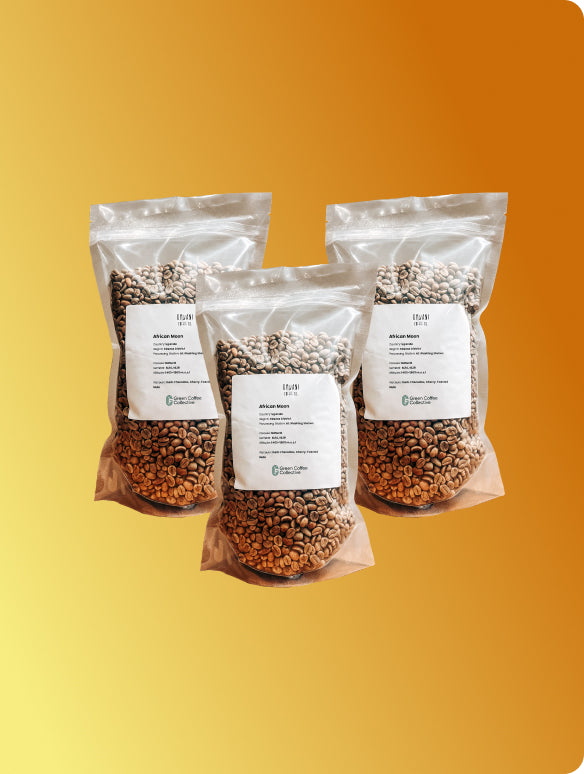
What is yield in coffee production and processing?
Yield refers to the quantity of coffee produced at a given stage of the supply chain, typically expressed as a ratio or weight. It appears in two main contexts: farm-level yield (the amount of cherry produced per tree or per hectare) and processing yield (the ratio of output at one stage to input at a previous stage - for example, how much green coffee you get from a given weight of cherry).
Farm-level yield is measured in kilograms of cherry per tree per year, or total tonnes of cherry per hectare. Average yields vary enormously by origin, variety, altitude, farming system, and management intensity - from below 1kg of cherry per tree in traditional shade-grown systems to 5kg or more in high-input, sun-grown monocultures. Yield and quality often trade off: the varieties and conditions that produce the most cherry per tree (like Robusta or low-altitude Catimor plantings) typically produce lower-quality cup character than lower-yielding, high-altitude, traditional varieties.
Processing yield describes the cherry-to-green conversion ratio - typically around 5:1 (five kilograms of cherry to produce one kilogram of green coffee), though this varies by processing method and cherry quality. Higher-moisture naturals may require closer to 6:1; well-prepared washed lots can achieve 4.5:1. Understanding processing yield helps producers and buyers calculate input costs per kilo of exportable green and assess the economics of different processing approaches.