

Uganda Uganda

Ugandan Green Coffee Beans

Explore our range of Ugandan coffee beans, with a variety of processing methods and regions. Perfect for professional roasters, our selection offers both versatility and quality, ensuring you find the ideal green beans for your roasts. Whether you’re looking for wholesale quantities for larger operations or smaller batches for testing, we provide the options you need. Comparing origins? Our green coffee beans collection has every lot we stock.

Regions
Rwenzori · Mount Elgon · Kigezi Highlands
Varieties
SL-34 · SL-28
Harvest
Sep – Dec
Scale
Africa's top exporter: 7.1 million 60kg bags/ year. (USDA FAS, 2026)

In stock now

3 Ugandan coffees in stock · 3 recently sold out

Recently sold out

Still worth a read – most producers come back next harvest.

ORIGIN GUIDE

Buying and roasting Ugandan green coffee

Saskia Chapman Gibbs, Marketing & Sustainability, Green Coffee Collective

Why Ugandan coffee tastes the way it does

Uganda is best known for Robusta, which grows wild in its forests and makes up most of the country’s output. But its mountains also produce excellent Arabica. Most of it comes from SL14 and SL28, varieties first selected in Kenya in the 1930s, alongside Bourbon. These give Ugandan Arabica its sweetness, fuller body and red-fruit character.

Each mountain region adds its own twist. Mount Elgon’s volcanic slopes produce clean, bright coffees with citrus, chocolate and florals. The Rwenzori Mountains lean rounder and fruitier, with strawberry, plum and cocoa. Kigezi, the highest of the three at up to 2,500m, gives vivid, berry-led lots with wine-like acidity.

Processing sets the style. Washed Ugandans are clean and balanced, with citrus and dark chocolate. Naturals, dried in the whole cherry, are heavier and sweeter, with winey, jammy fruit. A growing number of producers are also trying honey processing, which sits somewhere in between.

Read: A History of Ugandan Coffee: Between State and Market

How Ugandan coffee is processed

How the cherry is handled after picking changes the cup more than almost anything else.

WashedCherry skin and mucilage removed before drying – clean, bright, origin-expressive cup.0 in stockWhat is it?
NaturalWhole cherries dried with fruit intact – produces heavy body and fruit-forward flavour.3 in stock →What is it?
ExperimentalCoffee fermented in sealed, oxygen-free vessels – producing intense, fruity profiles.0 in stockWhat is it?
DecafCaffeine removed from the green beans before roasting, keeping as much of the origin character as possible.0 in stock

The regions

Translation missing: en.origin.map.title TANZANIA →RWANDA →KENYA →ETHIOPIA →DR CONGOSOUTH SUDAN Kampala Rwenzori Mount Elgon Kigezi Highlands Translation missing: en.origin.map.title TANZANIA →RWANDA →KENYA →DR CONGOSOUTH SUDAN Kampala Rwenzori Mount Elgon Kigezi Highlands
Rwenzori1,500–2,200m
One of Uganda’s main Arabica regions, high on the Rwenzori’s eastern slopes. Small family farms grow SL14, SL28 and Bourbon, processed as natural, washed or honey lots.
Mount Elgon1,300–2,200m
Uganda’s best-known Arabica region, on an extinct volcano by the Kenyan border. Clean, bright washed lots and heavier, winey naturals from shaded smallholder farms.
Kigezi Highlands1,500–2,500m
Uganda’s rising star, high in the cool, rainy southwest near the Rwandan border. Smallholders grow coffee alongside bananas and beans on steep terraced slopes.

Rwenzori rainfall: 2026 vs the 10-year average

2026 10-year average

Rwenzori has had  30% less rain than its 10-year average so far this year (806 mm against 1,143 mm, January to October). August to October were 41% below normal.

Monthly rainfall in Rwenzori, Uganda, 2026 compared with the 2016–2025 average
Month 2026 (mm) 10-year average (mm)
January 36 70
February 89 71
March 93 141
April 129 158
May 114 118
June 13 68
July 58 54
August 25 136
September 72 155
October 177 172
November not yet 156
December not yet 104

Why it matters: rain at flowering sets up the next crop, and dry weather at harvest helps naturals dry evenly. Big swings either way can mean a smaller or later harvest – we'll say so here as reports come in.

Source: NASA POWER (MERRA-2) for Rwenzori (0.061468726°S, 30.543256128°E) · updated monthly · last updated 8 Nov 2026

Meet a producer: Agri Evolve

Agri Evolve

Nyabirongo, Kisinga, Uganda ↗ Farming since 2016

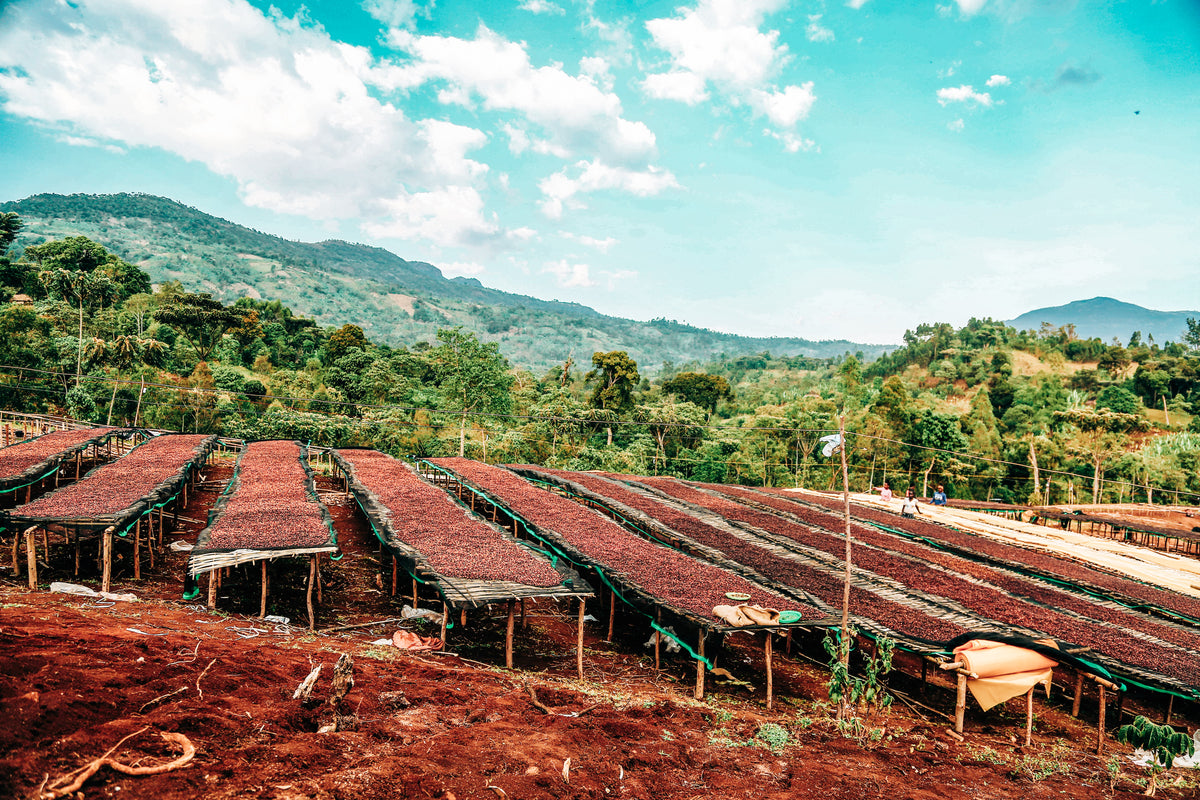
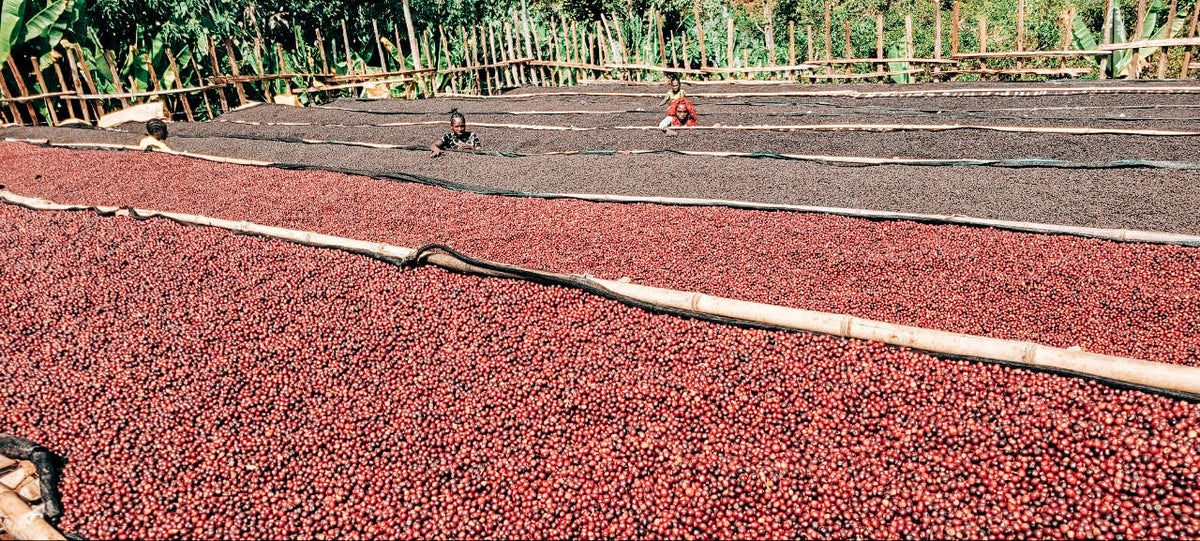
Agri Evolve was established in 2016 with a simple yet ambitious goal: to serve as a reliable collection point for both Dried Ugandan Arabica (DRUGAR) and ripe coffee cherries in the Rwenzori Mountains. Traditionally, farmers in this region processed their coffee themselves, often drying cherries on tarpaulins under the sun. While sourcing DRUGAR was initially easier due to these established practices, changing old habits and encouraging the sale of ripe cherries proved to be a challenge.

However, with significant investment in processing equipment, the creation of demonstration farms, and the hiring of experienced staff, Agri Evolve made remarkable strides in its second year. The quality and quantity of sourced ripe cherries improved drastically, setting the stage for a more refined coffee processing operation.

Today, Agri Evolve boasts modern processing facilities equipped with washer separators, mechanical dryers, hulling machines, and greenhouses. These advancements have greatly enhanced the quality of the coffee produced and solidified Agri Evolve’s reputation among local farmers.

Agri Evolve has become a trusted partner in the farming community, known for paying fair prices consistently and on time—a seemingly simple practice that has made a world of difference for the farmers. Through these efforts, Agri Evolve continues to transform coffee production in the Rwenzori Mountains, fostering growth and sustainability for the future.

From farm to our warehouse

Uganda’s coffee is grown by around 1.8 million smallholder households, mostly on family plots where coffee grows alongside bananas, beans and other food crops. Families pick and often dry the coffee themselves. Many pool their harvests through cooperatives and producer groups, which process and sell it on to exporters. Robusta makes up most of the crop, but specialty Arabica comes from the mountain regions of Mount Elgon, the Rwenzoris and Kigezi.

We buy Ugandan coffee through Omwani and Kwezi, who work with producer groups and washing stations in these regions. That lets us trace each lot back to its region, processing site and, often, the farmers behind it.

Lots change from harvest to harvest. Each crop is different, and we’d rather buy what’s cupping best that season than repeat a name for the sake of it. If you liked a past lot, join the arrivals list and we’ll tell you what’s closest when new crop lands.

Read: Land grabbing and coffee: The Kaweri case and how dispossession happens within the law

Ugandan lots we've sourced

Every lot we've brought in, with our team's cupping score where we have one. A good guide to what next season's will be like.

Past lots on record
8
Average cup score (7 scored)
85.9
Highest
86.75 Agri Evolve Pulped Anaerobic
Ugandan lots we've sourced
Lot Region Process Crop Score
Agri Evolve Pulped AnaerobicOrange, Tropical Fruit Rwenzori Mountains Pulped Anaerobic 24/25 86.75
Bukonzo DreamStrawberry, Caramel, Milk Chocolate Nyabirongo, Rwenzori Mountains Natural 23/24 86.25
Midnight FlyerCaramel, Apricot Nyabirongo, Rwenzori Mountains Washed 23/24 86.25
Bukonzo Dream Extended FermentationLychee, Green Tea, Sugar Cane Rwenzori Mountains Extended Fermentation 23/24 85.75
Midnight FlyerCaramel, Apricot Nyabirongo, Rwenzori Mountains Washed 24/25 85.75
Rwenzori Yeast FermentationLychee, Green Tea, Sugar Cane Rwenzori Mountains Natural 23/24 85.75
Uganda Bugisu AA Fully Washed RALemon, Black Tea, Brown Sugar Mt. Elgon, Bugisu Washed 24/25 84.5
Lion's Roar– – Washed c. 22/23 N/A

When to buy Ugandan green coffee

Fresh-crop Ugandan lots arrive months after the harvest ends. Buy on arrival for the brightest cup.

Buying Ugandan coffee in volume

From a first sample bag to a container, without the import paperwork.

0.5 – 5KG Sample and small batch Open to everyone. Most lots offer a sample size so you can cup before committing.Shop in-stock lots →
10 – 20KG Wholesale account Approved roasters see 10kg and 20kg sizes and trade pricing when signed in.Apply for wholesale →
FULL SACKS & CONTAINERS Through our import partners Sacks, pallets and full containers from the importers we buy Ugandan coffee from. Omwani

Roasting Ugandan coffee

How Ugandan Arabica behaves in the roaster depends on the variety and the processing method. SL28 and SL34 produce large beans, so they need steady heat to cook through to the core. Smaller varieties like SL14 take heat faster. Washed lots are usually the most consistent: charge confidently, keep the energy up through drying, then ease off before first crack. Naturals dry inside the whole cherry, so they can be more uneven from bean to bean. Roast them a little gentler and watch them closely towards the end. Most suit a light-medium to medium roast, which brings out red fruit and dark chocolate.

Never roasted coffee before? These are raw, unroasted beans – they need roasting before you can brew them. It's easier than it sounds.

Ugandan green coffee FAQs

What does Ugandan coffee taste like?

Ugandan Arabica is sweet and full-bodied, with red fruit and dark chocolate. Washed lots are clean and balanced, with citrus and florals. Naturals are heavier and sweeter, with winey, jammy fruit.

Is Ugandan coffee Arabica or Robusta?

Both. Robusta makes up most of Uganda’s crop and grows wild in its forests. The specialty Arabica we sell comes from the country’s mountain regions: Mount Elgon, the Rwenzori Mountains and Kigezi.

How do you roast Ugandan green coffee beans?

It depends on the variety and process. Large-bean varieties like SL28 and SL34 need steady heat to cook through, and washed lots handle a confident approach. Naturals can be more uneven, so roast them a little gentler. Most suit a light-medium to medium roast.