How to Buy Green Coffee Beans & Choose the Right Supplier

Table of Contents
- Think in Terms of Usability, Not Just Score
- What Does Good Value Mean?
- Should You Only Buy Fresh Harvest Coffee?
Green coffee beans sit at the foundation of every roast. Long before flavour develops in the drum, a coffee’s character is shaped by how it was grown, processed, prepared, graded, and transported across the world. By the time it reaches your roaster, it has already passed through multiple stages that influence how it will behave and taste.
For many beginners, that complexity can feel intimidating. There are origins to compare, processing methods to understand, varietals to interpret, and different types of suppliers to navigate. It can seem as though you need to understand everything before making your first purchase.
In reality, you don’t.
Learning how to buy green coffee is less about mastering every technical detail and more about understanding a small number of fundamentals that shape most buying decisions. Once those are clear, the process becomes far more straightforward - and far more enjoyable.
This guide walks through green coffee basics in a practical way, explaining how to buy green coffee beans, how to buy green coffee online, how suppliers differ, and what actually matters when choosing coffee for your roastery.
In Short: How to Buy Green Coffee
-
Start with processing and personal preference
-
Choose a supplier suited to your scale
-
Prioritise reliability over rarity
-
Deepen your knowledge gradually
You don’t need to know everything before you start buying green coffee well. Focus on the basics first, work with suppliers you trust, and let your knowledge build naturally over time. Confidence comes from doing, tasting, and learning step by step, not from having all the answers upfront. Start simple, stay curious, and you’ll quickly develop the judgement needed to make great buying decisions.
What Are Green Coffee Beans?
Green coffee beans are the raw, unroasted seeds of the coffee cherry. After harvest, the fruit is removed, the seeds are dried to stable moisture levels, and they are prepared for export.
Before roasting, green coffee beans are dense, lightly aromatic, and stable when stored correctly. They do not yet resemble the coffee you brew - roasting transforms their chemical structure and unlocks flavour.

It helps to think of green coffee as potential rather than a finished product. Much of what defines a coffee has already happened before it reaches the roaster.
Understanding coffee plant anatomy and botany, or seeing what growing a coffee plant actually looks like, can add helpful context to this early stage.
Why Green Coffee Is an Agricultural Product
Coffee is typically harvested once or twice per year in most producing regions, and each crop reflects the conditions in which it was grown. Rainfall patterns, temperature shifts, soil health, and farm management all influence how a coffee develops.
Because of this, variation is normal. Even coffees from the same producer can shift subtly between harvests. Rather than signalling inconsistency, these differences usually reflect changing environmental conditions.
Climate pressure, rising production costs, and evolving farming practices have made this agricultural context even more important to understand. Availability can change, flavour profiles may move slightly, and some varieties are becoming harder to produce in traditional growing regions.
You don’t need deep agronomic knowledge to buy well. But recognising that green coffee beans are shaped by nature helps set realistic expectations - particularly when thinking about freshness, supply, and price.
Understanding this foundation makes the journey from seed to green coffee much easier to follow.
The Three Fundamentals to Understand Before Buying Green Coffee
When people first learn how to buy green coffee beans, they often assume they must interpret every detail on a listing. In reality, most buying decisions can be simplified by focusing on three core factors: processing, plant genetics, and growing environment.
Everything else deepens naturally with experience.
Processing
Processing refers to how the fruit is removed from the seed after harvest, and it is one of the strongest predictors of flavour direction.
Washed coffees often present clarity and structure. Natural coffees tend to lean fruit-forward with more body, while honey-processed coffees frequently sit somewhere between the two.
A working understanding of washed, natural, and honey processing is often enough to guide early buying decisions. From there, curiosity may lead you toward what actually happens at a coffee washing station or why some origins favour certain processing methods.
More experimental approaches - including extended fermentation or carbonic maceration - can produce distinctive profiles, but they are rarely essential starting points.
Species and Varietal
Within species are varietals - cultivated plant types that influence resilience, yield, and flavour expression. A basic awareness helps explain why two coffees from the same country can behave very differently.
Exploring arabica vs robusta, understanding what coffee varietals and cultivars are, or learning why certain varieties dominate certain countries can provide useful depth when you are ready.
Environment
Coffee reflects where it is grown. Climate, altitude, and soil influence how a plant develops and how dense the seeds become.
Recognising that geography leaves a trace on flavour makes it easier to interpret differences between coffees. Looking more closely at how climate and altitude shape green coffee or what terroir means in coffee adds helpful perspective.
How to Buy Green Coffee Beans With Confidence
At its core, learning how to buy green coffee is less about finding the “best” coffee and more about finding one suited to your needs.
Start by defining your purpose. Are you roasting to learn, refine your palate, or support a small business? Suitability matters far more than rarity.
If you are just starting out, it usually makes sense to begin with a coffee that has been cleanly processed, behaves predictably in the roaster, and sits within a comfortable price range. Highly experimental lots can be exciting, but they often require tighter control and more experience to get the best from them.
Starting with something reliable gives you space to learn without feeling like you are fighting the coffee.
Understanding how to read a green coffee listing properly helps shift buying decisions from guesswork to informed choice.
Think in Terms of Usability, Not Just Score
High scores can be appealing, but they do not always translate to ease of roasting. Some coffees demand precision and consistency.
For many buyers, especially early on, a dependable coffee that performs well batch after batch often provides greater long-term value.
What Does Good Value Mean?
Value is contextual.
For some buyers it means reliable performance per kilo. For others, it is flavour relative to price, lower risk, scalability, or learning potential.
There is no universal definition — only what aligns with your goals. Understanding what makes a green coffee good value helps you define your own criteria rather than relying on assumptions.
Should You Only Buy Fresh Harvest Coffee?
Freshness matters, but it is not the only factor.
Fresher coffees often present brighter flavour expression and slightly greater roasting control. Older coffees can still perform well and sometimes allow access to higher-quality lots at more approachable prices.
Harvest timing is best viewed as one piece of context rather than a strict rule - something explored further when considering whether you should only buy coffee in harvest.
How to Buy Green Coffee Online and Choose the Right Supplier
Buying green coffee online has become increasingly common, particularly for home and small-scale roasters. The experience largely depends on who you are buying from and how clearly they present information.
Look for suppliers that provide transparent details on processing, harvest timing, origin, and storage. Clear information reduces uncertainty and makes repeat buying far easier.
Minimum order size is also worth paying attention to - and this often comes down to the type of supplier.

Where Do You Actually Buy Green Coffee?
Understanding where to buy green coffee is just as important as understanding what to buy.
Green coffee typically moves through several types of suppliers, each serving slightly different needs.
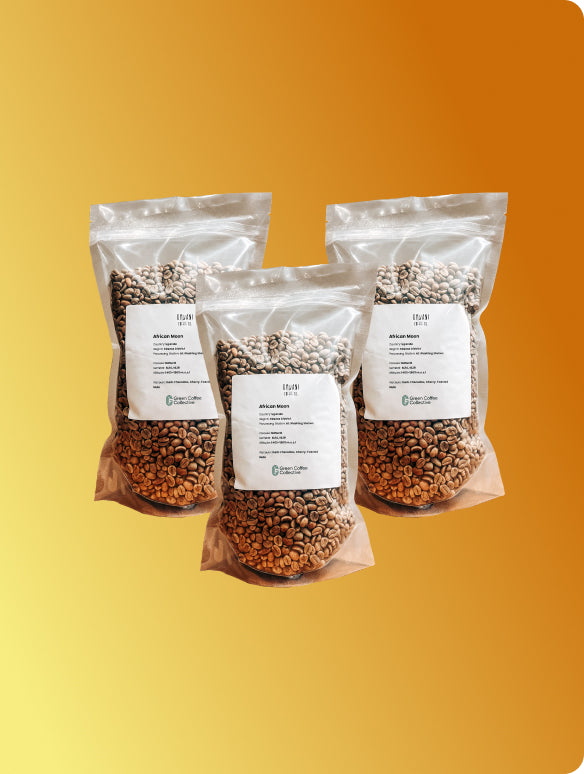
We sell green coffee beans in quantities from 0.5kg to 30kg. One of the biggest barriers when learning how to buy green coffee is access to small volumes - traditionally, the minimum purchase has been a full sack of around 60–70kg. By breaking larger lots down, we make green coffee more accessible to home and small-scale roasters.
Importers
An importer purchases coffee at origin, ships it into a consuming country, stores it in warehouses, and sells it to roasters.
Importers usually operate at a larger scale, and in many cases the minimum purchase quantity is a full sack - often around 60–70kg. For established roasteries buying in volume, this structure simplifies logistics and supports dependable supply.
Many newer roasters discover that importer models are designed around commercial quantities, moving full containers or full pallets (+600kg) which can make them less accessible when you are starting out. Understanding how green coffee gets from origin to buyer helps explain why this structure is necessary.
Small Quantity Green Coffee Suppliers
Small quantity green coffee suppliers play a unique role in the coffee supply chain. Rather than only selling full 30–70kg sacks, they break larger lots down into smaller, more manageable volumes.
That means you can buy green coffee beans in small quantities - whether that’s 1kg, 5kg, or just a few kilos to test.
For roasters learning how to buy green coffee beans, especially those focused on home roasting or small-batch roasting, this approach reduces risk and makes experimentation far more accessible. You can trial new origins, processing methods and varietals without committing to commercial-scale volume.
Clear information, transparent sourcing and manageable volumes often matter more than chasing the rarest coffee available.
That’s exactly why Green Coffee Collective exists. We make high-quality green coffee beans accessible to roasters of all sizes - from first-time home roasters to established professionals looking for flexibility.
Direct Relationships
Some roasters build sourcing relationships closer to origin. Understanding what direct trade actually means helps separate the idea from the practical realities, including financing, logistics, and long-term partnership.
For most beginners, however, working with a small quantity supplier or importer provides the most straightforward path.
What Actually Matters When Assessing Green Coffee Quality
Quality can appear highly technical, but early on, a few indicators carry most of the weight.
Clean processing, consistent preparation, and suitability for your roasting approach are often more useful signals than specialised metrics.
From there, learning about green coffee grading, how grading differs by country, and what screen size means builds confidence over time.
More advanced measurements - including moisture, density, and water activity - become increasingly relevant as your roasting develops, particularly when understanding key physical measurements.
Recognising coffee defects and how to spot them is also helpful, though most buyers do not need laboratory-level precision to make strong decisions.
As experience grows, you may notice how green coffee variability shows up in the roaster. This is a normal part of working with an agricultural product.
Freshness, Storage, and How Long Green Coffee Beans Last
One of the advantages of green coffee is longevity. When stored properly, it remains stable far longer than roasted coffee.
Using Green Coffee: What Happens After You Buy It
Green coffee must be roasted before brewing. Beginning with smaller batches allows you to build familiarity without unnecessary risk.
As your roasting develops, factors such as density, moisture content, and screen size begin to influence how heat moves through the bean. Understanding how green coffee density affects roasting or how moisture affects roast development becomes increasingly valuable over time.
You don’t need to master these variables before you begin.
Common Mistakes When Buying Green Coffee Beans
A few assumptions tend to create confusion:
-
Expensive does not always mean suitable
-
High scores do not guarantee compatibility
-
Fresh crop is not automatically better in every situation
-
Complexity does not equal quality
Learning how to buy green coffee is less about chasing perfection and more about building clarity through experience.
Confidence usually builds faster than you expect once you start buying, tasting, and reflecting on what works for you. Every purchase adds clarity, reduces uncertainty, and sharpens your judgement - so focus on steady progress rather than getting everything perfect from day one.
Conclusion
Learning how to buy green coffee does not require mastering every variable in the supply chain. A working understanding of processing, plant genetics, environment, and personal preference is more than enough to begin buying confidently.
There is no universally “correct” coffee - only the one that suits your tastes, your roasting style, and your goals.
Často kladené otázky
Jaký je nejlepší způsob, jak koupit zelená kávová zrna?
Jak mohu koupit zelená kávová zrna online?
Musím koupit celý pytel kávy?
Jak dlouho vydrží zelená kávová zrna?
Jak poznám, že zelená káva je kvalitní?
Co je Green Coffee Collective?
Související články, které by vás mohly zajímat
-
 4 min readGreen Coffee Basics
Jak skladovat zelenou kávu: 3 pravidla pro čerstvost až 12 měsíců
Domácí pražení zelených kávových zrn získává na oblibě mezi milovníky kávy, ale dosažení dokonalého šálku závisí na správném skladování. Používání...
Jak skladovat zelenou kávu: 3 pravidla pro čerstvost až 12 měsíců
Domácí pražení zelených kávových zrn získává na oblibě mezi milovníky kávy, ale dosažení dokonalého šálku závisí na správném skladování. Používání vzduchotěsných nádob, Mason sklenic nebo vakuově uzavřených sáčků a ochrana...
-
 9 min readHome Roasting
Jak si doma upražit kávu: trouba, horkovzdušná fritéza a všechno mezi tím
Kompletní průvodce pražením kávových zrn doma – zahrnuje všechny metody bez použití přístroje od trouby po horkovzdušnou fritézu, s podrobnými...
Jak si doma upražit kávu: trouba, horkovzdušná fritéza a všechno mezi tím
Kompletní průvodce pražením kávových zrn doma – zahrnuje všechny metody bez použití přístroje od trouby po horkovzdušnou fritézu, s podrobnými návody krok za krokem, doporučením úrovně pražení a vším, co...
-
Konečný průvodce domácím pražením kávy
Už jste někdy přáli, aby vaše domácí pražená káva chutnala stejně dobře jako ta z vaší oblíbené pražírny? Malé úpravy...
Konečný průvodce domácím pražením kávy
Už jste někdy přáli, aby vaše domácí pražená káva chutnala stejně dobře jako ta z vaší oblíbené pražírny? Malé úpravy mohou udělat velký rozdíl. Proto jsme vytvořili Ultimátní průvodce pražením...


Dale Goulding
Spoluzakladatel, Green Coffee Collective