Sourced by Semilla Coffee. Fulfilled by Green Coffee Collective.

Buy high-quality green coffee in small volumes, with fast delivery.

  • About Semilla Coffee

    Semilla Coffee was built around a conviction that runs counter to how much of the specialty market operates. Rather than seeking out the highest-scoring lots from the most established producers, Semilla commits to specific communities who lack market access and builds long-term relationships with them - buying solid coffees from producers without access to the specialty market, and working alongside them as their knowledge, quality, and profitability develop over time.

    The model is deliberately unhurried. Semilla's aim is to represent specific groups as they move forward along the value chain from periphery to core - broadening and deepening their commitment to these communities rather than buying only the top lots. They meet the prices producers request, invest in infrastructure at origin, and speak about coffee as the product of people rather than purely for its sensory attributes. The micro-finance initiative they run - a crowd-funded programme that redistributes financial support to coffee professionals in the Global South - reflects the same philosophy applied beyond the supply chain itself.

  • A Different Approach to Sourcing

    Semilla's focus is not cup score but rather the community involved in producing the coffee. Their work begins with identifying producers who have the energy and passion to connect to the specialty market but lack the infrastructure, market access, or buyer relationships to do so. Once that relationship is established, Semilla's commitment extends well beyond a single purchase - they invest in the skills, knowledge, and financial stability of the groups they work with, with the long-term goal of seeing producers build the autonomy to thrive in the specialty market on their own terms.

    This means Semilla takes on risk that most importers avoid. They buy from producers they believe in, not just those who have already proven themselves to specialty buyers. They engage with communities at the earliest stages of specialty production, when quality may not yet be consistent, and they stay. As they put it: they commit to buying from people they care about, and will not turn their back on them because of a point score.

    The practical expression of this philosophy is a tight, focused network. Semilla works with four producer groups - in Honduras, Guatemala, Rwanda, and Colombia - and they go deep with each one rather than spreading their buying across many origins and many producers. Every relationship is built to last.

  • Real Support Requires Risk

    Most importers talk about supporting smallholder producers. Semilla are explicit about what that actually requires: a willingness to take on risk. They recognise that true smallholder support is impossible unless you are willing to commit to communities before quality is consistent, to meet the prices producers request rather than negotiate them down, and to stay when things are difficult rather than moving on to easier relationships.

    This position shapes every sourcing decision Semilla makes. Rather than chasing the highest-scoring lots from producers who already have access to the specialty market, they commit to the slow and steady work of buying solid coffees from producers without access, and building the conditions under which those producers can develop. The goal, as Semilla put it, is to see the rising tide float all boats - not just the ones already closest to shore.

  • What Market Access Actually Means

    In Colombia, only around 2% of the country's coffee is sold outside the commercial market - despite Colombia's global reputation as one of the world's great coffee-producing nations. Around 60% of the smallholders in the Monkaaba collective Semilla works with are under 35 and have sold primarily on the local black market, in wet or dry parchment, with no transparency and no guarantee of a fair price year over year. Many producers, when they account for all their costs including their own labour, are effectively losing money selling at local market prices - without knowing it.

    In Honduras, 800 producers in Selguapa grow coffee at 1,800 metres above sea level with genetics that Semilla describe as producing bright, clean, fruited cups more reminiscent of African coffees than the common perception of Central American production. Only 40 of those 800 are currently selling to the specialty market. The other 760 continue to sell in cherry to local intermediaries, receiving prices that do not reflect the quality of what they are growing. Semilla estimate there are approximately 13,000 bags of coffee of exceptional quality in this community alone, currently bypassing the specialty market entirely.

    Market access is not a given. It requires a buyer willing to show up, stay, and pay a price that makes the alternative viable.

  • The Communities Behind the Coffee

    Semilla's four producer relationships each have their own history and their own set of challenges, but they share a common thread: communities who have something exceptional to offer and have been systematically excluded from the market that would reward it.

    In Honduras, the story begins with Antonio Ramirez - the man who first brought commercial coffee to Selguapa 30 years ago, planting Typica and Bourbon on abandoned hillside land at 1,800 metres. Today Semilla works with four communities in the Montecillos range - Selguapa, Chaguite, Guaspololo, and Bañaderos - and for many producers in the latter three, they were the first specialty buyer to ever knock on the door.

    In Colombia, Esnaider Ortega-Gomez and Didier Ortega lead Monkaaba - a collectivist project founded by seven smallholder families that has grown into a network of 60 families in San Agustin, Huila. Every weekend during harvest, their home is open to any smallholder who wants free sample roasting and cupping, with honest, unbiased feedback and no unexplained rejection based on a score alone.

    In Guatemala, the Café Colis Resistencia group in Mataquescuintla are producing coffee while simultaneously leading one of the most significant Indigenous rights struggles in Central America - the Xinca people's resistance to the Escobal silver mine, built without their consent on their land.

    In Rwanda, Semilla works with Emmanuel Rusatira of Baho Coffee, sourcing traceable microlots from individual smallholders and smallholder groups defined by identity or geographical location - an approach made possible by the extraordinary traceability infrastructure Baho Coffee has built.

  • Coffee as Politics

    For Semilla, coffee is not separable from the political and historical context in which it is grown. Their work engages directly with Indigenous land rights, colonial extraction, state violence, and the structural conditions that keep smallholder producers locked out of the market that would most reward their work. This is not a marketing position - it is the intellectual framework that determines who Semilla works with and why.

    The most vivid expression of this is their work with Café Colis Resistencia in Guatemala. The Indigenous Xinca people of the Mataquescuintla region have been fighting the imposition of the Escobal silver mine - estimated to be the second-largest silver mine in the world, owned by Canadian-based Pan American Silver - built without their consultation or consent in direct contravention of the United Nations Declaration on the Rights of Indigenous Peoples. Multiple local plebiscites reported at minimum 93% opposition to the project. In 2017, the Guatemalan Constitutional Court suspended the mine's licence pending proper consultations with the Xinca Parliament. In 2018, this was upheld by the Supreme Court.

    The Xinca resistance forced the Guatemalan government to formally recognise the existence of the Xinca people - something the state had previously denied. The number of recorded Xinca grew from 16,000 to 240,000 following this recognition, and the Xinca Parliament set a national constitutional precedent requiring any extractive project to go through a proper community consultation process. Buying coffee from this community is, for Semilla, an explicit act of solidarity alongside an act of commerce.

  • The Semilla Micro-Finance Initiative

    Beyond sourcing, Semilla runs a crowd-funded micro-finance initiative that redistributes financial support directly to coffee professionals in the Global South - the farmers, producers, and community members who make their work possible. This initiative reflects the same conviction that runs through everything Semilla does: that real support for smallholder producers requires more than a fair price at the point of purchase, and that the responsibility of those with access to capital extends beyond the transaction itself.

How we package
our coffees

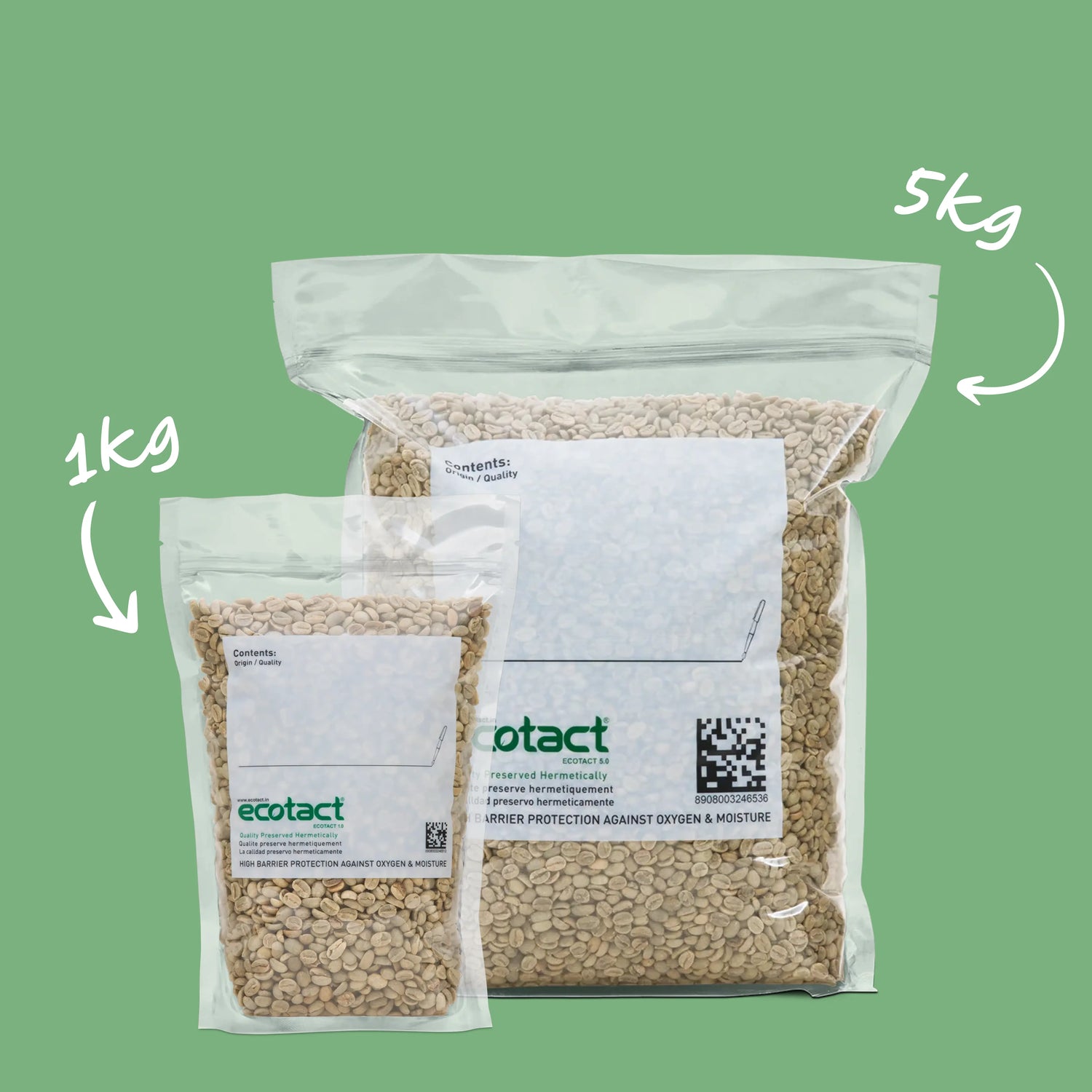
Barrier packaging designed for specialty coffee.

We use Ecotact bags because they offer high-barrier protection against oxygen, moisture, and external contaminants. This helps preserve the quality, aroma, and flavour potential of your green coffee during transport and storage. They're trusted by top producers and importers worldwide.

Heat-Sealed for Maximum Protection

Every bag is professionally heat sealed at our warehouse to lock in freshness. This creates a secure seal that prevents exposure to air or humidity - keeping your green coffee stable, even over long periods.

Convenient Resealable Zip Closures

Once opened, each bag has a resealable zip to help you store and protect the rest of your coffee between roasts. It’s a simple way to reduce waste and maintain freshness - especially helpful for home roasters or sampling.

Portion sizes for any roaster.

Whether you're roasting at home or running a production line, we've got a size to suit. Choose from 0.5kg, 1kg, or 5kg bags - all packed with the same level of care. Smaller volumes make it easy to try new coffees without the commitment.

Responsible packaging choices.

Our bags are made from Graded 7 multi-layer recyclable plastic. While they may not go in your home recycling bin, they are accepted by specialist facilities. More importantly, they reduce waste by dramatically extending the shelf life of your green coffee.
Your questions, answered

Who are Semilla Coffee?

Semilla Coffee is a specialty green coffee importer committed to working with smallholder producer communities who lack access to the specialty market. They build long-term relationships with a small number of specific producer groups - currently in Honduras, Guatemala, and Colombia - going deep with each community rather than sourcing broadly.

Why does Semilla focus on producers without market access?

Semilla's founding conviction is that the specialty market's positive impact is most needed - and least felt - by producers at the periphery of the supply chain. Rather than competing for the highest-scoring lots from established producers, they commit to communities at earlier stages of specialty production and stay with them as quality and capability develop over time.

What is the Semilla Micro-Finance initiative?

The Semilla Micro-Finance initiative is a crowd-funded programme that redistributes financial support directly to coffee professionals in the Global South. It is open to participation from anyone who wants to support the communities Semilla works with beyond a coffee purchase.

How does Semilla approach pricing?

Semilla meets the prices that producers request rather than negotiating down to a market rate. Their goal is to ensure producers are receiving prices that genuinely cover their costs of production and support long-term viability - something they note is not guaranteed even in the specialty market.