Sourced by Caldera Coffees Ltd. Fulfilled by Green Coffee Collective.

Buy high-quality green coffee in small volumes, with fast delivery.

  • About Caldera Coffees Ltd

    Caldera Coffees was founded by Jaime and Michelle, two Panamanians living in Hong Kong who noticed a gap between the sophistication of the city's coffee culture and its awareness of what Panama's highlands were actually producing. Named after the Caldera River that runs through Boquete — one of Panama's most celebrated coffee-growing regions — the business launched in 2021 after years spent building direct relationships with premium Panamanian estates.

    Today Caldera operates from both Hong Kong and the United Kingdom, supplying Asian and European specialty roasters with carefully selected Panamanian green coffee — from rare Geisha lots to experimental varietals and microlots from producers who are actively pushing the boundaries of what Panama can produce.

  • Panama: More Than One Story

    Panama is the 35th largest coffee producer among the world's producing countries — a figure that tells you almost nothing useful about the quality of what it grows. The country's reputation in specialty coffee has been built not on volume but on a small number of landmark moments that changed how the industry understood what coffee could be worth and what it could taste like.

    The turning point came in 2004, when a washed Geisha from Hacienda La Esmeralda sold for $21 per pound at the Best of Panama auction — at a time when the highest price being paid was $4.80. It was a moment that announced Panama to the world and set in motion a shift in how the country's producers thought about quality, experimentation, and the international market. Lots from Panama have since sold for over $800 per pound.

    But Geisha is the beginning of Panama's story, not the whole of it. Across more than 100 distinct microclimates shaped by Caribbean and Pacific winds, volcanic soils, and elevations of up to 2,800 metres above sea level, producers are working with Typica, Caturra, Catuai, Bourbon, and an expanding range of experimental varietals. The same innovative spirit that drove the Geisha revolution is now producing exceptional lots across a much wider range of varieties and processing methods — and Caldera is sourcing directly from the estates leading that work.

  • The Chiriquí Highlands

    All of Panama's specialty coffee comes from the Chiriquí province, concentrated across three growing regions: Boquete, Volcán, and Renacimiento. Each sits in the shadow of the country's volcanoes — Volcán Barú, El Valle, and La Yeguada — whose soils are rich, fertile, and exceptionally well-suited to growing complex, high-scoring coffee.

    Boquete is the oldest and best-known of the three regions, with farms reaching elevations of up to 2,800 metres above sea level. It is home to a phenomenon known locally as bajareque — a cool mist that forms as winds cross the northern mountains and descend over the farms, slowing cherry ripening and increasing sugar concentration. The result is a more complex, sweeter cup. Boquete is where the Caldera River runs, and it is where Caldera's founders grew up.

    Volcán sits to the west and shares many of Boquete's growing characteristics. Renacimiento is the most remote of the three, with less infrastructure and more difficult access — but the same exceptional terroir. All three benefit from the narrow geography of Panama, where the proximity of two oceans creates a layered microclimate environment unlike anywhere else in the producing world.

  • The Estates

    Caldera works with a select group of Panamanian estates, many of them Best of Panama award winners with records that speak for themselves. The farms they source from are not chosen by category or competition score alone — they are chosen because the producers behind them are seriously committed to quality, to their land, and to the kind of processing discipline that produces consistent, exceptional results.

    Among the estates in Caldera's network:

    Chevas Coffee Estate

    The first Chevas farm was established in the Alto Chiquero region of Boquete in the 1970s, with two further farms later added in El Salto and Alto Quiel, each with distinctive microclimates and fertile, organic-rich soils. Elevations range from 1,500 to 1,750 metres above sea level. The estate grows Caturra, Maragogype, Catuai, Typica, and Geisha.

    Altieri Estates

    A family-run estate founded by Eugene Altieri 20 years ago, comprising two farms — Pipim Estates in Alto Lino and Mima Estates in Alto Quiel — growing coffee between 1,350 and 2,200 metres above sea level. The farms are divided into eleven plots named after each of Eugene's grandchildren. Altieri achieved 3rd place for Geisha Natural at the 2024 Best of Panama, with multiple further top rankings in 2022 and 2023.

    Bambito Estate

    A family legacy in Panama's Chiriquí province since the early 1900s, with Alberto Sittón Rios taking ownership from his father in 1945. Now in its fourth and fifth generation under the stewardship of Priscilla Amar de González, the estate's position between two mountain ridges creates distinct microclimates. Bambito claimed 1st place at the 2021 Best of Panama with their Geisha Washed submission. The estate also runs classes for the children of seasonal coffee pickers during harvest and contributes to the local school meals programme in Nueva Suiza year-round.

    Black Moon Farm

    Located in the highlands of Boquete, Black Moon is built on a regenerative agriculture model focused on living soils, carbon sequestration, and ecological resilience. Black Moon won 1st place in the Varietals category at the 2024 Best of Panama with their Constellation Chiroso Lot, which achieved an SCA score of 94.1 — the highest recorded score for any non-Geisha varietal. Their maiden harvest lots scored 93.5 and 92.5 at the 2022 Best of Panama.

    Janson Coffee Farm

    A family farm established by the sons of Carl Axel Janson, who arrived in Panama from Sweden in 1926. The farm includes a 200-hectare private nature reserve with wetlands and diverse wildlife, with coffee plantations on the slopes of the Tisingal and Barú volcanoes at 1,350 to 1,700 metres above sea level. The farm runs on solar energy, uses mountain spring water for the washed process, composts cherry pulp for fertiliser, and uses dry parchment as fuel for dryers. Janson earned 3rd place in the Geisha Natural category and 5th place in the Washed category at the 2023 Best of Panama.

    Café Kotowa — Las Brujas

    Established in the early 1900s and now in its fourth generation under Ricardo Koyner, Las Brujas sits on the south side of Volcán Barú. The farm benefits from Pacific rains and a natural forest canopy that maintains a cool climate year-round with a well-defined dry period, allowing for very ripe cherry maturation. The Geisha grown here traces back to seed-bearing plants selected across 12 generations from the original CATIE Research Station stock that arrived in Panama in 1970. Café Kotowa won 4th place in the Varietals category at the 2025 Best of Panama.

    Cuatro Caminos Coffee Estates / La India

    An agricultural cooperative owning and operating nearly a dozen farms in the Boquete area, with scientifically managed volcanic soil and whole-value chain oversight from seed to bean. La India is a 16.8-hectare farm at 1,700 metres above sea level with 36,000 trees. Cuatro Caminos Farm is a 40-hectare property at an average altitude of 1,800 metres, acquired in 2019 and planted with Caturra and Typica between 2019 and 2021, situated in densely wooded terrain with abundant natural water sources.

    Finca La Alquería

    Founded in 2019 and owned by José Porta, Finca La Alquería integrates conservation plans, forest reserves, and beekeeping into its operations, relying on biological and agronomic controls to maintain a minimal chemical load. José Porta joined ABRACCIO — an initiative by Altieri Specialty Coffee that provides product evaluation, process supervision, and market access to small growers with sound estate management but limited sales infrastructure. Altieri certifies origin, processes, and cup profiles for ABRACCIO members.

    MiFinquita

    Located in the highlands of Los Pozos at approximately 1,650 metres above sea level, MiFinquita works with a wide diversity of varieties including Catuai, Maragogype, and Geisha across many smaller, distinct lots rather than large uniform production. The farm uses Balloon vessels — a controlled anaerobic fermentation system that allows precise regulation of oxygen exposure during fermentation — followed by slow drying on raised African beds. The surrounding high-altitude forest, solar energy use, and natural composting reflect a farm philosophy centred on the full biocycle that sustains coffee quality.

    Hacienda La Esmeralda

    One of the most influential estates in the history of specialty coffee globally, and a farm Caldera visit directly during origin trips to cup and select from the current harvest. Esmeralda's farms sit across both the eastern and western slopes of Volcán Barú, with post-harvest processing managed to precise standards across raised drying beds and temperature-controlled drying rooms.

  • Processing in Panama

    Panama's producers are not resting on the reputation of a single varietal or a single processing method. Across the estates Caldera works with, there is a genuine culture of experimentation — producers developing and refining techniques that go well beyond the standard washed and natural divide.

    Anaerobic fermentation is widely used across Caldera's estate network, with producers carefully controlling fermentation temperature, duration, and oxidation phases to develop specific flavour outcomes. Black Moon Farm's Chiroso underwent 48-hour anaerobic fermentation followed by a 12-hour oxidation period, then 60 days drying in a dark room and four months resting in sealed bags. Chevas Estate processes selected lots through cold room drying after pulping and washing. Finca Nuguo ferments at precisely controlled temperatures — 32°C for 3.5 to 4 days — before drying in a temperature-controlled environment and resting in sealed black bags.

    This level of processing precision is not unusual among Caldera's partner estates. It reflects a broader commitment across the Chiriquí highlands to understanding and controlling every variable that affects cup quality — and it is what makes the lots Caldera brings to GCC distinctive even within Panama's already high-quality offer.

  • How Caldera Sources

    Caldera's sourcing is built on direct relationships and time spent at origin. Each harvest, they travel to the Chiriquí highlands to visit farms, cup new lots alongside producers, and make selections based on what is actually in the cup that season rather than on reputation or prior year performance. They have a local presence in the Chiriquí coffee region year-round — someone who cups at farm during harvest and relays the nuances of daily developments as they unfold, allowing Caldera to follow coffees much more closely from cherry to cup.

    The approach reflects an understanding that great coffee is seasonal and unrepeatable. Each harvest is shaped by a combination of climate, elevation, and processing decisions that will never occur in exactly the same way again. Caldera's role is to be present at that moment — to cup, select, and understand the coffees that best represent each season before they are offered to roasters.

    Over the past year, Caldera has introduced their coffees to buyers across the UK and continental Europe through events including the Nordic Coffee Festival, London Coffee Festival, World of Coffee in Geneva, Bristol Coffee Festival, and HOSTMilano, among others. The growth in their network has been matched by a deepening of their relationships with farm partners — a clearer understanding of when coffees are ready, what defines their character, and how decisions made during harvest shape what is eventually cupped months later.

How we package
our coffees

Barrier packaging designed for specialty coffee.

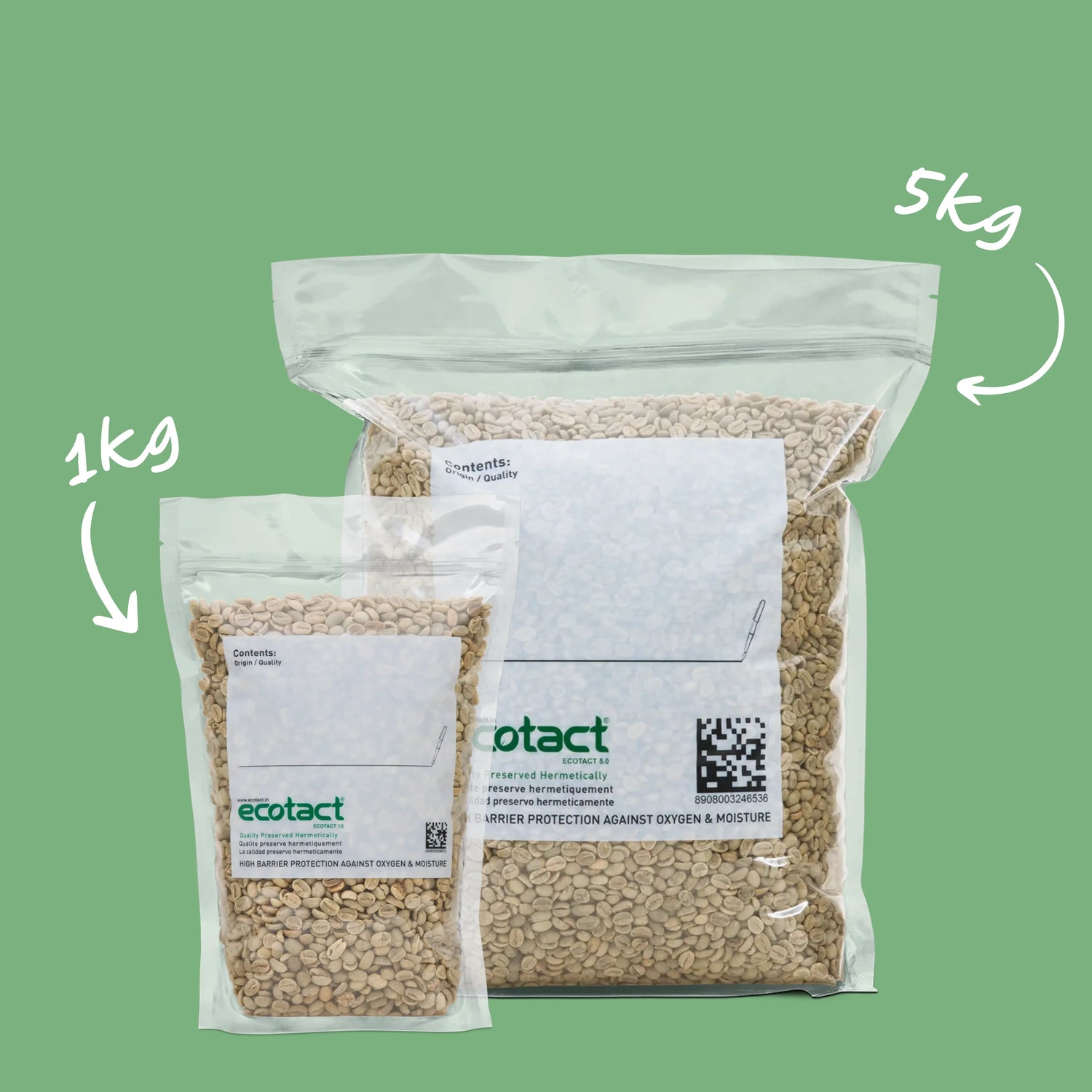
We use Ecotact bags because they offer high-barrier protection against oxygen, moisture, and external contaminants. This helps preserve the quality, aroma, and flavour potential of your green coffee during transport and storage. They're trusted by top producers and importers worldwide.

Heat-Sealed for Maximum Protection

Every bag is professionally heat sealed at our warehouse to lock in freshness. This creates a secure seal that prevents exposure to air or humidity - keeping your green coffee stable, even over long periods.

Convenient Resealable Zip Closures

Once opened, each bag has a resealable zip to help you store and protect the rest of your coffee between roasts. It’s a simple way to reduce waste and maintain freshness - especially helpful for home roasters or sampling.

Portion sizes for any roaster.

Whether you're roasting at home or running a production line, we've got a size to suit. Choose from 0.5kg, 1kg, or 5kg bags - all packed with the same level of care. Smaller volumes make it easy to try new coffees without the commitment.

Responsible packaging choices.

Our bags are made from Graded 7 multi-layer recyclable plastic. While they may not go in your home recycling bin, they are accepted by specialist facilities. More importantly, they reduce waste by dramatically extending the shelf life of your green coffee.
Your questions, answered

Who are Caldera Coffees?

Caldera Coffees is a specialty green coffee importer founded by Jaime and Michelle, two Panamanians who launched the business in 2021 after years building direct relationships with premium Panamanian estates. They operate from Hong Kong and the United Kingdom, supplying Asian and European roasters with carefully selected Panamanian green coffee.

Where does Caldera source their coffee from?

All of Caldera's green coffee comes from Panama, sourced exclusively from estates in the Chiriquí province — specifically the Boquete, Volcán, and Renacimiento growing regions. They work with a select group of producers, many of them Best of Panama award winners.

Is Caldera only about Geisha?

No — and this is an important part of how Caldera positions itself. While many of their partner estates produce exceptional Geisha lots, Caldera also sources experimental varietals and microlots from producers who are actively pushing beyond Panama's most famous cultivar. Their network includes estates working with Chiroso and other varietals alongside Geisha.

How does Caldera select the estates it works with?

Caldera leverages long-standing personal relationships with Panamanian producers built over many years before the business officially launched. They source based on cup profile criteria, quality standards, and alignment with specific roaster needs — from rare Geisha to other varietals. Their founders are Panamanian, with personal and family connections to the Chiriquí growing regions.

What processing methods are available through Caldera?

Caldera's partner estates work across washed, natural, honey, and anaerobic processing, with a number of producers using advanced techniques including temperature-controlled fermentation, dark room drying, and extended resting periods. The specific processes available depend on the lots in the current offer.