Low Caffeine Green Coffee Beans

Low Caffeine Green Coffee Beans

Unroasted, naturally low caffeine green coffee for roasters. These coffees carry less caffeine because of the plant itself, with no decaffeination involved: Laurina, a Bourbon mutation, and Racemosa, a separate wild species from southern Africa, each have roughly half the caffeine of typical Arabica. They're rare, low-yielding and unlike anything else on most menus. Buy from 0.5kg with samples on most lots – and if you need the caffeine removed almost entirely, see our decaf green coffee beans. Looking for roasted coffee? These are raw beans you roast yourself – here's how to start.

Looking to make a saving?

Build your own one-off small batch bundle. Choose from a diverse selection expertly curated coffees from across over 30 countries and save up to 10%.

Start building bundle
  • Why some coffees are naturally low in caffeine

    Caffeine is partly a defence – it deters insects – so how much a coffee plant makes is largely down to its genetics. Laurina, also called Bourbon Pointu, is a natural mutation of Bourbon that produces around half the caffeine of standard Arabica, and pays for it with lower yields and more pest pressure. Racemosa is a different species altogether, native to the coastal forests of southern Mozambique and KwaZulu-Natal, with around half the caffeine of Arabica and a quarter of Robusta. Our guide to coffee species shows where they sit alongside Arabica.

  • How much caffeine compared with regular coffee and decaf?

    As a rough guide by dry weight: Robusta carries around 2–2.7% caffeine, Arabica around 1–1.5%, and Laurina and Racemosa roughly half of Arabica. Decaf sits far lower again, with at least 97% of its caffeine removed. Exact figures vary by lot, growing conditions and how they're measured, so treat low caffeine as noticeably less, not caffeine free.

  • Roasting low caffeine green coffee

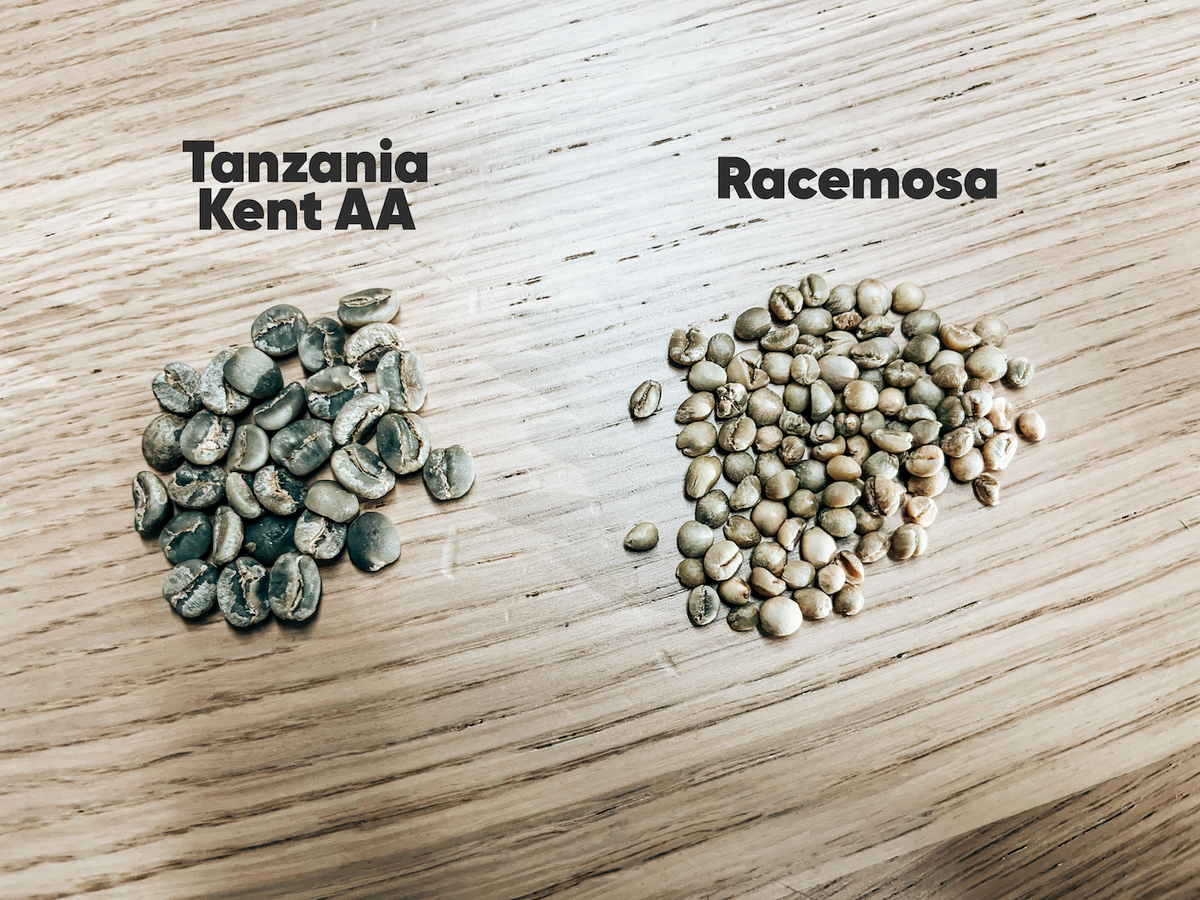
    Neither behaves like a standard Arabica. Racemosa beans are tiny – around the size of a lentil – so they can be lost through gaps in some roasters, heat through very quickly and give a faint first crack (our producer uses a stethoscope to hear it). Roast it in small batches with a lower charge and close attention. Laurina's small, pointed beans roast more like a delicate washed Arabica: keep it light to protect its sweet, tea-like character.

  • What low caffeine coffee tastes like
    Less caffeine means less bitterness, so both tend to read sweeter and softer than you'd expect. Laurina is delicate and clean, often with citrus, florals and red fruit. Racemosa is genuinely unlike Arabica: herbal and savoury in places – basil, lavender, mint, even umami – with washed lots showing bright fruit and naturals going syrupy and tropical. Cup it with an open mind.

  • Decaf Green Coffee Beans

    Decaf Green Coffee Beans

    Swiss Water, Sugar Cane and CO2 decaf greens that hold up to any roast profile - no compromise on flavour.

  • Rare

    Rare & Special

    Limited lots, unusual varietals, unexpected origins. For roasters who want something worth talking about.

  • Competition

    Competition

    Competition-grade green coffees with standout flavour, precision, and traceability to support your best brews.

Your questions, answered

Is Laurina coffee caffeine free?

No. Laurina has roughly half the caffeine of typical Arabica – enough to notice, but nowhere near decaf levels.

What is Racemosa coffee?

A wild coffee species native to coastal southern Africa, with tiny beans, very low yields and around half the caffeine of Arabica. Read more in our Racemosa feature.

Can I roast low caffeine coffee at home?

Yes. Laurina roasts much like a small-bean Arabica. Racemosa is harder: the beans are tiny, so check your roaster's drum or chamber won't lose them, and roast in small batches.

Does low caffeine coffee taste different from decaf?

Usually, yes. Nothing has been extracted from a low caffeine bean, so its sugars, acids and aromatics are intact. Decaf can lose some character during processing, although the best modern decafs come very close.

Is low caf coffee the same as decaf?

No. Low caf coffee contains less caffeine because of the plant’s genetics. Decaf coffee has caffeine removed after harvest. Low caf coffees retain their natural structure and flavour, while decaf focuses on achieving the lowest possible caffeine level through processing.

Why are low caf coffees more expensive?

Low caf varieties produce smaller yields and require more attentive farming because they lack caffeine’s natural pest protection. Limited supply and higher production difficulty mean pricing is often higher than more common Arabica varieties.

Do you offer samples or trial batches before committing to larger orders?

Yes, we offer samples for most of our coffees. If you need a larger sample than what’s typically available, we recommend trying one of the smaller quantity options listed on our site. That way, you can test the coffee before committing to a larger order.

What sizes or quantities can I order?

We offer coffee starting from as little as 0.5kg (1 lb) all the way up to full sacks. If you’re looking for larger quantities than what’s listed on our site, just get in touch! We’d be happy to help you organise and place a custom order. We're here to make sure you get exactly what you need.