How to Store Green Coffee Beans: A Practical Guide

Table of Contents
One of the advantages of buying green coffee is that it keeps far longer than roasted coffee. But "longer" does not mean "forever," and how you store green coffee beans makes a real difference to what you taste when you finally roast them.
Poor storage does not just shorten shelf life - it quietly degrades the coffee's flavour potential. Acidity flattens, aromatics fade, and the cup becomes dull and woody. The good news is that green coffee storage is not complicated. A few simple principles, followed consistently, will keep your beans in good shape for months.
This guide covers what conditions green coffee needs, which containers work best, how long you can realistically store green coffee beans, what to watch out for, and how we handle storage before the coffee reaches you.
What affects green coffee during storage?
Green coffee is a raw agricultural product, and it is hygroscopic - it absorbs and releases moisture from its environment. That is why moisture control matters more than anything else when storing green coffee.
Moisture. Green coffee is typically dried to 10-12% moisture content before export. If it absorbs moisture from a humid environment, it becomes vulnerable to mould, fermentation, and accelerated degradation. If it loses too much moisture in a very dry environment, it dries out further and can taste flat and papery. (Our guide on 'key physical measurements: moisture, density, water activity' explains how to measure this if you have the equipment.)
Temperature. Heat accelerates chemical reactions, including the slow oxidation that degrades green coffee over time. Cooler is better, but extreme cold brings its own problems (more on the freezer question below).
Oxygen. Exposure to air drives oxidation - the same process that makes cooking oils go rancid. In green coffee, oxidation gradually breaks down the lipids and aromatic precursors that become flavour during roasting.
Light. UV light can degrade organic compounds in green coffee. It is a slower factor than moisture or oxygen, but it adds up over months.
All four of these work together. Your job when storing green coffee beans at home is to minimise exposure to all of them at once.
How to store green coffee beans at home: the basics
The principles are straightforward. Keep your green coffee cool, dry, dark, and sealed from air.
Temperature: Aim for a stable room temperature - ideally between 18-22°C. Avoid storing green coffee next to heat sources (ovens, radiators, sunny windowsills) or anywhere with significant temperature swings. Consistency matters more than hitting a precise number. A cupboard in a cool room is fine.
Humidity: Keep relative humidity between 50-60%. In most UK and European homes, this is close to normal indoor conditions. If you live somewhere particularly damp, or if you are storing coffee in a garage or shed, humidity could be a concern. A cheap hygrometer will tell you where you stand.
Light: Store green coffee away from direct light. A cupboard, a pantry, or an opaque container all work. If you use a transparent container like a glass jar, keep it in a dark spot.
Air: Minimise air exposure. This is where your choice of container matters most.
Choosing a green coffee bean storage container
You do not need specialist equipment. Several common options work well for storing green coffee beans at home.
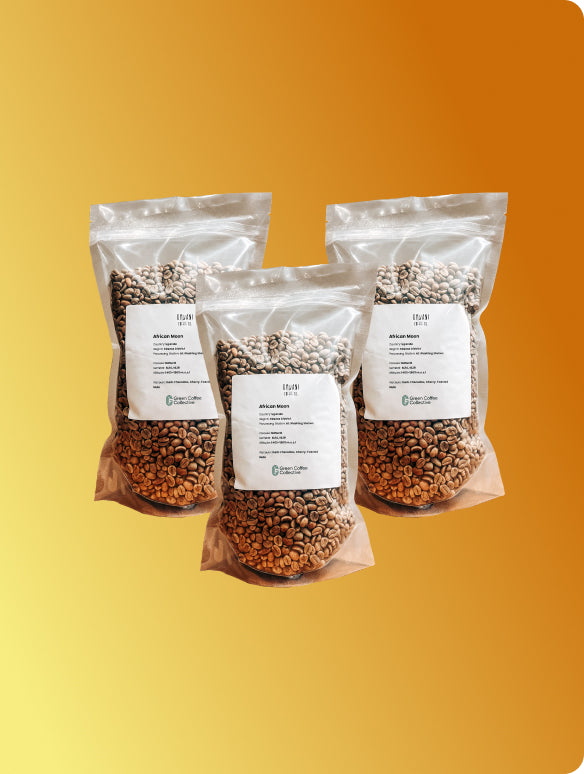
The bag it came in. If your green coffee arrived in a sealed, lined bag - such as a GrainPro liner, Ecotact bag, or similar barrier packaging - that is already good storage. Squeeze out as much air as you can, reseal it tightly, and keep it in a cool, dark place. This is the simplest and often the best option for quantities you will roast through within a few months.
Airtight plastic or glass containers. A good-quality airtight container (clip-lock plastic, a Kilner jar, or similar) works well for green coffee you have decanted from its original packaging. The key is a proper seal - if you can feel air escaping when you press the lid, it is not airtight enough. If using glass, store it somewhere dark or wrap the jar to block light.
Vacuum-sealed bags. If you have a vacuum sealer, this is the most effective option for green coffee bean storage long term. Removing the air slows oxidation significantly and gives you the longest storage life at home. Vacuum sealing is particularly worth it if you have bought more green coffee than you will roast in the next month or two.
Mason jars. These work - their rubber-gasketed lids are reasonably airtight. The glass is the only downside: store them in a dark cupboard rather than on an open shelf.
What to avoid: paper bags (not airtight), open containers, anything near strong odours (green coffee can absorb smells from its environment), and original jute sacks (these are for transport, not long-term home storage - jute breathes, which is the opposite of what you want).
How long can you store green coffee beans?
This depends on the coffee and the conditions, but here are some practical guidelines for home storage.
Well-stored green coffee in good packaging (sealed barrier bag or vacuum-sealed, cool and dark) will typically stay in good condition for 6 to 12 months. Some coffees - particularly well-dried washed lots - can hold up for over a year with minimal noticeable change.
Green coffee in a decent airtight container at room temperature will usually be at its best within the first 3 to 6 months. After that, you may start to notice the cup flattening - less brightness, less complexity, a general dulling of flavour.
Experimentally processed coffees - anaerobics, co-fermented lots, and some naturals - tend to evolve faster in storage than traditional washed coffees. The higher concentration of volatile aromatic compounds means the flavour can shift more noticeably over time. Plan to roast through these within a shorter window.
Past-crop coffee (coffee from a previous harvest season) is not necessarily bad, but it will have already spent months in transit and warehousing before reaching you. If you buy past-crop green, prioritise roasting it sooner rather than later.
The important thing is that green coffee does not "go bad" overnight. It is not like roasted coffee, which starts losing quality within weeks of roasting. Green coffee degrades slowly and gradually. You have time - but less time than you might think if storage conditions are not right.

Should you store green coffee beans in the freezer?
Freezing does slow chemical degradation. Some professional buyers and roasters freeze green coffee for long-term storage with good results. But there are practical problems at home.
Condensation is the main risk. When you take frozen green coffee out into room temperature, moisture from the air condenses on the cold beans. This sudden moisture spike can cause problems - promoting mould if the coffee is not used immediately, and potentially affecting roast behaviour.
If you freeze, commit to it. Divide your green coffee into single-roast portions before freezing, sealed in vacuum bags or airtight containers. When you want to roast, take out one portion and let it come to room temperature fully inside the sealed bag before opening. Do not repeatedly freeze and thaw the same coffee.
For most home roasters, it is not necessary. If you are buying in quantities you will roast through within a few months and storing properly at room temperature, freezing adds complexity without much benefit. It makes more sense if you have a large amount of green coffee you know you will not get to for 6+ months.
How we store green coffee before it reaches you
Most guides on green coffee storage focus only on what happens at your end. But by the time the coffee arrives at your door, it has already been through months of storage and transport. How that is handled matters.
We store our green coffee in climate-controlled warehousing with stable temperature and humidity. Coffees are kept in their original barrier-lined packaging (GrainPro or equivalent) inside jute or woven poly sacks, protected from light and temperature fluctuation.
When we ship to you, we pack green coffee in sealed, lined bags designed to maintain the storage conditions through transit. This means the coffee arriving at your door is in the same condition as when it left our warehouse - the clock on home storage starts from there, not from when the coffee was harvested.
If you have any concerns about the freshness or condition of green coffee you have received from us, get in touch. We would rather know than have you roasting something that is not right.
How to tell if your green coffee has gone off
Green coffee does not spoil dramatically the way perishable food does. It fades. But there are some clear signs that things have gone wrong.
Smell it. Healthy green coffee smells clean - grassy, slightly sweet, perhaps a bit hay-like. If it smells musty, mouldy, or like wet cardboard, that is a storage problem. Sharply fermented or vinegary smells can indicate defects that have developed or worsened in storage.
Look at it. Consistent colour is a good sign. Wide variation (some beans very pale, others darkening) can indicate uneven moisture or mixed-age beans. Visible mould - powdery white, yellow, or blue-green spots - means the coffee has been exposed to too much moisture and should not be roasted. (More on visual signs in 'green coffee defects: how to spot them and what they do'.)
Roast a small test batch. If you are unsure, roast a small amount and taste it. Stale green coffee produces flat, woody, papery cups with little acidity or sweetness. If the cup is noticeably dull compared to what you expected, the green may have aged beyond its best.
Common storage mistakes
The most common storage failure is the simplest one: not resealing the bag properly after taking beans out. Every time you leave the bag open, you are letting in air and moisture. Get in the habit of squeezing air out and sealing tightly each time.
Where you store matters too. The kitchen feels like a natural spot, but it is often the warmest and most humid room in the house. A cupboard in a cooler room is a better choice.
Buying more than you can realistically roast through is another easy trap. Bulk buying to save money only works if the coffee is still in good shape by the time you get to the bottom of the bag. For most home roasters, smaller quantities bought more frequently gives better results than stocking up.
It is also worth paying attention to harvest dates on listings. A coffee harvested 18 months ago and stored well may still be fine, but it has less runway left than something from the current crop.
And if you are topping up a container with fresh green on top of older green, the older coffee gets buried and forgotten. Keep lots separate and labelled so nothing sits longer than it should.
Wrapping up
Green coffee storage is not complicated, but it does reward a bit of care. Keep your beans sealed, cool, dark, and dry, and they will hold their quality for months. Buy in quantities you will actually roast through, pay attention to harvest dates, and do not overthink it - a cupboard and a decent airtight container will get you most of the way there.
If you are not sure how fresh your green coffee is or how best to store a specific lot, ask us. We know when it was harvested, how it has been stored, and how it is likely to behave over time.
Frequently Asked Questions
How long do green coffee beans last before roasting?
What is the best way to store green coffee beans?
Is it better to keep green coffee in the bag or in a jar?
Do raw green coffee beans go bad?
What is the best green coffee bean storage container?
Can you store green coffee in the fridge?
Related Articles You Might Find Interesting
-
 8 min readGreen Coffee Basics
Green Coffee Defects: How to Spot Them and What They Do
Green coffee defects affect both flavour and roast behaviour. Here's how to identify them, what the SCA categories mean, and...
Green Coffee Defects: How to Spot Them and What They Do
Green coffee defects affect both flavour and roast behaviour. Here's how to identify them, what the SCA categories mean, and what to do when you find them.
-
 12 min readGreen Coffee Basics
How to Buy Green Coffee Beans & Choose the Right Supplier
Green coffee buying can feel overwhelming — origins, processing methods, varietals, grading, suppliers. In reality, most decisions come down to...
How to Buy Green Coffee Beans & Choose the Right Supplier
Green coffee buying can feel overwhelming — origins, processing methods, varietals, grading, suppliers. In reality, most decisions come down to a small number of fundamentals. This guide walks through what...
-
 6 min readGreen Coffee Basics
The Coffee Trade Explained: How Coffee Is Graded, Priced and Traded Globally
Coffee moves through one of the most complex agricultural trading systems in the world - yet for most roasters and...
The Coffee Trade Explained: How Coffee Is Graded, Priced and Traded Globally
Coffee moves through one of the most complex agricultural trading systems in the world - yet for most roasters and coffee drinkers, the mechanics behind it remain largely invisible. This...


Dale Goulding
Co-Founder, Green Coffee Collective