Sourced by Ensambles. Fulfilled by Green Coffee Collective.

Buy high-quality green coffee in small volumes, with fast delivery.

  • About Ensambles

    Ensambles Cafés Mexicanos is an independent Mexican company sourcing and exporting specialty green coffee globally, with inventory held in both the UK and mainland Europe. Founded by Gibrán Cervantes, Ensambles works with indigenous smallholder producers across five Mexican states - Chiapas, Guerrero, Oaxaca, Veracruz, and Michoacán - all farming under agroforestry and regenerative agriculture systems. Their coffees come from shade-grown plantations that promote biodiversity, soil and water conservation, and environmental protection.

    Ensambles operates through a close partnership with the Bios Terra Institute (IBT), a research centre focused on regenerative agriculture, technological development, and knowledge management in Mexican coffee-growing regions. Throughout the year, a team of field technicians from IBT - mostly women, some native to the communities they work in - visit producers, run workshops, and deliver on-farm training in agronomic practices, yield improvement, post-harvest management, and environmentally responsible production systems. In each state, a permanent field technician facilitates communication with farming communities, many of whom speak indigenous languages.

    During harvest, Ensambles' quality control team travels with mobile laboratories to coffee-growing communities to analyse samples, provide personalised feedback to each producer, and facilitate direct purchases. Lots are then assembled based on shared characteristics - moisture content, water activity, physical defects, terroir, and sensory analysis - before dry milling and classification at Ensambles' own mill in Coatepec, Veracruz.

  • The Origins

    Ensambles sources across five Mexican states, each with distinct growing conditions, communities, and cup profiles.

    Chiapas: Elevations of 1,200 to 1,400 metres above sea level, with a wide range of varietals including Marsellesa, Catimor, Sarchimor, Gesha, Bourbon, Typica, Oro Azteca, Caturra, Criolla, and Garnica. Processing methods include both washed and natural. Ensambles sources here through cooperatives including COFEMO and the Quetzal programme.

    Guerrero: Elevations of 1,500 to 1,900 metres, with Typica, Bourbon, Mundo Novo, Costa Rica 95, and Marsellesa varietals. Natural processing. Ensambles works with several producer families and groups in Guerrero, including the Carranza family, Las Guerreras, and Indii.

    Oaxaca: Elevations of 1,400 to 1,900 metres, with Typica, Bourbon, and Mundo Novo varietals. Washed and anaerobic processing. Producers sourced from include Las Mazatecas, Los Huehuentones, Xochiltepec, Ñuu Savi, Maricela, and Rubén Cervantes.

    Veracruz: Elevations of 1,200 to 1,300 metres. Home to El Equimite, Ensambles' own biodynamic coffee farm, and the Tlapajti community wet mill project in the Sierra de Zongolica. Processing includes natural anaerobic.

    Michoacán: Elevations of 1,400 to 1,500 metres, with Caturra and Typica varietals. Natural processing.

  • El Equimite - Biodynamic Coffee Farm

    El Equimite is Ensambles' own coffee farm and research centre, located in Coatepec, Veracruz, between the Gulf of Mexico and the Cofre de Perote National Park. The farm sits within a cloud forest microclimate with misty days and cool temperatures. It has not used chemical products for over 20 years. In 2017 it received Demeter biodynamic certification - one of only two coffee farms in all of Mexico, and fewer than ten in Latin America, to hold this certification.

    The farm covers 33 hectares in total: 13 hectares under coffee cultivation, 4 hectares for pastures and animal grazing, and 15.7 hectares dedicated to biodiversity conservation. El Equimite grows over 20 arabica varieties, including Geisha, Caturra, Pink Bourbon, Bourbon SL28, Anacafé 14, Tabi, Garnica, and Typica - some at risk of extinction due to climate change. The farm holds organic certification from both the Mexican Ministry of Agriculture and the USDA National Organic Program, as well as a Biodiversity Seal for Agro-Biodiverse Farms from Pronatura Veracruz.

    El Equimite's coffees have been recognised at the Cup of Excellence - 12th place in 2021 and 7th place in 2022 - and the farm's 2022 harvest took 1st place at the 20th Mexican Barista Championship. Beyond producing its own coffee, El Equimite functions as a training ground: field technicians working with Ensambles' partner communities learn processing and farm management techniques at El Equimite before passing that knowledge on to producers across Mexico's five sourcing states.

  • The Tlapajti Project

    Tlapajti - meaning "To Heal" in Nahuatl - is a long-term community development initiative in the Sierra de Zongolica, Veracruz, led by Ensambles for more than eight years. The project began as an effort to transform coffee processing in indigenous communities: moving from cherry sales with no added value to quality parchment production through a community wet mill, with controlled fermentations and improved drying techniques to elevate cup quality and generate better incomes for producing families.

    The project is built on partnerships between Ensambles, the Bios Terra Institute, El Equimite, and Kaffeemacher - a Swiss roastery whose managing partner Philipp Schallberger joined the initiative after meeting Gibrán Cervantes, sharing a commitment to transparency and ethics in the supply chain. Since the end of 2024, a community wet mill on producer Germán Guerra's farm has been operating, giving producers the autonomy to process their own cherries without milling costs and the ability to standardise processes, improve traceability, and create a new value chain for the community.

    One of Tlapajti's goals is organic certification for its producers. Currently some are on track to achieve this - strengthening production under agroforestry systems, producing their own compost, improving soil health, and protecting local water sources and biodiversity.

  • Regenerative Agriculture and the Bios Terra Institute

    The Bios Terra Institute (IBT) sits at the heart of Ensambles' sourcing model. IBT is a research centre focused on regenerative agriculture, technological development, and knowledge management, working to promote the transfer and implementation of these practices in Mexican coffee-growing regions, cooperatives, and small-scale producers.

    The farming systems IBT supports and promotes include organic farming, syntropic agriculture, the keyline method, biodynamic practices, and permaculture - all aimed at social, environmental, and economic transformation in vulnerable coffee-producing regions. These are not theoretical commitments: field technicians from IBT are present year-round in each of Ensambles' five sourcing states, providing on-farm training, farm visits, and workshops directly to the indigenous communities they work with.

    Ensambles' coffees originate from shade-grown plantations across all five states. The shade canopy promotes biodiversity, soil health, water conservation, and environmental protection - and the communities farming within these systems are supported to maintain and improve them through ongoing technical assistance funded and coordinated by Ensambles and IBT.

  • Quality Control

    During harvest, Ensambles' quality control team travels with mobile laboratories directly to coffee-growing communities. Each producer receives individual feedback on their samples, and lots are assembled based on shared characteristics: moisture content, water activity, physical defects, terroir, and sensory analysis. This approach allows Ensambles to offer complete traceability - every lot is built from coffees with clearly understood and documented characteristics.

    After assembly, lots move to Ensambles' own dry mill in Coatepec, Veracruz, for milling and classification. From there, Ensambles manages domestic and international logistics directly, with inventory held in both the UK and mainland Europe for fast, flexible access for roasters across both markets.

How we package
our coffees

Barrier packaging designed for specialty coffee.

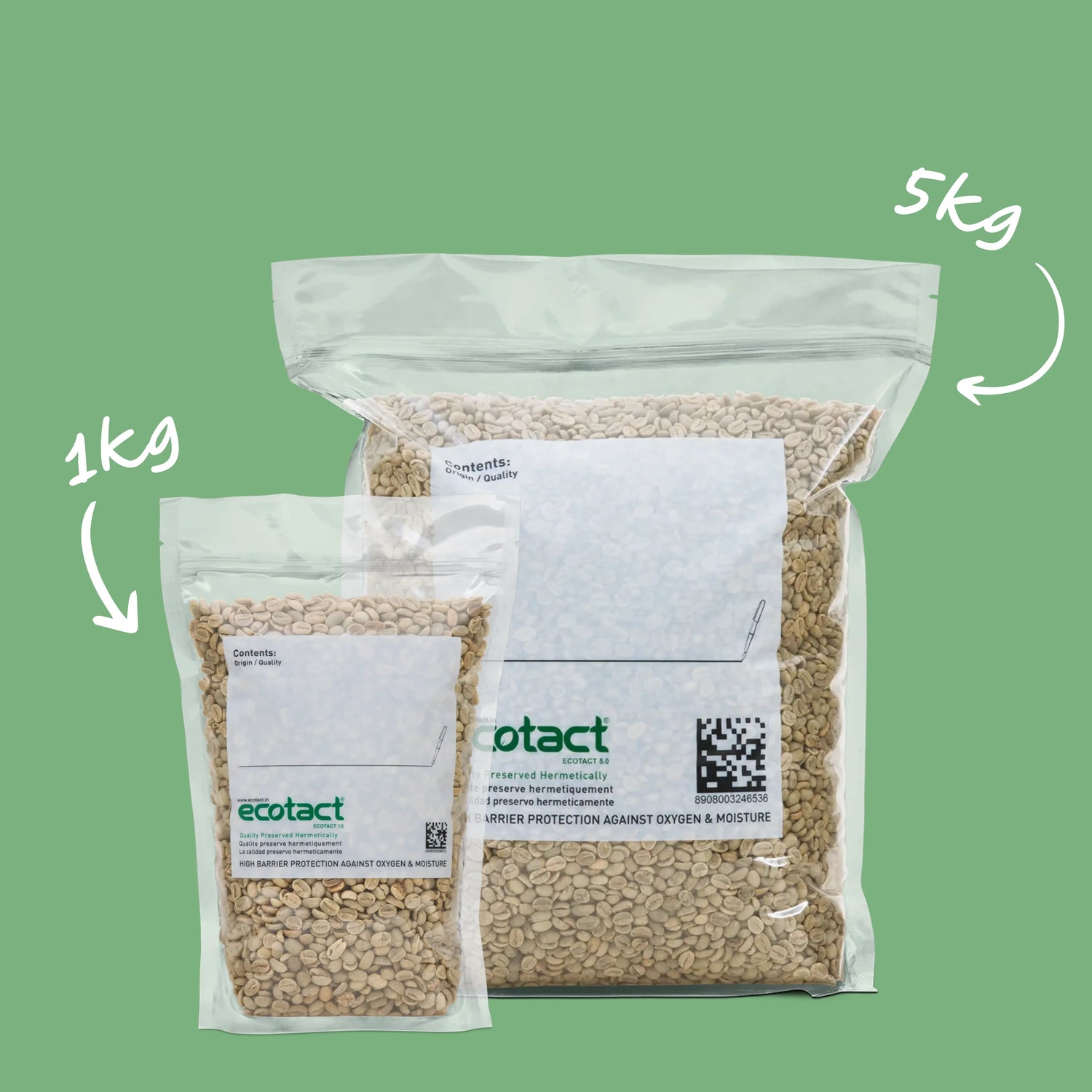
We use Ecotact bags because they offer high-barrier protection against oxygen, moisture, and external contaminants. This helps preserve the quality, aroma, and flavour potential of your green coffee during transport and storage. They're trusted by top producers and importers worldwide.

Heat-Sealed for Maximum Protection

Every bag is professionally heat sealed at our warehouse to lock in freshness. This creates a secure seal that prevents exposure to air or humidity - keeping your green coffee stable, even over long periods.

Convenient Resealable Zip Closures

Once opened, each bag has a resealable zip to help you store and protect the rest of your coffee between roasts. It’s a simple way to reduce waste and maintain freshness - especially helpful for home roasters or sampling.

Portion sizes for any roaster.

Whether you're roasting at home or running a production line, we've got a size to suit. Choose from 0.5kg, 1kg, or 5kg bags - all packed with the same level of care. Smaller volumes make it easy to try new coffees without the commitment.

Responsible packaging choices.

Our bags are made from Graded 7 multi-layer recyclable plastic. While they may not go in your home recycling bin, they are accepted by specialist facilities. More importantly, they reduce waste by dramatically extending the shelf life of your green coffee.
Your questions, answered

Who are Ensambles?

Ensambles Cafés Mexicanos is an independent Mexican specialty green coffee exporter founded by Gibrán Cervantes. They source from indigenous smallholder producers across five Mexican states - Chiapas, Guerrero, Oaxaca, Veracruz, and Michoacán - all farming under agroforestry and regenerative agriculture systems. They hold inventory in the UK and mainland Europe.

Which states does Ensambles source from?

Ensambles currently sources from Chiapas, Guerrero, Oaxaca, Veracruz, and Michoacán. Each state has distinct growing conditions, varietals, and processing methods.

What is the Bios Terra Institute?

The Bios Terra Institute (IBT) is a research centre focused on regenerative agriculture, technological development, and knowledge management. IBT's field technicians - mostly women, some native to the communities they work in - are present year-round in each of Ensambles' sourcing states, providing on-farm training, workshops, and technical support to producers. IBT is a core partner in Ensambles' sourcing model.

What is El Equimite?

El Equimite is Ensambles' own biodynamic coffee farm in Coatepec, Veracruz. It holds Demeter biodynamic certification - one of only two farms in Mexico to do so - as well as organic certification from the Mexican Ministry of Agriculture and the USDA. It functions as both a producing farm and a training centre for Ensambles' field technicians and partner producers.

What is the Tlapajti project?

Tlapajti is a long-term community development initiative in the Sierra de Zongolica, Veracruz, led by Ensambles for more than eight years. Its centrepiece is a community wet mill that gives indigenous producers in the region the autonomy to process their own coffee, improve quality, and generate better incomes - with organic certification currently being pursued for participating producers.

How does Ensambles approach quality control?

During harvest, Ensambles' quality control team travels with mobile laboratories to producer communities, analysing samples and providing personalised feedback to each producer. Lots are assembled based on shared quality characteristics before milling and classification at Ensambles' own dry mill in Coatepec, Veracruz.