Sourced by Karst Organics. Fulfilled by Green Coffee Collective.

Buy high-quality green coffee in small volumes, with fast delivery.

  • About Karst Organics

    Karst Organics was founded by Stewart and Kar-Yee after a weekend visit to the coffee forests of Letefoho in 2017 changed everything. Stewart was already living in Timor-Leste working as a project manager on an educational programme with the Timorese military when a colleague, Antonio, invited them to visit his family's village. What they found — towering shade trees, intercropped coffee forests, third-generation farmers receiving $0.32 per kilo for their cherry from commercial buyers — set the course for everything that followed.

    Rather than walking away, they took green bean samples back to the UK, reached out to roasters, and acted on the feedback they received. They funded processing infrastructure themselves, delivered training in the field, and returned each harvest to work directly alongside the farming communities of Letefoho. By 2019, their first export lots were cupping at 84.5–85.5 points and Anette Moldvaer at Square Mile became their first buyer. In 2025, Karst exported close to 34 tonnes of green bean — over 90% of which was pre-ordered by their 50+ partner roasters.

    Karst spend six months of the year in Timor-Leste, including the entirety of the harvest in the mountains of Letefoho. They purchase cherry and parchment directly from each of the 144 households they work with, personally collecting from each farm. As both exporter and importer, they control the full supply chain from farmgate to UK warehouse — with complete transparency on pricing, processing costs, and shipping published openly on their website.

  • A Small Nation with a Powerful Story

    Coffee arrived in Timor-Leste with the Portuguese in the early 18th century. The fertile land suited it immediately and by the mid-18th century, coffee had become one of the country's most valuable exports. For all the wealth it generated, however, little was reinvested into the country's development. By the mid-20th century, Timor-Leste had become, in Karst's own words, little more than a neglected trading post.

    On the 28th November 1975, Timor-Leste declared independence from Portugal. Nine days later, Indonesian troops invaded, annexing the country and commercially monopolising its coffee sector. The 24-year struggle for independence that followed was brutal — many of the older farmers Karst works with today fought side-by-side in the coffee forests of Letefoho during that period. Independence finally came on the 20th May 2002, when Timor-Leste became the first new country of the millennium.

    Today, Timor-Leste is one of Southeast Asia's most underdeveloped nations. Food security is an urgent concern — the Global Hunger Index ranked it as the country with the highest hunger index in Southeast Asia as of 2023. Unemployment is high and the majority of the working population are subsistence farmers, most of them growing coffee. Karst was founded in direct response to this — and every decision they make about how they source, price, and sell reflects it.

  • What Makes Timorese Coffee Exceptional

    Timor-Leste's complicated history and subsequent lack of development has, paradoxically, resulted in one of the most distinctive and environmentally sound coffee-growing environments in the world. Because chemical fertilisers were never introduced into Timorese agricultural practice at scale, all coffee grown in the country is organic by default — a fact that was largely unknown to the international specialty market until recently.

    All of the coffee Karst sources is grown under a canopy of leguminous shade trees — primarily ai-kakeu (Casuarina) and ai-samtuku (Albizia) — which regulate temperature, contribute nutrients to the soil as their leaves fall, and support a biodiverse ecosystem that provides natural pest control. The average farm Karst works with is 1.4 hectares, but "farm" is almost a misnomer: the Timorese phrase is 'ba kafe laran' — go into the coffee — because these are small forests, not fields, with avocados, bananas, sweet potatoes, yams, and traditional medicinal plants grown alongside the coffee trees.

    Cherry skins from pulping, composted with chicken or cow manure and soil, are applied to the base of trees before the rainy season, delivering phosphorous and potassium to support flowering and root health. Nothing synthetic enters the system.

    The varietals are equally distinctive. Karst's coffees are produced from a combination of Typica and Hybrido de Timor — a natural hybridisation between C. Arabica and C. Canephora first discovered in 1917. The Hybrido de Timor delivers the cup quality of Arabica with the disease resistance of Robusta, and has since become the genetic foundation for many of the world's disease-resistant cultivars, including Sarchimors and Catimors. As climate change places increasing pressure on coffee-growing regions globally, the resilience of Timorese plants is not a footnote — it is increasingly significant.

  • How Karst Works

    Karst are unusual in the specialty green coffee world in one important respect: they are both exporter and importer, which means they control the full supply chain from farmgate in Letefoho to warehouse in the UK without intermediary agents at any stage. Every bag of cherry or parchment is purchased directly from each household by Stewart and Kar-Yee themselves, collected in their pick-up truck from each farm during the harvest.

    Their pricing is fixed before the harvest begins and does not fluctuate. In 2025, their farmgate price for ripe red cherry was $0.85 per kilo for the entire duration of the harvest. The commercial price in Letefoho that same year opened at $0.50, peaked at $0.62, and dropped back to $0.55. All farmgate prices, processing costs, and shipping figures are published openly on Karst's website.

    The 144 households Karst works with are organised into seven partner groups: Rotutu, Eratoi, Cristo Liurai, Hatuhei, Tau-Rema, Samoro, and Remagoa. Some sell cherry for processing at Karst's centrally managed wet mill; others process their own parchment at household level, supported by the pulping machines, fermentation buckets, and drying beds that Karst have supplied and funded over the years. The separation between groups allows Karst to maintain lot-level traceability across everything they export.

  • Eight Years of Investment

    What Karst have built in Letefoho since 2017 is not just a sourcing operation — it is an accumulated body of investment in people, infrastructure, and agricultural practice. The timeline of that investment is published transparently on their website, year by year, but the headline figures tell part of the story: export volumes have grown from 4.8 tonnes in their first year to close to 34 tonnes in 2025, with quality maintained and over 90% pre-ordered before the harvest began.

    Physical investments have included the construction and expansion of a centralised processing facility in Rotutu, the installation of 900 metres of water piping to provide reliable water supply to both the facility and local households, the supply of pulping machines, drying racks, and fermentation equipment to individual farming households, and — most recently — the construction of a new warehouse and cupping lab in Lebululi, being built by hand by Karst's local team.

    Maun Simao, Karst's field manager, is a lifelong Letefoho resident with over 20 years' experience in Timor-Leste's coffee sector. He is one of two permanent full-time locally employed members of the Karst team, with additional seasonal workers contracted, registered with the labour department, and paid with social security contributions. Karst were insistent on formal employment contracts from the beginning, at a time when cash-in-hand, as-needed labour was the norm in the region.

    In October 2023, Karst launched a tree planting initiative: for every 10kg of green bean sold to a partner roaster, they pledge to plant one seedling. The goal is 1,800 coffee trees per hectare, working toward a target yield of 5,400kg of cherry per hectare — a figure that would meaningfully increase average household income and long-term farm viability.

How we package
our coffees

Barrier packaging designed for specialty coffee.

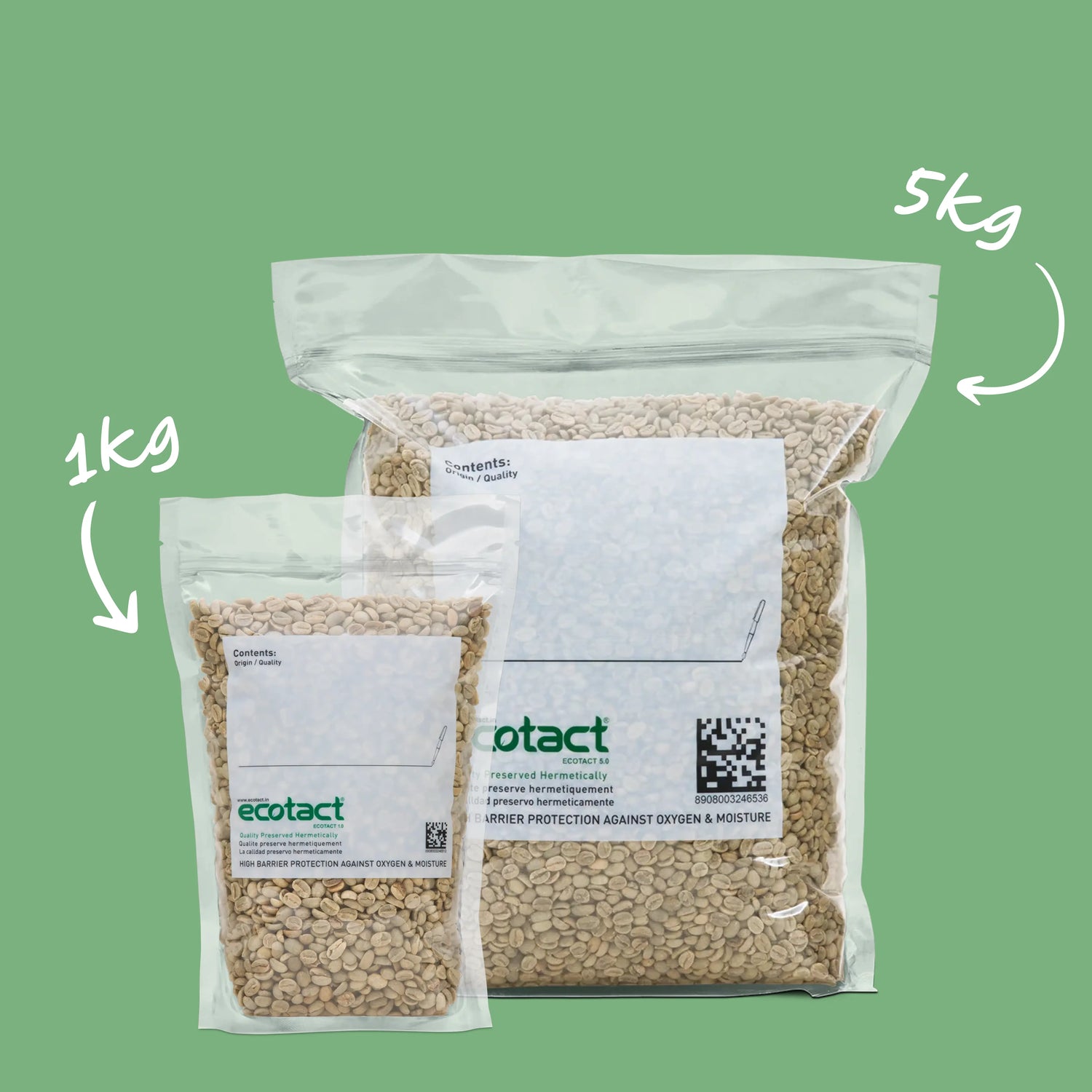
We use Ecotact bags because they offer high-barrier protection against oxygen, moisture, and external contaminants. This helps preserve the quality, aroma, and flavour potential of your green coffee during transport and storage. They're trusted by top producers and importers worldwide.

Heat-Sealed for Maximum Protection

Every bag is professionally heat sealed at our warehouse to lock in freshness. This creates a secure seal that prevents exposure to air or humidity - keeping your green coffee stable, even over long periods.

Convenient Resealable Zip Closures

Once opened, each bag has a resealable zip to help you store and protect the rest of your coffee between roasts. It’s a simple way to reduce waste and maintain freshness - especially helpful for home roasters or sampling.

Portion sizes for any roaster.

Whether you're roasting at home or running a production line, we've got a size to suit. Choose from 0.5kg, 1kg, or 5kg bags - all packed with the same level of care. Smaller volumes make it easy to try new coffees without the commitment.

Responsible packaging choices.

Our bags are made from Graded 7 multi-layer recyclable plastic. While they may not go in your home recycling bin, they are accepted by specialist facilities. More importantly, they reduce waste by dramatically extending the shelf life of your green coffee.
Your questions, answered

Who are Karst Organics?

Karst Organics are a relationship-focused green bean exporter and importer founded by Stewart and Kar-Yee. They source exclusively from the coffee farming communities of Letefoho, Timor-Leste, and operate as both exporter and importer — meaning they control the full supply chain from farmgate to UK warehouse without intermediary agents. They spend six months of every year in Timor-Leste, including the entirety of the harvest season.

Where does Karst source their coffee from?

All of Karst's coffee comes from Letefoho, in the Ermera district of Timor-Leste. They work with 144 households across seven partner groups: Rotutu, Eratoi, Cristo Liurai, Hatuhei, Tau-Rema, Samoro, and Remagoa. Every lot is traceable to its partner group.

How does Karst's pricing work?

Karst set their farmgate price before the harvest begins and it does not fluctuate. In 2025, they paid $0.85 per kilo for ripe red cherry — significantly above the commercial market rate in Letefoho that year, which peaked at $0.62. Full farmgate prices, processing costs, and shipping figures for every year since 2019 are published openly on Karst's website.

What processing methods does Karst use?

The majority of Karst's coffee is fully washed, reflecting the established processing tradition in Letefoho. They have been steadily expanding their natural and honey processed lots as their drying infrastructure has developed — including polytunnels added in 2024. All processing is overseen by Stewart and Kar-Yee during their time at origin.